
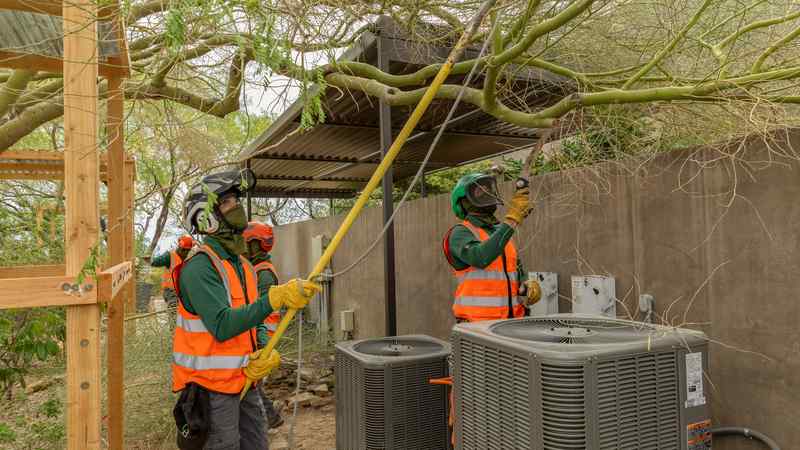
Learn seven warning signs that a tree on your Las Vegas property may be diseased or dying and when to call an ISA Certified Arborist for help.
Trees are among the most valuable assets on any Las Vegas property. They provide shade that can knock double-digit degrees off your backyard temperature, they raise curb appeal, and they contribute to quality of life in every neighborhood from Henderson to Summerlin to North Las Vegas. But even well-established trees can decline — and in the extreme conditions of the Mojave Desert, decline can happen quickly.
Catching a diseased or dying tree early gives you options. A professional assessment may reveal a problem that can be treated, saving you the cost of removal. And when a tree is too far gone, identifying it before it drops a massive limb protects your family, your home, and your neighbors.
Benjamin's Tree Service has been serving Las Vegas since 2001. Our ISA Certified Arborists (ISA Cert. WE-15785A) have diagnosed thousands of trees across Clark County. Here are the seven most common warning signs we see — and what each one means for your property.
> Quick Summary
> - Dead or leafless branches at the top of the canopy often signal root or vascular problems
> - Fungal growth on the trunk or root flare is a strong indicator of internal decay
> - Bark that peels, cracks, or falls off in large sheets can point to disease or sun damage
> - Leaning trees with exposed or heaving roots need immediate professional evaluation
> - Early intervention by an ISA Certified Arborist can save a tree — or prevent a dangerous failure
1. Dead or Dying Branches in the Crown
The first sign many Las Vegas homeowners notice is a cluster of dead branches near the top of the tree, sometimes called "crown dieback." While it is normal for a tree to shed the occasional small branch, progressive dieback — where more and more of the upper canopy becomes bare or brittle — is a red flag.
In the desert, crown dieback often results from:
- Heat stress and insufficient irrigation — roots cannot supply enough water to the full canopy during 115°F summers
- Vascular disease — infections like bacterial leaf scorch or Verticillium wilt block the tree's internal water-transport system
- Root damage — construction, soil compaction, or changes to the grade around the tree
If you see multiple dead branches or entire sections of canopy that failed to leaf out this spring, schedule a tree assessment before the problem spreads.
2. Fungal Growth on the Trunk or Base
Mushrooms or shelf-like fungal brackets growing on the trunk, at the base of the tree, or along major surface roots are among the most serious warning signs. These fungi are not growing on the surface — they are fruiting bodies produced by organisms that are actively decomposing wood inside the tree.
Common culprits in the Las Vegas Valley include:
- Ganoderma — produces large, reddish-brown shelf fungi at the base, indicating root and butt rot
- Armillaria (honey fungus) — causes white rot and can spread between trees through root contact
- Phellinus — creates hard, hoof-shaped brackets on the trunk, signaling heartwood decay
A tree with visible fungal fruiting bodies may already have significant internal decay. It may look stable from the outside while being structurally hollow. This is why our arborists sometimes recommend a resistograph or sonic tomography test to measure remaining sound wood before deciding between treatment and tree removal.
3. Peeling, Cracking, or Missing Bark
Healthy bark is a tree's armor — it protects the living tissue underneath from UV radiation, pests, temperature extremes, and disease. When bark begins to peel off in large sheets, crack vertically, or separate from the trunk, the protective barrier is compromised.
In Las Vegas, bark problems often stem from:
- Sunscald — intense afternoon sun on the southwest-facing side of the trunk can cook the cambium layer, causing bark to crack and die. This is especially common after improper trimming removes too much canopy.
- Bacterial or fungal cankers — localized infections that kill a patch of bark, often oozing sap or leaving a dark, sunken wound
- Borer infestation — insects like the flatheaded borer attack stressed trees, leaving D-shaped exit holes in the bark
Minor bark damage on one side of the trunk is not necessarily a death sentence. But if bark is falling away in multiple areas, exposing bare wood around the circumference, the tree is likely in serious decline.
4. A Sudden Lean or Shifting Root Plate
Trees naturally lean slightly, especially if they are growing toward sunlight or were shaped by prevailing winds. A gradual lean that has been stable for years is usually not dangerous. However, a *new* lean — especially one that developed after a storm or a period of heavy irrigation — is an emergency sign.
What to look for:
- Soil heaving on the opposite side — a mound of lifted soil or cracked ground at the base suggests roots are pulling out
- Exposed roots on the lean side — roots lifting from the ground indicate the tree is actively tipping
- A gap between the trunk base and the soil — the root plate has partially separated from the ground
A leaning tree with root plate movement can fall with little warning. In Henderson, Spring Valley, and other communities with homes close together, this can cause catastrophic property damage. If you notice a sudden lean, keep people away from the area and call for emergency tree service immediately.
5. Leaves That Are Discolored, Wilted, or Dropping Early
Every Las Vegas homeowner expects some leaf stress during the peak of summer. But certain patterns of discoloration or premature leaf drop point to something more than seasonal heat.
Warning signs include:
- Yellowing between leaf veins (interveinal chlorosis) — often caused by iron deficiency in Clark County's highly alkaline soil, but can also signal root disease
- Brown, scorched leaf margins — may indicate salt damage from reclaimed irrigation water, bacterial leaf scorch, or root problems
- Early leaf drop on one side of the tree or on specific branches — localized dieback usually means a vascular blockage or canker in that section
- Small, sparse leaves across the whole canopy — the tree cannot sustain its full leaf area due to root stress or trunk decay
Some of these conditions are treatable with soil amendments, adjusted irrigation, or targeted pruning. Others signal decline that requires a long-term management plan. A certified arborist can distinguish between nutrient deficiency, disease, and environmental stress.
6. Cavities, Holes, or Hollow Sections in the Trunk
Large cavities in the trunk — whether caused by old pruning wounds that never healed, decay organisms, or storm damage — reduce the structural integrity of the tree. Birds, insects, and wildlife often take up residence in these openings, which can accelerate the decay.
A common misconception is that a hollow tree is automatically dangerous. In reality, trees can remain structurally sound even with significant internal decay, because most of the load-bearing capacity is in the outer shell of wood. The key question is: *how much sound wood remains?*
Our arborists evaluate trunk cavities by looking at:
- The size and depth of the cavity relative to the trunk diameter
- Whether the cavity extends below ground level (root crown rot)
- The presence of carpenter ants, termites, or other wood-destroying insects
- Whether the tree has compartmentalized the decay (sealed it off with new growth) or if it is still actively spreading
If a cavity compromises more than one-third of the trunk's circumference at any point, the risk of failure rises sharply. In many cases, the safest option is planned removal by a professional tree removal service rather than waiting for an uncontrolled failure.
7. Excessive Deadwood and Hanging Branches
Finally, a tree carrying a heavy load of dead branches throughout the canopy — not just at the top — is telling you something. Widespread deadwood across the entire crown indicates systemic decline rather than a localized injury.
In Las Vegas, this pattern often appears in trees that:
- Were severely topped or lion-tailed years ago and never recovered proper canopy structure
- Have root systems compromised by nearby construction, paving, or soil compaction
- Are planted in locations where they never receive adequate water
- Are species poorly suited to the desert climate that have gradually declined over many years
Dead branches of any size are a hazard during Clark County's monsoon storms, when wind gusts regularly exceed 60 mph. Even a three-inch-diameter dead branch falling from 30 feet can injure someone or damage a vehicle, roof, or pool equipment.
If your tree has extensive deadwood, a professional assessment will determine whether crown cleaning — removing only the dead, diseased, and broken branches — can extend the tree's useful life, or whether the tree is too far gone.
What to Do If You See These Signs
If you have noticed one or more of these warning signs on a tree at your Las Vegas, Henderson, North Las Vegas, or Summerlin property, the most important step is getting a professional evaluation. Many tree problems that look alarming are treatable when caught early. And problems that cannot be treated need a safe, planned response — not a late-night emergency after a branch crashes through your patio cover.
Benjamin's Tree Service is fully licensed and insured in Nevada. We are 5-star rated on Google and have been serving Clark County and surrounding communities since 2001. Our ISA Certified Arborists provide honest assessments and will never recommend removal when treatment is the better option.
Frequently Asked Questions
Can a diseased tree be saved?
Many tree diseases and stress conditions are treatable, especially when caught early. Fungal infections, nutrient deficiencies, and pest problems often respond to targeted treatment. However, trees with advanced internal decay or major structural compromise may be beyond recovery. A professional assessment is the only way to know for certain.
How much does a tree assessment cost in Las Vegas?
Benjamin's Tree Service provides free estimates for tree trimming and removal. For detailed written reports — such as those needed for insurance claims, HOA disputes, or real estate transactions — our tree assessment report service provides a thorough, ISA-standard evaluation.
Is a dead tree on my property dangerous?
Yes. A dead tree loses structural integrity rapidly, especially in the desert heat. Bark separates, wood dries and becomes brittle, and root anchoring weakens. Dead trees near structures, walkways, or property lines should be removed promptly.
Should I remove a tree myself if it looks dangerous?
No. Trees that show signs of structural failure — leaning, cracked trunks, large dead branches — are unpredictable and extremely dangerous to work around without professional equipment and training. Our emergency tree service team is available when safety is a concern.
For more Las Vegas tree care guidance, explore 3 Tips for High Yielding Fruit Trees in Las Vegas and When Is the Best Time to Plant a Tree in Las Vegas?. The University of Nevada, Reno Extension horticulture program publishes research-based guidance specific to Nevada growing conditions.
Protect Your Property and Your Family
Your trees are an investment worth protecting, and identifying problems early is the most cost-effective approach to tree care. Whether you have noticed dead branches, fungal growth, bark damage, or any of the other warning signs described above, one phone call can give you the answers you need.
Call Benjamin's Tree Service at 725-227-6160 or visit [benjaminstreeservice.com/contact](/contact) to schedule your free estimate today.
Benjamin's Tree Service
ISA Certified Arborists serving Las Vegas & the surrounding areas since 2001.
Related Reading
Tree Care Tips
Dead or Dormant Tree in Las Vegas? 4 Easy Ways to Tell
Not sure if you have a dead or dormant tree in Las Vegas? Use the scratch test, bud check, and flex …
9 min read
Tree Care Tips
Common Tree Pests in Las Vegas: A Homeowner's Guide
Aphids, spider mites, and palo verde root borers are common tree pests in Las Vegas. Learn the warni…
10 min read
Tree Care Tips
Palo Verde Tree Care in Las Vegas: A Seasonal Guide
Learn palo verde tree care in Las Vegas, including watering, pruning, monsoon safety, warning signs,…
9 min read