
Learn how to care for trees in the Las Vegas desert climate. Expert tips on watering, pruning, and protecting trees from extreme heat, alkaline soil, and monsoon winds.
The Las Vegas Valley sits in the Mojave Desert, where summer temperatures regularly exceed 115 degrees Fahrenheit, annual rainfall averages just over four inches, and the alkaline caliche soil challenges even the hardiest trees. These conditions make tree care in the Las Vegas desert climate fundamentally different from tree care anywhere else in the country. What works in Portland or Atlanta can damage or kill trees here.
This guide covers everything Las Vegas homeowners need to know about keeping trees healthy in one of the harshest climates in the United States. Whether you live in Summerlin, Henderson, Spring Valley, or North Las Vegas, the principles are the same — but the execution requires local expertise and an understanding of desert-specific biology.
Benjamin's Tree Service has been caring for trees across the Las Vegas Valley since 2001. Our ISA Certified Arborists understand the unique demands of the Mojave Desert, and this guide reflects over two decades of hands-on experience with the trees, soil, and weather patterns of Southern Nevada.
Understanding the Las Vegas Desert Climate and Its Impact on Trees
Las Vegas presents a combination of environmental stressors that few other cities match. Understanding these conditions is the first step toward effective tree care.
Extreme Heat and UV Exposure
Summer daytime temperatures in Las Vegas routinely reach 110 to 117 degrees Fahrenheit. Ground-level temperatures on exposed soil or near hardscape can exceed 140 degrees. Trees face intense UV radiation that can cause sunscald on exposed bark — particularly on the south and southwest sides of trunks and branches. Young trees and recently pruned trees are especially vulnerable because they have less canopy cover to shade their own bark.
Low Humidity and Rapid Evapotranspiration
Relative humidity in Las Vegas often drops below 10 percent during summer months. Trees lose moisture through their leaves far faster than in humid climates. A mature shade tree in Las Vegas can transpire 50 to 100 gallons of water per day during peak summer. This rapid moisture loss means that watering schedules designed for other regions are dangerously inadequate here.
Alkaline Caliche Soil
Much of the Las Vegas Valley — from Enterprise to North Las Vegas — sits on caliche, a calcium carbonate hardpan that can be as solid as concrete. Caliche creates two major problems for trees: it blocks root penetration and it raises soil pH to 7.5 or higher. High pH locks out iron, manganese, and zinc, causing chlorosis — the yellowing of leaves that Las Vegas homeowners see constantly. Breaking through caliche during planting and amending soil properly is essential for long-term tree health.
Limited Rainfall
Las Vegas receives an average of 4.2 inches of rain per year, most of it during brief monsoon storms in July and August. These storms produce flash flooding but do little for deep root hydration. Trees in Las Vegas depend almost entirely on irrigation, which means any disruption to your watering system — a broken timer, a clogged emitter, or a municipal water restriction — can stress or kill a tree within weeks during summer.
Wind Events
The Las Vegas Valley experiences periodic high-wind events, particularly in spring. Sustained winds of 40 to 60 mph with gusts exceeding 70 mph hit the valley several times per year. Trees with poor structure, shallow root systems, or top-heavy canopies are at serious risk of failure during these events. Residents in exposed areas like Summerlin and the western valley are especially familiar with wind-related tree damage.
Best Trees for the Las Vegas Desert Climate
Choosing the right species is the single most impactful decision you can make for long-term tree success in Las Vegas. The following species have proven themselves in the Mojave Desert over decades.
Native and Desert-Adapted Shade Trees
- Mesquite (Prosopis species) — the most reliable shade tree for Las Vegas. Chilean mesquite, honey mesquite, and velvet mesquite all thrive in desert heat, tolerate alkaline soil, and develop deep root systems. They provide filtered shade and require minimal supplemental water once established.
- Palo Verde (Parkinsonia species) — a signature desert tree with green bark that photosynthesizes even when leafless. Museum palo verde and Desert Museum palo verde are popular choices in Henderson and Summerlin landscapes.
- Desert Willow (Chilopsis linearis) — a small to medium tree that produces showy trumpet-shaped flowers from spring through fall. Highly drought-tolerant once established. Excellent for residential yards in Spring Valley and Paradise.
- Ironwood (Olneya tesota) — extremely long-lived and drought-tolerant. Slow-growing but virtually indestructible once established. Native to the Sonoran Desert and well-adapted to Southern Nevada.
Popular Non-Native Trees That Perform Well
- African Sumac (Searsia lancea) — evergreen, moderate water needs, and tolerant of alkaline soil. One of the most commonly planted trees in Las Vegas commercial and residential landscapes.
- Chinese Pistache (Pistacia chinensis) — excellent fall color in Las Vegas, moderate water needs, and good heat tolerance. A popular choice for homeowners who want seasonal interest.
- Tipu Tree (Tipuana tipu) — fast-growing with a broad canopy. Performs well in Las Vegas with regular irrigation but requires structural pruning to prevent limb failure.
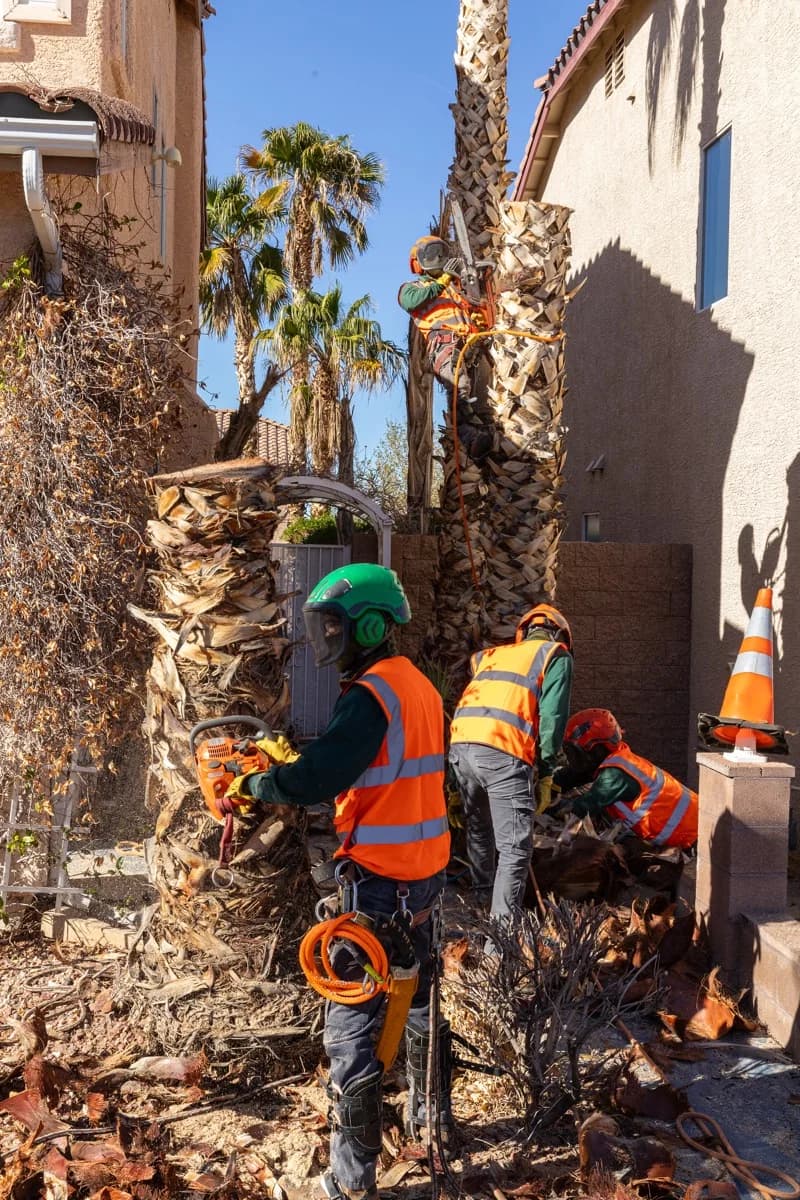
- Fan Palms (Washingtonia species) — Mexican fan palms and California fan palms are everywhere in the valley. They tolerate extreme heat and alkaline soil but require regular trimming to remove dead fronds and seed pods.
Trees to Avoid in Las Vegas
- Most pine species (except Afghan pine and Mondell pine) — they struggle with heat, alkaline soil, and low humidity.
- Silver Maple — shallow root systems cause infrastructure damage, and they are highly susceptible to heat stress.
- Weeping Willow — requires far more water than Las Vegas can sustainably provide.
- Most fruit trees without careful variety selection — many stone fruits need more chill hours than Las Vegas provides. Consult an arborist before planting.
Seasonal Tree Care Calendar for Las Vegas
Tree care in the desert follows a different rhythm than the rest of the country. Here is what your trees need in each season.
Spring (March Through May)
Spring is the most active period for tree care in Las Vegas. Temperatures are moderate, trees are breaking dormancy, and this is the optimal window for most major work.
- Schedule a professional tree assessment to evaluate winter damage and structural integrity before wind season peaks.
- Complete structural pruning on deciduous trees before full leaf-out. This is the best time for trimming and pruning because trees can heal wounds quickly during active growth.
- Increase irrigation frequency as temperatures climb. By May, most trees need deep watering every 5 to 7 days.
- Apply iron chelate treatments to trees showing chlorosis — spring uptake is most effective.
- Plant new trees early in spring (March or early April) to give roots time to establish before summer heat arrives.
Summer (June Through September)
Summer is survival mode for Las Vegas trees. The goal is maintaining health, not pushing growth.
- Water deeply and consistently. Most mature trees need 15 to 20 gallons per inch of trunk diameter, applied every 5 to 7 days. Water at the drip line, not at the trunk.
- Do not prune heavily in summer. Removing canopy exposes bark to sunscald and increases water stress. Light deadwood removal is acceptable, but major structural pruning should wait.
- Watch for signs of heat stress: leaf scorch, premature leaf drop, wilting, and branch dieback. These symptoms signal that a tree needs more water or has root system damage.
- Inspect irrigation systems weekly. A single clogged emitter can kill a tree in extreme heat.
- Monitor for pests that thrive in heat, including giant palm borers, bark beetles, and spider mites.
Fall (October Through November)
Fall is the second-best planting window in Las Vegas and a good time to prepare trees for winter dormancy.
- Plant new trees in October or early November. Soil is still warm enough for root growth, but air temperatures are cooling.
- Reduce irrigation frequency as temperatures drop. By November, most trees need water every 10 to 14 days.
- Apply a final deep watering before winter to hydrate root zones through the cooler months.
- Schedule stump grinding for any trees removed during the year — fall weather is ideal for this work.
- Rake and remove fallen leaves to prevent fungal issues and maintain a clean landscape.
Winter (December Through February)
Winter is the dormant season and the ideal time for certain types of tree work.
- Prune most deciduous trees during winter dormancy. Without leaves, the branch structure is fully visible, making it easier to identify and correct structural problems.
- Do not prune trees that bloom on old wood (like Texas mountain laurel) until after they flower in spring.
- Protect young trees from frost. While Las Vegas winters are mild, overnight temperatures can drop into the mid-20s in the northwest valley and Henderson foothill areas. Wrap young trunks and cover canopies of frost-sensitive species on freeze nights.
- Continue watering — dormant trees still need moisture. Reduce frequency to every 14 to 21 days, but do not stop entirely.
- Schedule tree assessment reports during winter. Dormant trees reveal structural issues that foliage hides during the growing season.
Watering Trees in the Las Vegas Desert
Watering is the single most important factor in tree health in Las Vegas. Get it right and most trees thrive. Get it wrong and even well-adapted species will decline.
How Much Water Do Trees Need
The Southern Nevada Water Authority (SNWA) provides watering guidelines based on plant type and season. For mature trees, the general rule is 15 to 20 gallons per inch of trunk diameter per watering session. A tree with a 6-inch trunk diameter needs 90 to 120 gallons per session.
How Often to Water
- Summer (June–September): every 5 to 7 days
- Spring and Fall: every 7 to 14 days
- Winter: every 14 to 21 days
These are baseline recommendations. Trees planted in heavy caliche soil, near hardscape that radiates heat, or in south-facing exposures may need more frequent watering.
Where to Water
Water at the drip line — the outer edge of the canopy — not at the base of the trunk. Tree roots extend outward far beyond the trunk, and the absorbing roots that take up water are concentrated at the drip line and beyond. Watering at the trunk promotes crown rot and does not reach the roots that need it most.
Common Watering Mistakes in Las Vegas
- Shallow, frequent watering — this encourages shallow root systems that make trees vulnerable to wind throw and heat stress. Water deeply and less frequently instead.
- Relying on lawn sprinklers — grass sprinklers wet the top two inches of soil. Tree roots are 12 to 36 inches deep. Trees on the same irrigation zone as turf are chronically underwatered.
- Stopping winter watering — dormant trees still lose moisture. Las Vegas winter air is dry, and trees need supplemental water year-round.
- Ignoring irrigation system failures — check drip emitters and bubblers monthly. A single failed emitter on a hot July week can cause irreversible damage.
Common Tree Problems in Las Vegas
Iron Chlorosis
The most common tree health issue in Las Vegas. Leaves turn yellow while veins stay green — a clear sign of iron deficiency caused by high soil pH. Treat with chelated iron applications in spring. Severe cases may require trunk injections performed by a certified arborist.
Sunscald
Exposed bark on the south and southwest sides of tree trunks can crack and split from intense UV and heat. Prevent sunscald by maintaining adequate canopy cover and avoiding heavy summer pruning. Young trees benefit from trunk wraps during their first two to three summers.
Wind Damage
High-wind events cause branch failure, uprooting, and structural cracking. Prevent wind damage through regular structural pruning that reduces canopy weight and improves wind flow through the tree. Trees with included bark — where two codominant stems press together without a proper branch collar — are especially at risk and should be cabled or reduced by a professional.
Overwatering and Root Rot
Despite the desert climate, overwatering kills trees in Las Vegas. Trees planted in caliche basins with poor drainage effectively sit in standing water after heavy irrigation. Root rot from Phytophthora and other pathogens follows. Signs include canopy thinning, yellowing leaves, and a sour smell from the soil near the trunk.
Pest Infestations
Las Vegas trees face several significant pests. Giant palm borers attack Washingtonia palms. Bark beetles target stressed pine and ash trees. Spider mites thrive in hot, dry conditions. Whiteflies colonize ash trees and Chinese elms. Early detection is critical — schedule regular tree assessments to catch infestations before they become fatal.
When to Call a Professional Arborist
Not all tree care requires professional help, but several situations demand the expertise and equipment of a certified arborist.
You Need a Professional When:
- A tree is leaning, cracking, or showing signs of structural failure — this is an emergency tree service situation that requires immediate assessment.
- Large branches (over 4 inches in diameter) need removal — improper cuts cause permanent damage and create entry points for disease.
- A tree is near power lines, structures, or fences — working near utilities requires specialized training and equipment.
- You suspect disease or pest infestation — misdiagnosis leads to wrong treatments that waste money and may accelerate the problem.
- You need a tree removed — tree removal in the Las Vegas Valley requires careful planning, especially in tight residential lots common in Henderson, Paradise, and Spring Valley neighborhoods.
- Your HOA requires a certified arborist report — many Las Vegas HOAs and property management companies require formal tree assessment reports before approving removals or major work.
- You are planning a commercial tree care project — commercial properties require tree service plans that account for liability, irrigation infrastructure, and long-term maintenance.
Benjamin's Tree Service provides all of these services across the Las Vegas Valley, including Summerlin, Henderson, North Las Vegas, Spring Valley, Paradise, and Enterprise. Our ISA Certified Arborists have the training and local experience to diagnose problems accurately and recommend solutions that work in the desert climate.
Protecting Your Trees During Las Vegas Extreme Heat Events
When the National Weather Service issues an Excessive Heat Warning for the Las Vegas Valley — which happens multiple times every summer — your trees need extra attention.
Emergency Heat Protocol for Las Vegas Trees
- Run an extra deep-watering cycle 24 hours before the heat event begins.
- Add temporary shade cloth over young or newly planted trees if possible.
- Do not prune anything during an extreme heat event — any wound created will lose moisture rapidly.
- Check soil moisture daily during the event. If the soil is dry at 4 inches deep, water immediately regardless of your normal schedule.
- After the heat event passes, inspect trees for leaf scorch, branch dieback, and bark cracking. These symptoms may not appear until 7 to 14 days after the event.
If a tree shows significant decline after a heat event, call for an emergency assessment rather than waiting. Early intervention can save a tree that delayed treatment cannot.
Frequently Asked Questions About Tree Care in Las Vegas
How often should I water my trees in Las Vegas during summer?
Most mature trees in the Las Vegas desert climate need deep watering every 5 to 7 days during summer. Apply 15 to 20 gallons per inch of trunk diameter at each watering session. Water at the drip line, not at the trunk base. Young trees and newly planted trees may need more frequent watering during their first two summers.
What is the best time of year to prune trees in Las Vegas?
Winter (December through February) is the best time for major structural pruning on deciduous trees in Las Vegas. Trees are dormant, the branch structure is visible, and wound closure begins quickly when growth resumes in spring. Avoid heavy pruning in summer — removing canopy during extreme heat causes sunscald and increases water stress.
Why are my tree leaves turning yellow in Las Vegas?
Yellow leaves with green veins indicate iron chlorosis, the most common tree health problem in the Las Vegas Valley. It is caused by the alkaline caliche soil (pH 7.5 or higher) that locks out iron and other micronutrients. Treat with chelated iron applications in spring, or consult a certified arborist about trunk injection treatments for severe cases.
How do I protect my trees from Las Vegas wind storms?
Regular structural pruning is the best protection against wind damage in Las Vegas. Reduce canopy density to allow wind to pass through rather than catching the tree like a sail. Address codominant stems and included bark with cabling or reduction cuts. Remove dead branches that can become projectiles. Schedule a tree assessment before spring wind season to identify vulnerabilities.
Can palm trees survive the Las Vegas desert climate?
Yes — Mexican fan palms and California fan palms are extremely well-adapted to the Las Vegas desert climate. They tolerate extreme heat, alkaline soil, and moderate drought. However, palms require regular trimming to remove dead fronds and seed pods, and they are susceptible to giant palm borers. Schedule professional palm tree service annually to keep them healthy and safe.
Get Expert Tree Care for Your Las Vegas Property
Trees are among the most valuable assets on any Las Vegas property. They provide shade that reduces cooling costs, increase property values by 7 to 19 percent according to the USDA Forest Service, and make desert living more comfortable. But they need care that accounts for the extreme conditions of the Mojave Desert.
Benjamin's Tree Service has been providing professional tree care across the Las Vegas Valley since 2001. Our ISA Certified Arborists understand the desert climate, the local soil conditions, and the specific needs of every tree species grown in Southern Nevada. From routine trimming and pruning to emergency tree removal, stump grinding, and formal tree assessment reports, we handle every aspect of tree care for residential and commercial properties.
We serve homeowners and businesses across Las Vegas, Henderson, Summerlin, North Las Vegas, Spring Valley, Paradise, and Enterprise. Contact us today for a Free Tree Inspection.
Call 725-300-0399 to schedule your Free Tree Inspection.
Benjamin's Tree Service
ISA Certified Arborists serving Las Vegas & the surrounding areas since 2001.