
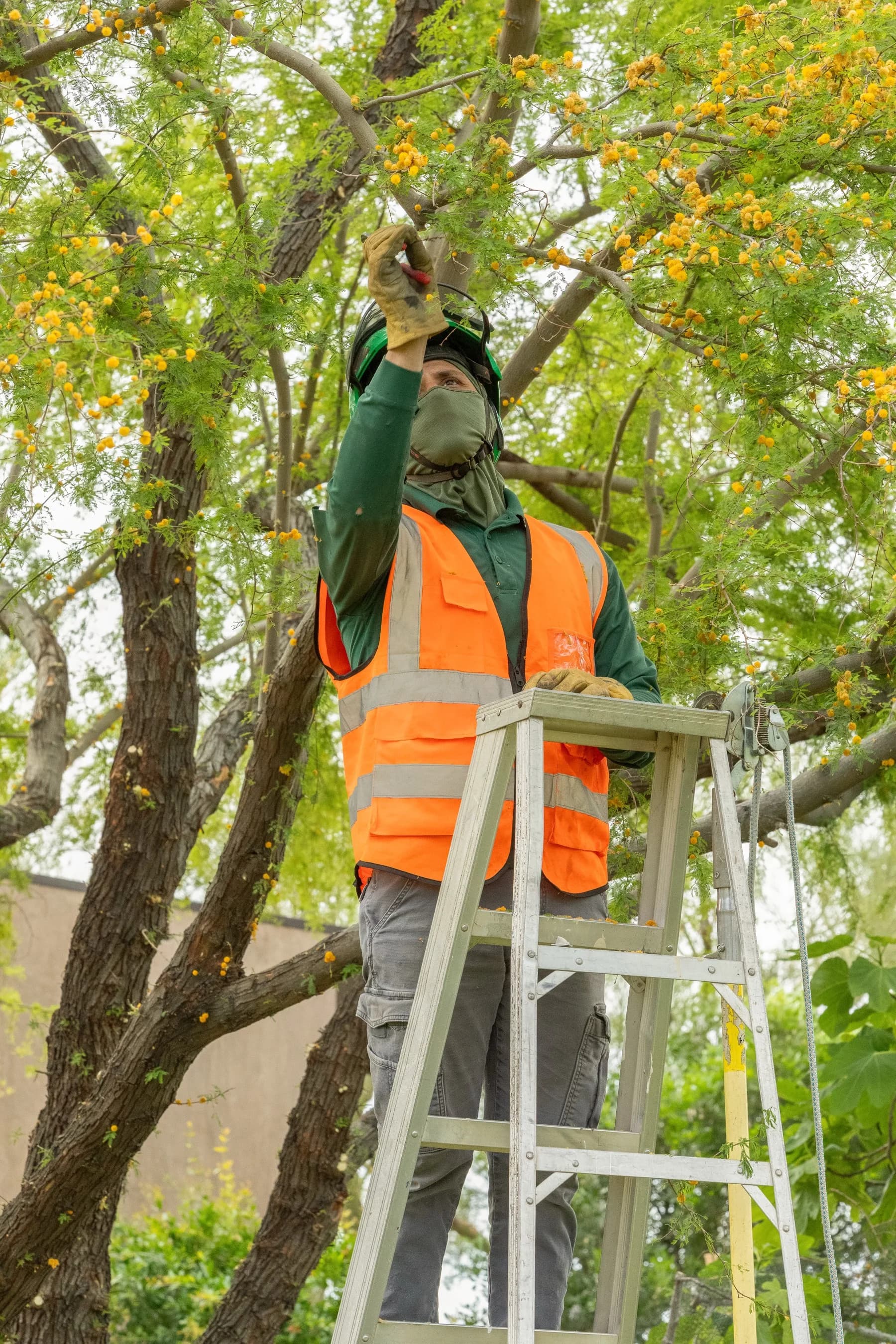
A Spring Valley homeowner inherited a yard of neglected, overgrown trees that were dragging down property value and creating safety hazards. Here is how Benjamin's Tree Service transformed the entire property in three days.
When a Spring Valley homeowner purchased a foreclosure property near South Rainbow Boulevard, the listing photos focused on the interior renovation potential. What they did not show was the backyard — a dense tangle of overgrown mulberry trees, dead pine stumps, unmanaged palm trees with five years of dead fronds, and an African sumac that had swallowed a section of block wall.
The new owner planned to renovate the home and either move in or rent it out. Either way, the exterior needed to match the interior investment. He contacted Benjamin's Tree Service for a full property assessment and a plan to bring the landscape back to a safe, clean, presentable condition.
The Assessment
Our arborist walked the property and catalogued every tree. The findings painted a clear picture of years of deferred maintenance:
- Three mature mulberry trees in the backyard had not been pruned in at least five years. The canopies were dense and top-heavy, with dead interior wood throughout. One mulberry had roots that had lifted a section of the concrete patio, creating a two-inch trip hazard. Another had grown into the block wall, with roots that had shifted the wall outward by nearly three inches.
- Two dead Aleppo pine stumps — roughly 18 inches in diameter each — sat in the side yard. The previous owner had apparently had the trees topped years ago; the remaining trunks had died and been cut to five-foot stumps. Both stumps showed termite activity.
- Four Washingtonia fan palms along the back fence had accumulated years of dead fronds — the classic "hula skirt" that harbors roof rats, scorpions, and creates a fire hazard in the desert climate. The fronds extended down to the 10-foot mark on 25-foot palms.
- One African sumac in the front yard had an overgrown canopy that completely blocked the front window, shaded the entryway into permanent darkness, and had one major limb resting on the roof.
The property also had a mature desert willow in the front yard that was in good health and just needed light pruning — proof that not everything on the lot was a problem.
The Plan
Our arborist proposed a phased approach completed over three consecutive days:
Day 1 — Hazard Removal and Stump Grinding
- Remove the mulberry tree that had grown into the block wall. The root system was compromising the wall's structural integrity, and repairing the wall required the tree to come out first.
- Grind the two dead pine stumps below grade and treat the stump holes to eliminate termite activity.
- Remove the dead wood from the remaining two mulberry trees and perform structural pruning to reduce canopy weight and improve form.
Day 2 — Palm Trimming and African Sumac Renovation
- Trim all four fan palms — remove dead fronds, seed pods, and any frond boots that were loose. This would eliminate pest habitat and dramatically improve the visual impact of the back fence line.
- Prune the African sumac in the front yard: remove the limb resting on the roof, raise the canopy to restore visibility to the front window and entryway, and thin the crown to reduce wind load and improve light penetration.
Day 3 — Final Pruning, Cleanup, and Property Walk
- Light structural pruning on the desert willow — remove crossing branches and shape for long-term growth.
- Crown-clean the two remaining mulberries to remove any remaining deadwood.
- Final debris removal, yard raking, and property walk with the homeowner to review the work and discuss a maintenance schedule going forward.
The Work
Day 1
The mulberry growing into the block wall was the most complex piece of the project. The tree was roughly 30 feet tall with a 25-foot canopy spread. Its root system had grown under and through the block wall, so removal required sectional cutting from the top down — no room to fell the tree without hitting the wall, the neighbor's fence, or the patio.
Our climber rigged each section and lowered it to the ground crew. When the trunk was removed down to the stump, we could see the extent of the root intrusion — three major roots had penetrated the wall's footing. The stump was ground 14 inches below grade, and the exposed roots along the wall were cut flush.
The two dead pine stumps were ground in under an hour. Both showed extensive termite channeling through the wood. The homeowner was advised to have a pest inspection done on the home's foundation — dead stumps with active termites within 15 feet of a structure are a red flag.
The remaining two mulberries received structural pruning: dead interior branches removed, crossing limbs cut, and the canopies thinned by roughly 25%. This transformed them from dense, shapeless masses into clean, well-structured shade trees.
Day 2
The four fan palms were trimmed to a clean "10 and 2" profile — fronds cut at an upward angle that leaves a natural, maintained appearance. Five years of dead fronds came off each palm, producing an enormous volume of debris. The crew filled a 30-yard roll-off container in a single morning just from palm waste.
The African sumac renovation was the visual highlight of the project. Before pruning, the tree's canopy extended to the ground on all sides, blocking the front window entirely and creating a dark cave effect at the front door. Our climber raised the canopy to 8 feet, removed the limb resting on the roof, thinned the crown by 30%, and shaped the remaining canopy into a clean umbrella form.
The result was immediate: the front of the house went from hidden and dark to open and welcoming. Sunlight reached the front window for the first time in years.
Day 3
The desert willow received light pruning — a few crossing branches removed and minor shaping. This tree was a reminder that not every tree on a neglected property is a problem. Some species are just more resilient and forgiving than others.
Final cleanup included raking all work areas, blowing debris from hardscape, and hauling away the remaining wood and brush. The crew removed approximately 5 tons of material over the three days.
The Result
The property transformation was dramatic:
- One hazard mulberry tree and two dead pine stumps removed — eliminating structural damage to the block wall and active termite habitat
- Two mulberry trees structurally pruned — now providing clean shade instead of creating hazards
- Four fan palms trimmed — removing pest habitat, reducing fire risk, and restoring a clean fence line
- One African sumac renovated — front of the home completely opened up with full window visibility and a welcoming entryway
- One desert willow maintained — light pruning to preserve its natural form
- Total project time: 3 days with a 3 to 4 person crew
- Total material hauled: approximately 5 tons
The homeowner completed his interior renovation two months later and listed the property as a rental. He later told us the yard was specifically mentioned by multiple prospective tenants as a deciding factor — the clean, well-maintained landscape set the property apart from comparable rentals in the Spring Valley area.
Lessons for Las Vegas Property Owners
Deferred tree maintenance compounds quickly
Every year of skipped maintenance increases the cost and complexity of bringing a property back. A tree that needs a $300 pruning today may need a $2,000 removal in three years.
Curb appeal starts with the trees
In Las Vegas neighborhoods where most lots have limited landscaping, the trees are the dominant visual feature. Overgrown, dead, or neglected trees make the entire property look abandoned — even if the home itself is in good condition.
A property tree plan saves money long-term
After the renovation, we set the homeowner up with an annual tree service plan: mulberry pruning every 12 months, palm trimming annually, and African sumac thinning every 18 months. The annual cost of this maintenance plan is less than 10% of what the initial renovation cost — and it keeps the property in the condition that attracts and retains good tenants.
Get Your Property Assessed
Whether you have just purchased a home, are preparing a property for sale or rental, or have simply fallen behind on tree maintenance, Benjamin's Tree Service can help. Our ISA Certified Arborists provide full property tree assessments across Spring Valley, Henderson, Summerlin, North Las Vegas, Paradise, Enterprise, and every community in the Las Vegas Valley. Call 725-300-0399 for a Free Tree Inspection and find out what your property needs.
Benjamin's Tree Service
ISA Certified Arborists serving Las Vegas & the surrounding areas since 2001.