
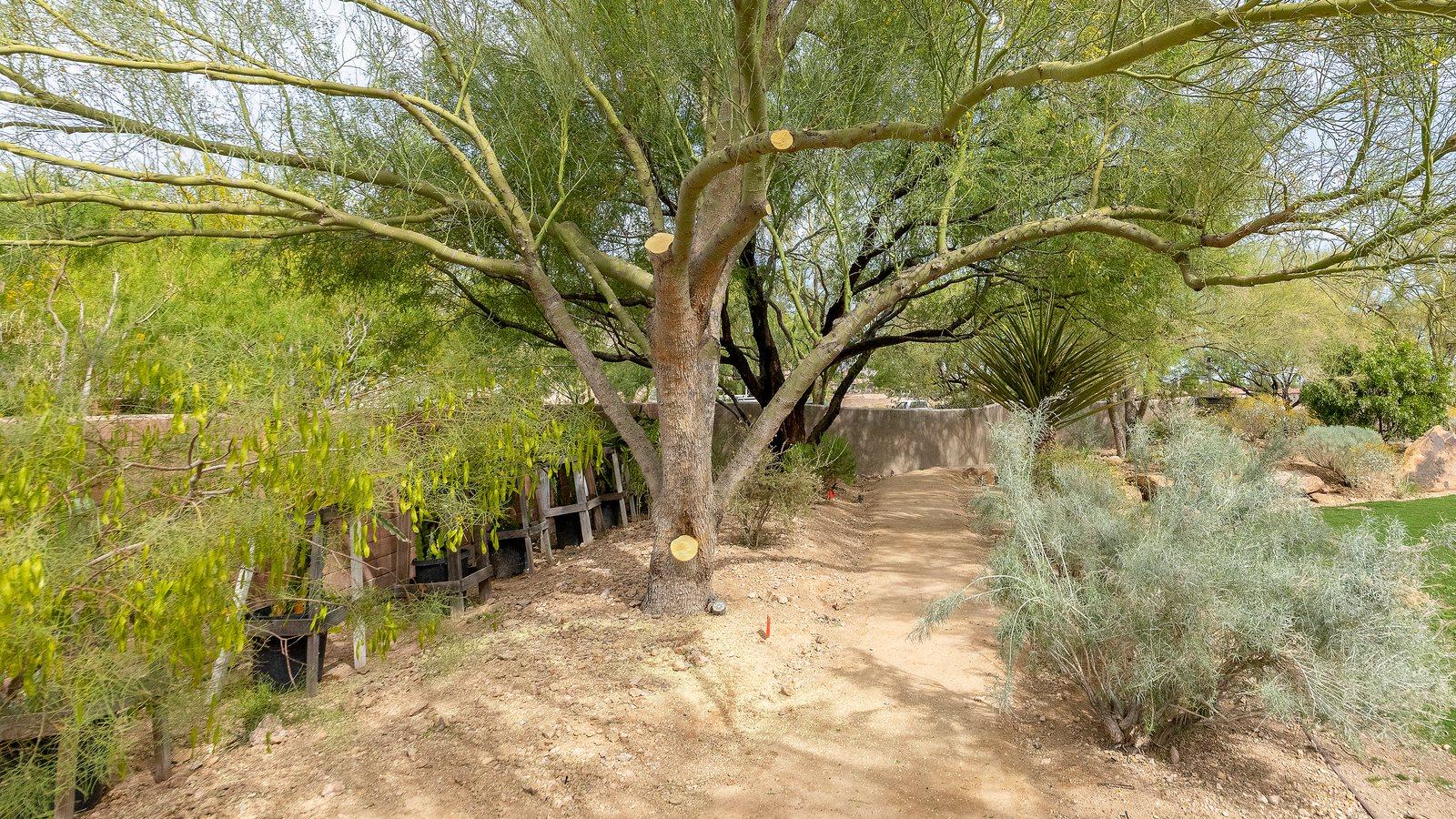
Watering a Las Vegas tree involves more than wetting the surface. This guide explains where to apply water, how to check soil moisture, which mistakes to avoid and when to call a professional.
Quick Summary
- Deep root watering means applying water slowly so it soaks the soil where a tree's water-absorbing roots are, instead of wetting only the surface.
- The University of Nevada, Reno Cooperative Extension says water-absorbing roots are concentrated in the top 2 feet of soil and extend to the drip line and beyond, and that there are none within 6 inches of the trunk.
- Drip tubing, bubblers and soaker hoses are common ways to spread water across the root zone.
- A soil probe shows how far the water went.
- Overwatering and underwatering can look alike. If a tree looks stressed, have it assessed.
- This guide covers technique. For how much and when, see our posts on watering trees in the desert and the fall watering schedule.
What is deep root watering?
Deep root watering is slow watering that soaks the zone where a tree's water-absorbing roots actually grow. Sprinkling the surface for a few minutes wets only the top layer and can leave the root zone dry.
The word "deep" can mislead. Most roots do not run straight down. The University of Arizona Cooperative Extension says most tree roots are in the top two feet of soil and extend as much as 3 to 5 times the width of the canopy. Its watering handout puts a typical tree root zone at 18 to 36 inches deep. Deep root watering means wetting that whole zone.
It is different from deep root feeding. Our deep root feeding service delivers nutrients to the root zone, while watering itself is not one of the services listed on our website. This guide is general information, not advice about a specific tree.
Where should the water go?
For an established tree, the two universities describe the target a little differently. The drip line is the ground below the outer edge of the canopy.
- University of Arizona: the most active water absorption is at the drip line and beyond, not close to the trunk, and most roots spread 1 1/2 to 4 times as wide as the canopy. That is where it says to water.
- University of Nevada, Reno: there are no water-absorbing roots within 6 inches of the trunk, and its guide suggests drip tubing that covers 60% to 75% of the critical root zone, the area within the drip line.
A newly planted tree is different, because its roots are still in the root ball. The University of Arizona's planting guidelines say to wet the root ball and the loosened soil around it to the depth of the root ball. If the watering basin is wider than the root ball, the root ball can stay dry while the soil around it is wet. Once roots grow outward, the watering area moves outward too.
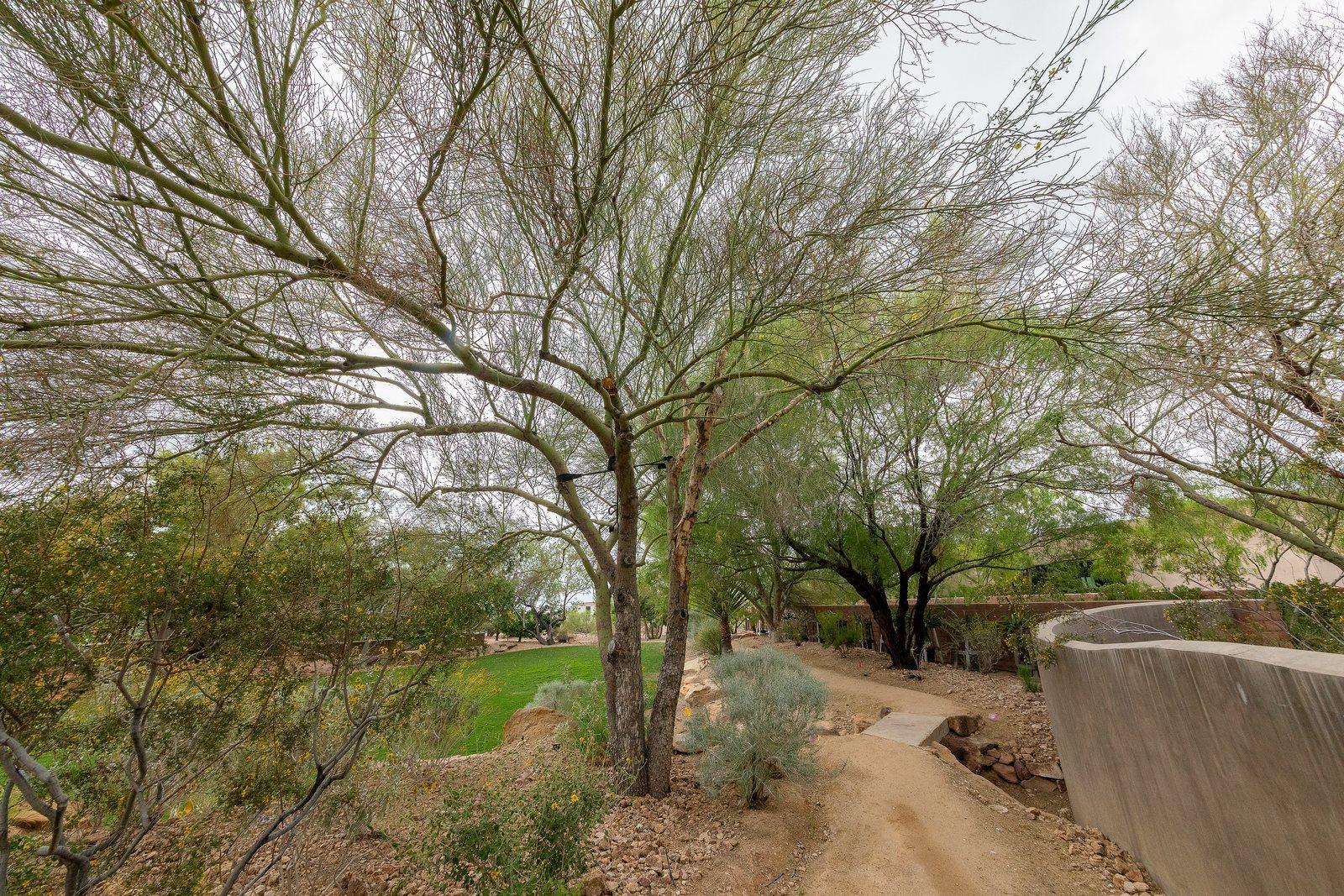
How to water deeply
The goal is slow, wide, even wetting. The University of Arizona describes these tools:
- Drip systems: most have too few emitters. Add emitters and move them toward the drip line as the tree grows.
- Bubblers: level basins about a foot wide, in a ring just inside and outside the canopy edge, not near the trunk.
- Soaker hoses: they work, but they can clog and release water unevenly.
- Sprinklers: not recommended for trees, because wind and evaporation waste water.
The Nevada guide prefers inline drip tubing with pressure-compensating emitters, covered with organic mulch.
A few habits help any method:
- Match the pace to the soil. Arizona says sandy, shallow or compacted soil needs water more often for less time, while clay absorbs slowly and should be watered slowly and less often.
- Mulch 3 to 4 inches deep over the root zone, kept away from the base of the plant, to slow evaporation.
- Learn your run time. Arizona suggests using a probe to find how long water takes to fill the root zone, then repeating that time.
- Test drainage before planting in shallow, compacted or heavy soil: Arizona says water still standing 24 hours after filling a foot-deep hole twice means poor drainage. Hardpan such as caliche can cause poor drainage.
How to check how deep the water went
Arizona describes a smooth rod, 1/4 to 3/8 inch across, pushed into the ground soon after you irrigate. It slides easily through wet soil and gets hard to push when it reaches dry soil.
- Probe near the drip line, not the trunk, in more than one spot.
- Aim for the bottom of the root zone, not past it. Watering deeper only wastes water, Arizona notes.
- Do not force the probe. A hard stop can mean dry soil, rock, caliche or something buried, so try a second spot.
- Avoid places where irrigation, gas, electric or other lines may be buried. If unsure, skip probing and ask a professional.
If the probe stops short, water a little longer next time. If it goes in easily far below the root zone, shorten the run.
How much and how often?
There is no single answer. Species, root depth, soil, weather, tree age and your system's output matter. Arizona notes that plants can use 3 to 5 times as much water in hot, dry, windy seasons as in winter, and that young trees need water more often than established ones.
University guidance is a starting point, not a Las Vegas schedule. The Nevada chart for mature trees (18 to 24 inches deep, every 1 to 2 weeks) is labeled for northern Nevada, and the guide says trees may need water more often above 100 degrees. It also publishes southern Nevada weekly water tables and a downloadable Tree Irrigation Handbook.
Our posts on watering trees in the desert and the fall watering schedule cover the detail. Check your local water provider's current rules before changing a schedule.
Common mistakes
- Watering a mature tree at the trunk instead of at and beyond the drip line.
- Relying on lawn sprinklers, since lawns and trees have different root depths.
- Giving every tree the same schedule, whatever its species, soil or age.
- Watering deeper than the root zone.
- Leaving drip emitters where they were first installed while the tree keeps growing.
- Piling mulch against the trunk.
- Adding water to a struggling tree without checking whether the soil is already wet. Arizona's handout opens with a blunt line: most people over water plants.
Signs a tree may need attention
The University of Arizona lists these signs. They are clues, not a diagnosis.
- Possible underwatering: dry soil, older leaves turning yellow or brown or dropping, and leaves that wilt or curl.
- Possible overwatering: soil that stays damp, algae or mushrooms in the soil, young leaves turning light green or yellow, wilted shoots, and brittle green leaves.
If the signs persist after you adjust your watering, or you cannot tell which applies, the cause may not be water. A tree assessment is a professional evaluation of a tree's health, structure and risk potential, according to our service page.
When to call a tree professional
Call when a large or mature tree looks stressed, when signs persist, or when a tree is close to a house.
Benjamin's Tree Service has served Las Vegas since 2001, according to our website, and our tree assessment reports come from an ISA Certified Arborist (certificate WE-15785A). Our deep root feeding service starts with a tree and soil assessment, and our service page says a long-term care plan can include irrigation guidance. That is advice, not a watering service.
Questions worth asking any tree professional:
- What species is this tree, and what does it need in this soil?
- Is the soil draining, or is water standing near the roots?
- Where should my emitters or bubblers sit as the tree grows?
Frequently asked questions
How do you deep water a tree?
Apply water slowly at and beyond the drip line, covering a wide area, until the soil is wet through the root zone. Check with a soil probe and repeat what worked.
How often should established trees be watered?
It depends on species, soil, weather and root depth. The University of Nevada, Reno suggests deep, infrequent watering of mature trees, in a chart labeled for northern Nevada. See our posts for Las Vegas detail.
Where is a tree's drip line?
It is the ground directly below the outer edge of the canopy. Water-absorbing roots are most active there and beyond, or within it, per Nevada.
Can you overwater a tree?
Yes. The University of Arizona says overwatering can damage or even kill plants. Damp soil, mushrooms and pale young leaves are possible signs, but they can have other causes.
How does watering a newly planted tree differ?
Its roots are still in the root ball, so the root ball and nearby soil need to stay moist. As roots grow outward, the watering area moves with them.
Next step
Not sure what your tree needs? Use our contact page to schedule service, choose the tree assessment or deep root feeding option, and add a photo if you have one. You can also call 725-227-6160 (Monday to Friday, 7:00 am to 6:00 pm; emergency service 24/7).
Sources
- University of Nevada, Reno Cooperative Extension, Watering Trees in Hot, Dry Home Landscapes (Kratsch and Jensen, 2023). Read November 7, 2026.
- University of Arizona Cooperative Extension, Watering Trees and Shrubs (Call and Daily, revised August 2017). Read November 7, 2026.
- University of Arizona Cooperative Extension, Planting Guidelines for Container Trees and Shrubs (Schuch, March 2025). Read November 7, 2026.
Benjamin's Tree Service
ISA Certified Arborists serving Las Vegas & the surrounding areas since 2001.
Related Reading
Tree Care Tips
When Do You Need a Tree Risk Assessment in Las Vegas?
Learn when a tree risk assessment is worth ordering in Las Vegas, how it differs from a free estimat…
8 min read
Tree Care Tips
ISA Certified Arborist in Las Vegas: When You Need One
Not sure you need an ISA Certified Arborist in Las Vegas? Learn which tree jobs need one, how to ver…
8 min read
Tree Care Tips
Dead or Dormant Tree in Las Vegas? 4 Easy Ways to Tell
Not sure if you have a dead or dormant tree in Las Vegas? Use the scratch test, bud check, and flex …
9 min read