
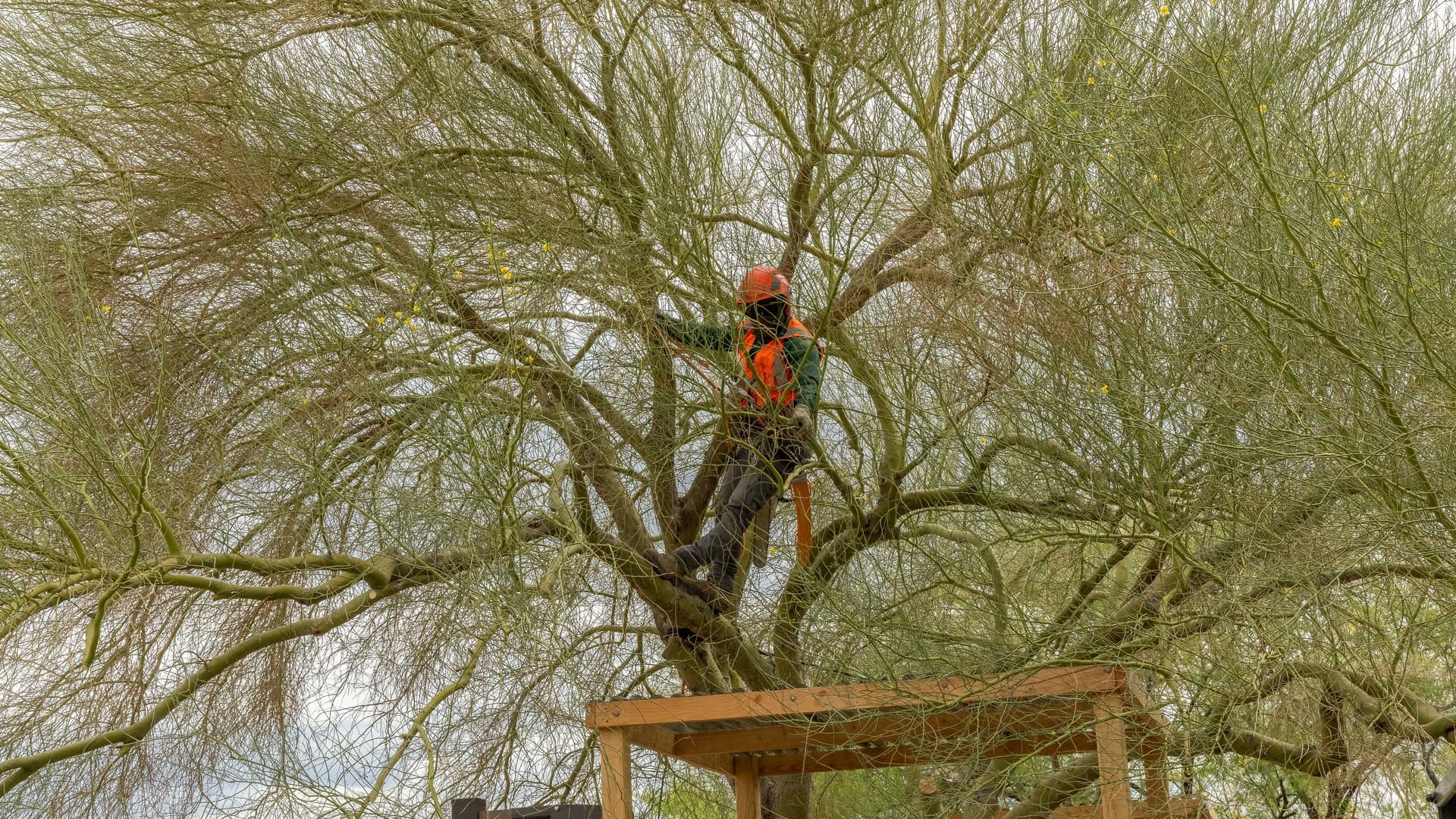
Not sure if you have a dead or dormant tree in Las Vegas? Use the scratch test, bud check, and flex test to tell the difference before you cut it down.
Telling a dead or dormant tree in Las Vegas apart is harder than it sounds. A bare tree in December is usually just resting, but a bare tree in June may be in real trouble, and the two can look almost identical from the driveway. Cutting down a tree that was only dormant is an expensive mistake, and so is waiting too long on one that is truly dead and starting to shed limbs.
This guide walks through four simple checks you can do yourself, what normal dormancy looks like for common Las Vegas Valley trees, the warning signs that point to a dead tree, and when it is time to call a certified arborist.
Quick Summary
- Use four checks together: the scratch test, the flex test, a bud check, and a look at the base and trunk. No single test is enough on its own
- Green, moist tissue under the bark means the tree is alive, even if it has no leaves
- Many Las Vegas trees drop leaves in winter or leaf out late in spring, so a bare tree between November and April is usually normal
- A tree that stays bare well into late spring while neighbors' trees of the same species have leafed out deserves a closer look
- Large dead limbs, a hollow trunk, or a leaning tree over a house or fence should not wait for spring
- Benjamin's Tree Service has served Las Vegas Valley homeowners since 2001, ISA Certified (WE-15785A), 5-star Google rated
Table of Contents
- What dormancy looks like in Las Vegas trees
- How to tell if you have a dead or dormant tree in Las Vegas
- Signs a tree is truly dead
- What to do while you wait
- When to call a certified arborist
- Dead or dormant trees across the Las Vegas Valley
- Frequently asked questions
What Dormancy Looks Like in Las Vegas Trees
Dormancy is a normal rest period, not a sign of failure. Deciduous shade trees such as ash, mulberry, Chinese pistache, and crape myrtle drop their leaves as days shorten and temperatures fall, then stay bare through winter. That leaf drop typically runs from November into December in the Las Vegas Valley, and new growth returns in March or April.
A few local species do not follow that calendar. Honey mesquite leafs out late, sometimes well into April, which makes homeowners nervous every year. Palo verde is drought deciduous, so it can drop most of its small leaves in a dry stretch, but its bark stays green because the trunk and branches photosynthesize. Evergreens such as olives, eucalyptus, and pines should hold foliage all year, so heavy needle or leaf drop on those is a stress signal rather than dormancy. Palms never go dormant at all.
Summer can cause its own confusion. Extreme heat and drought stress can make a tree drop leaves in July or August, which looks like dormancy but is really the tree protecting itself. That is why the season matters as much as the tree when you are trying to read the signs.
How to Tell If You Have a Dead or Dormant Tree in Las Vegas
These four checks take about ten minutes and cost nothing. Run all of them, on more than one branch, before you decide anything.
1. The scratch test. Pick a small twig or branch, scrape away a thin strip of outer bark with a fingernail or pocketknife, and look at the layer underneath. Green and moist means the tree is alive. Brown, gray, or dry and papery means that branch is dead. The North Carolina Cooperative Extension describes the same scratch test for dead or dormant trees as a quick way to reveal whether there is still life in the tree. Test several spots, because one dead branch does not mean a dead tree.
2. The flex test. Bend a small twig. A living twig flexes and bounces back, while a dead twig snaps cleanly with a dry crack. This works best on branches thinner than a pencil, and it is most reliable when you compare a few twigs from different parts of the canopy.
3. The bud check. Look closely at the tips of branches. Plump, slightly swollen buds that are firm to the touch are a good sign, even in the middle of winter. Shriveled, dark, or crumbly buds that come off with a light rub suggest the branch has died back.
4. The base and trunk check. Walk around the tree and look for peeling bark in large sheets, mushrooms or shelf-like fungus growing at the base, soft or hollow-sounding wood when you tap the trunk, and small round holes with fine sawdust that can point to boring insects. Also look at the soil line for exposed or cut roots. Trouble at the base often explains trouble in the canopy.
If the scratch test is green, the twigs flex, and the buds look plump, you almost certainly have a dormant tree. If every test comes back dry, brown, or brittle across the whole canopy, you are probably looking at a dead one.
Signs a Tree Is Truly Dead
Dormancy is reversible and death is not, so it helps to know what a dead tree tends to look like in the Las Vegas Valley.
- No leaf-out in spring. If your tree is still bare in May while other trees of the same species on your street have fully leafed out, the tree may be dead or badly declining. Give deciduous trees through late spring before deciding, since a cool or dry winter can delay leaf-out
- Brown, brittle wood everywhere you scratch. Partial dieback is common and often fixable, but a tree that shows no green in the trunk or major limbs is past saving
- Bark falling away in patches. Loose, peeling bark on the trunk often means the cambium layer underneath has died
- Fungus at the base. Conks or mushrooms on the root flare or lower trunk usually point to internal decay
- Sudden dropping of limbs. Dead wood becomes brittle fast, and desert wind or a monsoon gust can bring down branches with no warning
- A leaning or shifting trunk. New soil heaving on one side of the tree can mean the root system is failing
Several of these overlap with the problems described in our guide on the signs your Las Vegas tree is diseased or dying, so read that next if your tree shows more than one.
What to Do While You Wait
If your checks come back mixed or you are not sure, patience is usually the right call, as long as the tree is not a hazard.
- Do not overwater or fertilize to force a comeback. A tree with a compromised root system cannot use the extra water, and soggy soil makes decay worse. Stick to a deep, infrequent schedule like the one in our fall watering guide for Las Vegas trees
- Mark the tree and note the date. Tie a bit of flagging tape on a branch you scratch-tested, take a photo, and recheck in four to six weeks
- Wait until late spring before writing off a deciduous tree. Give it through May, since some species are slow to leaf out after a cool or dry winter
- Leave heavy pruning until you know. Removing live wood from a stressed tree adds more strain, so hold off until you can tell what is alive
- Keep people and property clear of large dead limbs. If a big dead branch hangs over a roof, patio, or play area, do not wait for spring
When to Call a Certified Arborist
Call a professional when your own checks leave you unsure, when the tree is large, or when it stands close to your house, a block wall, a power line, or a neighbor's yard. The International Society of Arboriculture notes that homeowners should consider hiring an arborist when a tree is dead or dying, an unacceptable risk, or causing an obstruction.
At Benjamin's Tree Service, our ISA Certified Arborist (WE-15785A) can give you a documented answer through a tree assessment report, including whether the tree is alive, what is wrong, and what your options are. If the tree can be saved, we can often bring it back with targeted trimming and pruning that removes only the dead wood. If it cannot, our tree removal crews handle the job safely, including rigging pieces down over structures. Homeowners with a limb already hanging or a tree that has started to lean can call our emergency tree service line.
Removal is not always a permit issue in Clark County, but HOAs often have their own rules, so it is worth reading our overview of tree removal permits in Clark County before scheduling a job.
Dead or Dormant Trees Across the Las Vegas Valley
Conditions differ from one neighborhood to the next. Older trees in established parts of Henderson often have deep, mature root systems and more tolerance for stress, while newer tracts in Summerlin and North Las Vegas frequently have younger trees planted in compacted, caliche-heavy soil that struggles to drain. Young trees in those areas are more likely to fail after a hard summer, so give any tree under five years old extra attention in spring.
Frequently Asked Questions
How can I tell if my tree is dead or dormant in Las Vegas?
Scratch a small twig with a fingernail or knife. Green, moist tissue underneath means the tree is alive and dormant. Brown, dry tissue in several places means the branch, or possibly the whole tree, is dead. Pair the scratch test with a flex test on thin twigs and a look at the buds.
When do Las Vegas trees normally lose their leaves?
Most deciduous shade trees drop leaves between November and December and leaf out again in March or April. Mesquite can be slower, sometimes leafing out into late April, and palo verde may drop leaves during dry stretches while its bark stays green.
How long should I wait before deciding a tree is dead?
For a deciduous tree, wait through late spring, roughly the end of May, before deciding it will not leaf out. If the tree has large dead limbs, a hollow trunk, or a lean over your home, do not wait, and call an arborist right away.
Can a dead tree come back to life?
No. A tree with no living tissue in its trunk and major limbs cannot recover. A tree with partial dieback can often recover if the dead wood is removed and the underlying stress, such as overwatering, drought, or root damage, is corrected.
Should I remove a dead tree myself?
We do not recommend it for anything large. Dead wood is brittle and unpredictable, especially near structures or power lines. A trained crew with the right rigging equipment can take the tree down safely and protect your property.
Get a Straight Answer About Your Tree
If you cannot tell whether your tree is dead or just resting, a quick professional look can save you from removing a healthy tree or ignoring a dangerous one. Benjamin's Tree Service has served Las Vegas Valley homeowners since 2001. Call us at 725-227-6160 or request a tree assessment and we will tell you exactly what is going on with your tree.
Benjamin's Tree Service
ISA Certified Arborists serving Las Vegas & the surrounding areas since 2001.
Related Reading
Tree Care Tips
Common Tree Pests in Las Vegas: A Homeowner's Guide
Aphids, spider mites, and palo verde root borers are common tree pests in Las Vegas. Learn the warni…
10 min read
Tree Care Tips
Palo Verde Tree Care in Las Vegas: A Seasonal Guide
Learn palo verde tree care in Las Vegas, including watering, pruning, monsoon safety, warning signs,…
9 min read
Tree Care Tips
Deep Root Feeding for Las Vegas Trees: A Complete Guide
Learn how deep root feeding helps Las Vegas trees overcome caliche soil, extreme heat, and drought. …
8 min read