
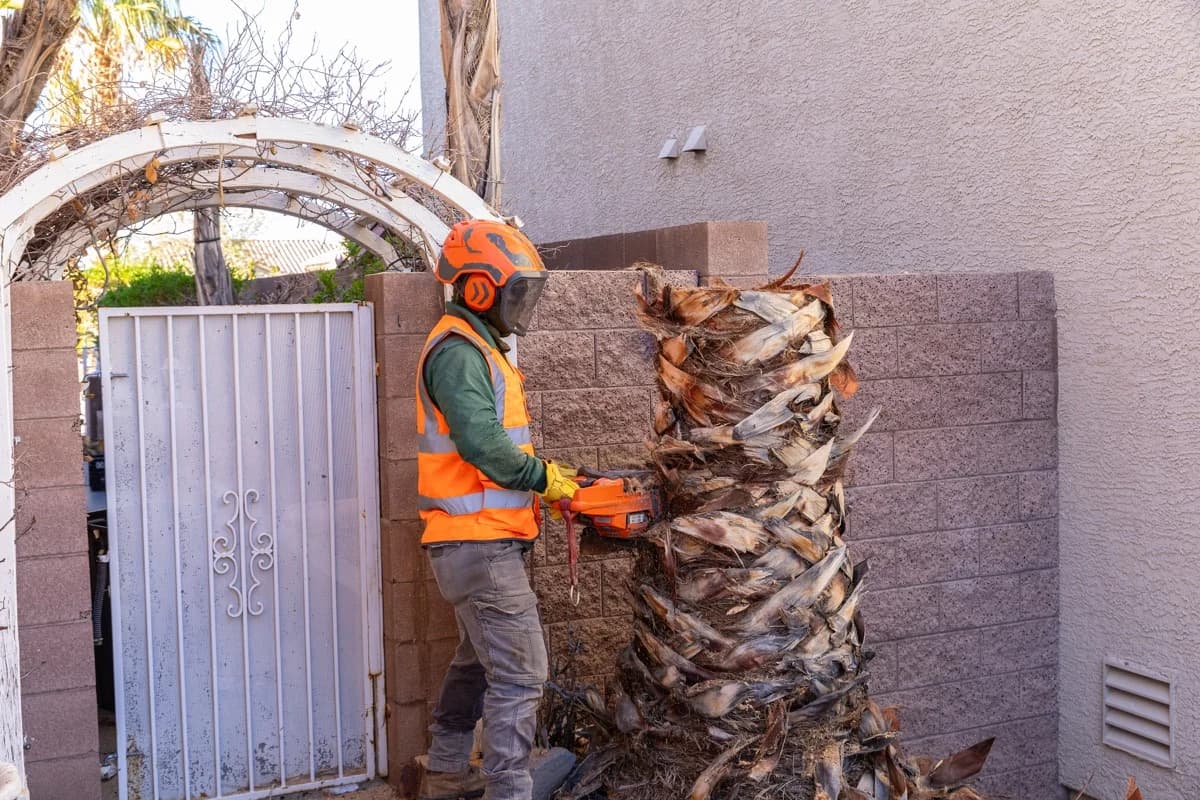
Fallen trees, cracked limbs, and uprooted trunks can happen without warning in the Las Vegas Valley. Learn what qualifies as a tree emergency, what to do before help arrives, and how to choose the right emergency tree service provider.
When a mature tree drops a 2,000-pound limb onto your roof at 2 a.m. during a July monsoon, theory stops mattering and response time starts. Emergency tree situations are among the most dangerous and stressful events a Las Vegas homeowner can face. Unlike routine tree care, emergencies demand immediate action, specialized equipment, and the kind of judgment that only comes from years of working with trees under pressure.
This guide covers everything Las Vegas Valley homeowners need to know about emergency tree service — from identifying what constitutes a genuine emergency to understanding what happens during a professional response, what it costs, and how to reduce your risk before the next storm rolls in.
Benjamin's Tree Service has been providing emergency tree response across the Las Vegas Valley since 2001. Our crews have responded to tree emergencies in Summerlin, Henderson, North Las Vegas, Paradise, Spring Valley, Enterprise, and every community in between. This guide reflects real-world experience, not textbook advice.
What Qualifies as a Tree Emergency
Not every tree problem is an emergency, and misidentifying the situation can lead to either dangerous delays or unnecessary expense. Understanding the distinction helps you make the right call.
Immediate Emergencies — Call Now
These situations require same-day or same-hour response because they pose an active threat to life, property, or infrastructure:
- A tree or large limb has fallen on a structure — house, garage, shed, fence, or vehicle. Even if the damage looks minor, the remaining tree structure may be unstable and could drop additional weight.
- A tree has fallen on or near power lines. This is a life-threatening situation. Do not approach the tree, do not attempt to move it, and do not touch anything in contact with the lines. Call NV Energy (702-402-5555) first, then a tree service. In Henderson, contact the city's utility division. Downed power lines can energize the ground in a wide radius.
- A tree is actively leaning or splitting and could fall on an occupied structure, vehicle, or pedestrian area. If you can hear cracking sounds, see the tree shifting, or notice the root plate lifting on one side, evacuate the area immediately.
- A tree is blocking a road, driveway, or emergency access route. This is particularly critical when it prevents emergency vehicles from reaching your property or your neighbors' properties.
- Storm damage has left hanging limbs (called "widow makers") suspended in the canopy above areas where people walk, park, or gather. These limbs can fall without warning hours or even days after the storm that dislodged them.
Urgent but Not Immediate — Schedule Within 24 to 48 Hours
These situations need professional attention soon but are not active life-safety threats:
- A tree is leaning noticeably more than it was before a storm, but is not actively moving or cracking. The lean may indicate root failure, but the tree is currently stable.
- A large section of bark has separated from the trunk, exposing sapwood. This can indicate internal decay or storm damage that compromises structural integrity.
- A tree has significant canopy loss on one side, creating an imbalanced weight distribution that makes future failure more likely during wind events.
- Root heaving is visible — the ground around the base of the tree is cracked or lifted on one side, suggesting the root plate is failing. This is common after heavy rain saturates the soil in areas like Spring Valley and Enterprise where clay content is higher.
Not an Emergency — Schedule Routine Service
- Dead branches in the canopy that are not directly over structures or high-traffic areas. These should be removed during scheduled maintenance.
- A tree that has been declining gradually over weeks or months. Slow decline indicates a health issue, not a structural emergency.
- Cosmetic damage — broken small branches, minor bark scraping from vehicles, or leaf loss from heat stress. These are normal in Las Vegas and rarely require urgent intervention.
Common Causes of Tree Emergencies in Las Vegas
The Las Vegas Valley has its own set of environmental triggers that cause tree failures. Understanding these helps homeowners anticipate problems before they escalate.
Monsoon Storms (July Through September)
The Mojave Desert monsoon season is responsible for more tree emergencies in Las Vegas than any other single factor. These storms combine three destructive elements:
1. Microbursts with wind speeds exceeding 80 mph that can snap healthy trunks and uproot mature trees
2. Rapid soil saturation that weakens root anchorage — trees that survived 60 mph winds in dry soil can topple in 40 mph winds when the ground is wet
3. Lightning strikes that can split trunks, explode internal moisture into steam, and kill trees instantly
Neighborhoods in the western valley — Summerlin, Centennial Hills, and the northwest — are particularly exposed to monsoon wind events because storms funnel through the mountain passes. Henderson and Anthem also see heavy monsoon activity due to their proximity to the McCullough Range.
High-Wind Events (Spring and Fall)
Las Vegas experiences strong wind events outside of monsoon season, particularly in March, April, and October. Spring winds are the most persistent, with sustained speeds of 40 to 60 mph lasting for hours. These winds test every structural weakness in a tree's architecture.
Trees that were improperly pruned — particularly those that were "topped" or had their central leader removed — are far more likely to fail in wind. Topping creates dense clusters of weakly attached regrowth that acts like a sail in high wind, dramatically increasing the leverage forces on the trunk and root system.
Drought Stress and Irrigation Failure
Las Vegas trees depend entirely on irrigation. When a watering system fails — a broken timer, a clogged line, or a shut-off valve left closed — trees can go from healthy to critically stressed within two to three weeks during summer. Severe drought stress kills fine root hairs, which are the trees primary means of water absorption. Once these roots die, even restoring irrigation may not save the tree.
Drought-stressed trees are also structurally compromised. Wood that has lost moisture is more brittle and more likely to fracture under wind load. Dead branches shed without warning. Root systems that have dried and shrunk lose their grip on the soil.
Construction and Development Damage
The Las Vegas Valley continues to see significant residential and commercial development, particularly in the southwest (Enterprise, Southern Highlands) and northwest (Skye Canyon, Centennial Hills). Construction activity near existing trees causes root zone compaction, grade changes, and root severance that may not show symptoms for one to three years. By the time the tree shows visible decline, the root system damage is often irreversible and structural failure becomes a matter of time.
Poor Pruning History
Many tree emergencies are not caused by weather at all — they are caused by years of improper pruning. Trees that have been repeatedly topped, lion-tailed (stripped of interior branches), or pruned by unqualified workers develop structural weaknesses that eventually lead to failure. Common results include:
- Codominant stems with included bark that split apart under wind load
- Over-extended limbs with no taper that snap under their own weight
- Dense regrowth clusters from topping cuts that become top-heavy and tear away from the trunk
What to Do When a Tree Emergency Happens
The first 30 minutes after a tree emergency matter. Here is a step-by-step response guide for Las Vegas homeowners.
Step 1 — Ensure Personal Safety
Move all people and pets away from the affected area. Do not approach a fallen tree — the root plate may still be under tension, and the trunk can shift or roll without warning. If the tree is on a structure, do not enter the structure until it has been assessed for stability.
If power lines are involved, stay at least 35 feet away. Assume every downed line is live. Do not drive over downed lines. Do not attempt to remove branches from power lines with any tool, including wooden poles — electricity can arc through damp wood.
Step 2 — Call Emergency Services if Needed
Call 911 if anyone is injured, if the tree is blocking a public road, or if power lines are down. NV Energy's emergency line is 702-402-5555. Las Vegas Fire and Rescue and Henderson Fire Department both respond to tree-related emergencies that threaten structures or create immediate public safety hazards.
Step 3 — Document the Damage
Once it is safe, photograph the tree from multiple angles. Document:
- The full extent of the fall or failure
- Any structural damage to buildings, vehicles, fences, or hardscape
- The root plate if the tree uprooted — this shows whether roots were healthy or compromised
- Any utility lines involved
- The time and weather conditions
This documentation is critical for insurance claims. Homeowner's insurance in Nevada typically covers damage caused by fallen trees, but the claims process requires thorough documentation.
Step 4 — Contact a Professional Tree Service
Call a licensed, insured tree service that offers emergency response. When you call, provide:
- Your address and the location of the tree on your property
- Whether the tree is on a structure, vehicle, or utility line
- The approximate size of the tree or limb involved
- Whether the situation is actively worsening (tree still moving, additional limbs falling)
- Whether anyone is injured or trapped
Benjamin's Tree Service offers emergency response across the entire Las Vegas Valley. Our crews are equipped for crane-assisted removals, complex rigging over structures, and coordination with utility companies.
Step 5 — Secure the Area
If possible, block access to the affected area with caution tape, barriers, or vehicles. Keep children and pets away. If the tree is in a front yard near a sidewalk or street, consider posting visible warnings for pedestrians, especially at night.
What Happens During a Professional Emergency Tree Response
Understanding the process helps set expectations and ensures you are not surprised by the scope of work involved.
Initial Assessment (15 to 30 minutes)
The crew leader will evaluate the situation before any cutting begins. This assessment determines:
- Whether additional trees nearby are compromised and may fail
- The safest approach for removing the fallen tree or limb — this may involve cutting from the top down, rigging sections with ropes, or using a crane for heavy lifts over structures
- Whether utility company coordination is needed before work can begin
- Whether the structure under or near the tree is safe to work adjacent to
Stabilization and Hazard Removal (1 to 4 hours for most residential jobs)
The crew removes the immediate hazard — the fallen tree, hanging limbs, or threatening leaner. This work typically involves:
- Sectional dismantling of the fallen tree, starting with branches and working inward to the trunk
- Careful rigging of sections over roofs, fences, or other structures to prevent additional damage during removal
- Crane deployment for heavy trunk sections or trees that fell in tight spaces — Las Vegas neighborhoods like Summerlin and Green Valley often have homes close together, requiring precision rigging
- Stump and root plate management — if a tree uprooted, the root plate must be cut away and the hole filled to eliminate the tripping hazard
Debris Removal and Cleanup
All wood, branches, and debris are hauled away. The area is raked and cleared. If the tree damaged a fence, irrigation line, or hardscape, the crew will note it for follow-up repair.
Emergency Tree Service Costs in Las Vegas
Emergency tree work costs more than scheduled work because it involves after-hours response, specialized equipment, and higher-risk conditions. Here are typical ranges for the Las Vegas Valley:
- Small tree or single large limb removal: $300 to $800
- Medium tree removal (12 to 24 inch diameter): $800 to $2,500
- Large tree removal (over 24 inch diameter): $2,500 to $6,000+
- Crane-assisted removal (tree on structure or in tight access): $3,000 to $10,000+
- After-hours premium: typically 25% to 50% above standard rates
These costs vary based on tree species, location on the property, accessibility, and the complexity of the removal. Trees on roofs, near pools, or tangled in power lines cost more because they require more time, more equipment, and more risk management.
Insurance Coverage
Most homeowner's insurance policies in Nevada cover damage caused by fallen trees, including the cost of removing the tree from the structure. However, coverage details vary:
- Tree removal from a structure is almost always covered
- Tree removal from a yard (no structural damage) may not be covered, or may be covered only up to a limited amount (often $500 to $1,000)
- Debris removal is sometimes a separate line item with its own limit
- Preventive removal of a hazardous tree that has not yet fallen is rarely covered
File your claim promptly and provide the documentation from Step 3. Your tree service provider should be able to provide a detailed invoice that breaks down the work performed, which helps with claim processing.
How to Reduce Your Emergency Tree Risk
The best emergency tree response is the one you never need. Las Vegas homeowners can significantly reduce their risk of tree emergencies through proactive maintenance.
Schedule Annual Professional Tree Assessments
A certified arborist can identify structural weaknesses, root system problems, disease, and pest damage before they lead to failure. This is especially important for mature trees near structures, which is most residential trees in neighborhoods like Paradise, Winchester, and Sunrise Manor where lots are smaller and trees are closer to homes.
Benjamin's Tree Service offers comprehensive tree assessments that evaluate structural integrity, root health, canopy balance, and species-specific risk factors.
Invest in Structural Pruning
Proper structural pruning is the single most effective way to reduce wind-related tree failure. Structural pruning:
- Establishes a single dominant leader to prevent codominant stem splits
- Reduces end-weight on over-extended limbs
- Opens the canopy to allow wind to pass through rather than catching like a sail
- Removes dead, crossing, and rubbing branches that create entry points for decay
The best time for structural pruning in Las Vegas is late winter through early spring (February through April), when trees are dormant or just beginning to break bud. This timing allows wounds to close quickly during the active growing season.
Maintain Your Irrigation System
Check your irrigation system monthly. Replace clogged emitters, verify timer schedules, and ensure water is reaching the drip line of every tree on your property. During summer, most mature trees in the Las Vegas Valley need deep watering every 5 to 7 days. Inadequate irrigation is one of the most common and most preventable causes of tree decline and eventual failure in this climate.
Choose the Right Species for Your Location
If you are planting new trees, select species that are well-adapted to the Las Vegas climate and appropriate for the space. Trees like mesquite, palo verde, and desert willow have deep root systems and open canopy structures that handle Las Vegas wind far better than dense, shallow-rooted species like ficus or Modesto ash. Consult the tree selection guidance in our Complete Guide to Tree Service in the Las Vegas Valley for species recommendations.
Remove Hazardous Trees Before They Fail
Some trees are beyond saving. If an arborist identifies a tree with severe structural compromise, advanced internal decay, or catastrophic root failure, removal is safer and cheaper than waiting for the tree to fall on its own terms. The cost of a planned removal is typically 30% to 50% less than an emergency removal of the same tree.
Las Vegas Emergency Resources
Keep these numbers accessible before storm season:
- Benjamin's Tree Service (Las Vegas Valley-wide): call for emergency response
- NV Energy Emergency Line: 702-402-5555
- Las Vegas Fire and Rescue (non-emergency): 702-383-2888
- Henderson Fire Department (non-emergency): 702-267-2222
- Clark County 311 (downed trees on public property): 702-455-4191
- Nevada 811 (call before you dig — underground utility locates): dial 811
Frequently Asked Questions
How quickly can an emergency tree service respond in Las Vegas?
Response times depend on the severity of the situation and current demand. During major storm events, wait times can extend to several hours as crews work through a backlog of emergencies. For isolated incidents during normal conditions, most reputable companies can respond within 2 to 4 hours. Benjamin's Tree Service prioritizes emergencies involving structural threats and downed utility lines.
Will my insurance cover emergency tree removal?
Most Nevada homeowner's insurance policies cover tree removal when the tree has damaged an insured structure (house, garage, fence). Coverage for removing a tree from the yard without structural damage is typically limited to $500 to $1,000. Review your policy details and contact your agent promptly after any tree incident. Your tree service provider's invoice will need to detail the work performed for the claims process.
Can I remove a fallen tree myself?
Small trees and minor limbs can sometimes be handled by homeowners with chainsaws and basic safety equipment. However, any tree involving power lines, structural damage, or sections overhead should be left to professionals. Tree removal is consistently ranked among the most dangerous occupations in the United States. Without proper training, rigging knowledge, and equipment, DIY removal of a large fallen tree creates significant risk of injury.
Should I get my trees inspected before monsoon season?
Absolutely. A pre-monsoon inspection in May or June is one of the smartest investments a Las Vegas homeowner can make. A certified arborist can identify trees with structural weaknesses that are likely to fail under monsoon conditions and recommend pruning, cabling, or removal before the storms arrive. Think of it as the same principle as checking your roof before rain season — the cost of prevention is a fraction of the cost of repair.
What is the difference between tree trimming and emergency tree service?
Tree trimming is scheduled, planned maintenance focused on health and aesthetics. Emergency tree service is reactive, focused on eliminating immediate hazards. Emergency work requires specialized techniques — working around downed power lines, rigging heavy sections off structures, and operating in unstable conditions — that go beyond standard trimming. Emergency crews carry additional insurance, use heavier equipment, and operate under protocols designed for high-risk situations.
Do Not Wait for the Storm to Make Your Plan
Las Vegas monsoon season arrives fast and hits hard. The homeowners who fare best are the ones who have a relationship with a tree service provider before the emergency happens. Schedule an assessment, address structural issues during the calm months, and know who to call when the unexpected happens.
Benjamin's Tree Service provides emergency tree response and preventive tree care across the entire Las Vegas Valley — Summerlin, Henderson, North Las Vegas, Paradise, Spring Valley, Enterprise, Green Valley, Anthem, and every neighborhood in between. Our ISA Certified Arborists have the equipment, training, and local experience to handle any tree emergency safely and efficiently. Call 725-300-0399 for a Free Tree Inspection or pre-monsoon tree assessment.
Benjamin's Tree Service
ISA Certified Arborists serving Las Vegas & the surrounding areas since 2001.