
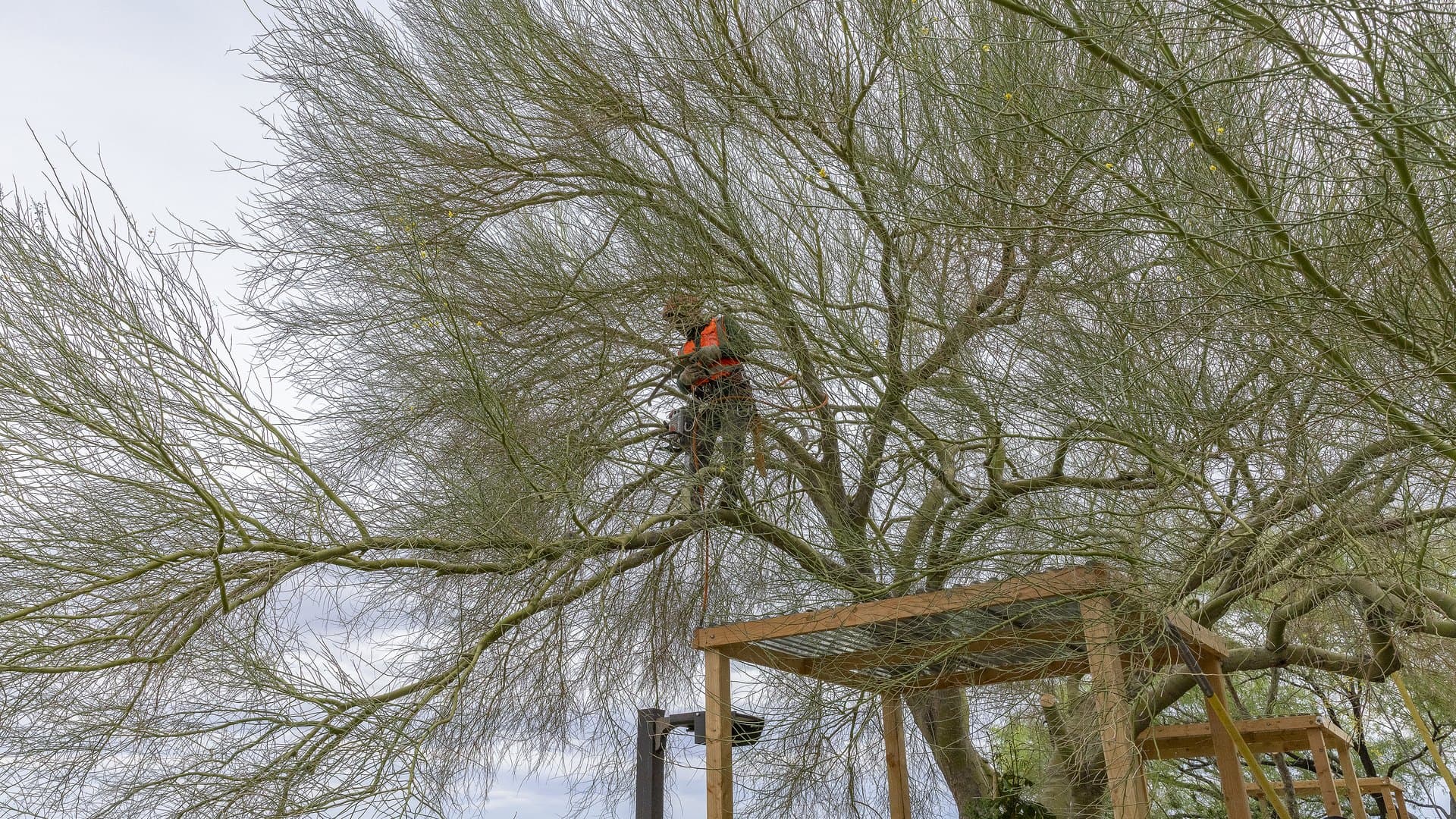
Learn palo verde tree care in Las Vegas, including watering, pruning, monsoon safety, warning signs, and when to call an ISA Certified Arborist.
Palo verde tree care in Las Vegas starts with understanding what makes this desert tree different. Its green bark can photosynthesize, its fine leaves help limit water loss, and its open canopy provides filtered shade without demanding the water of many broadleaf trees. Even so, a palo verde planted in a Las Vegas yard can struggle when irrigation, pruning, soil, or placement does not match the tree's natural growth habits.
Benjamin's Tree Service has served the Las Vegas Valley since 2001. Our licensed and insured team includes an ISA Certified Arborist (ISA Cert. WE-15785A), and our 5-star Google-rated crew works with desert-adapted trees across Clark County. This guide explains practical seasonal care, warning signs, and when a professional assessment makes sense.
Quick Summary
- Water palo verde trees deeply but infrequently, adjusting for tree age, soil drainage, weather, and current watering restrictions
- Keep irrigation away from the trunk and apply it across the active root zone instead of using shallow daily watering
- Prune for structure and clearance with selective cuts; never top a palo verde or strip out the interior canopy
- Inspect after monsoon winds for hanging branches, fresh cracks, a changed lean, or soil movement around the root plate
- Yellow leaves, sparse growth, bark injury, or repeated branch failure call for diagnosis—not automatic fertilizing or aggressive cutting
Table of Contents
- Why palo verde trees fit Las Vegas landscapes
- Watering and root-zone care
- Palo verde pruning and monsoon preparation
- Seasonal care from winter through fall
- Warning signs that need an arborist
- Frequently asked questions
Why Palo Verde Trees Fit Las Vegas Landscapes
Palo verde trees are recognizable by their green trunks and branches, small leaves, delicate branching, and bright yellow spring flowers. Their desert adaptations make them a natural fit for water-conscious landscapes in Las Vegas, Henderson, Summerlin, and North Las Vegas. Once established in an appropriate site, they can provide shade and seasonal color with less irrigation than many high-water trees.
That desert tolerance does not make a palo verde maintenance-free. Nursery trees can arrive with crowded branches, circling roots, or a stake that stays on too long. In residential yards, emitters may be placed beside the trunk and never moved outward as the tree grows. Rock mulch can reflect intense summer heat, while lawns or daily drip cycles may keep the root crown wetter than the species prefers.
The goal is a balanced canopy, sound branch attachments, and roots that can support the tree through heat and wind. A professional tree assessment can distinguish a routine adjustment from a structural or root-zone problem.
Palo Verde Tree Care in Las Vegas Starts With Watering
Watering is one of the most common sources of palo verde trouble. Both chronic drought and chronic overwatering can produce stress, but the symptoms may look similar from the ground. Sparse leaves, yellowing, twig dieback, and weak growth do not tell you to add water automatically. First check where water is applied, how deeply it penetrates, and whether the soil drains between cycles.
Newly planted trees need more frequent monitoring while roots expand into surrounding soil. Established trees generally benefit from deeper, less frequent irrigation. The exact schedule depends on the tree's age, soil, exposure, emitter output, season, and current Southern Nevada Water Authority rules. SNWA's seasonal landscape watering guidance is a useful starting point, but tree irrigation still needs to be matched to the site.
Place water over the root zone rather than against the trunk. As a palo verde grows, move or add emitters farther from the base so moisture encourages roots to expand outward. Avoid a constantly wet collar around the trunk, which can contribute to decay and poor anchorage. A slow application that reaches deeper soil is usually more useful than a brief daily cycle that only wets the surface.
Before increasing irrigation, probe the soil several inches below the surface in more than one location. Desert soil can look dry on top while remaining wet below, particularly near turf, a leaking valve, or compacted caliche. Our guide to watering trees in the Las Vegas desert covers practical checks for overwatering and underwatering.
Mulch, Rock, and the Root Crown
Keep organic mulch broad, shallow, and several inches away from the trunk. Do not mound mulch against green bark or bury the root flare. In rock landscapes, make sure irrigation is not hidden directly against the trunk.
Fertilizer is not a substitute for correct watering or root-zone care. Palo verde trees are adapted to lean desert conditions, and unnecessary fertilizer can push soft growth that needs more water and may respond poorly to wind. If a tree shows nutrient symptoms, soil and irrigation conditions should be reviewed before using deep root feeding or another treatment.
How to Prune a Palo Verde Without Weakening It
Young palo verde trees often develop low branches, multiple stems, and a naturally open form. Good pruning guides that structure gradually. It does not attempt to turn the tree into a dense, perfectly rounded canopy in one visit.
Selective cuts may remove dead, damaged, crossing, or poorly attached branches while preserving enough live canopy for shade and photosynthesis. Clearance pruning can address a walkway, roof, wall, driveway, or sightline without stripping unrelated branches. The International Society of Arboriculture's tree-pruning guidance explains why cut placement and branch selection matter.
Avoid topping, lion-tailing, and excessive crown raising. Topping leaves large wounds and can trigger crowded regrowth. Lion-tailing removes interior branches while leaving foliage at the tips, which can place more leverage on long limbs. Raising the canopy too quickly can leave a young trunk exposed and shift too much weight upward. Our article on why tree topping hurts Las Vegas trees shows why severe size reduction is not a shortcut to a safer tree.
For larger cuts or work above the ground, use professional trimming and pruning. Palo verde branches can be thorny, tangled, and difficult to control. Homeowners should not climb the tree or use a chainsaw, ladder, or pole saw where a branch could strike a person, structure, or utility line.
Prepare Palo Verde Trees for Monsoon Winds
Las Vegas monsoon storms can bring sudden gusts, dust, and heavy rain. A palo verde with overextended branches, weak unions, prior topping cuts, or restricted roots may be more vulnerable when wind loads the canopy. Preparation should focus on defects and targets, not on removing as much foliage as possible.
Before storm season, look from the ground for dead branches, cracks where limbs join, rubbing branches, an unbalanced canopy, and limbs over roofs, pools, walls, or parked vehicles. Check whether recent construction, trenching, or hardscape work disturbed roots. If the tree has changed since your last inspection, schedule an assessment before the next wind event.
After a storm, keep people and vehicles away from hanging limbs or a tree with a changed lean. Fresh soil lifting on one side of the trunk, exposed roots, a split union, or a large suspended branch can indicate an active hazard. Review our Las Vegas monsoon tree inspection guide, and call emergency tree service when failure may be underway.
Seasonal Palo Verde Care Calendar
Winter: Inspect Structure and Irrigation
Cooler weather makes it easier to see branch structure and review the tree without summer heat. Check irrigation components for leaks or clogged emitters, and confirm that water is reaching the expanding root zone. Winter can also be a useful time for an arborist to identify crossing branches, prior damage, or gradual structural work for a young tree.
Do not assume every leaf drop or sparse period means the tree is dying. Palo verde foliage responds to temperature and moisture conditions, and the green bark continues to contribute energy. Evaluate the whole pattern: twig flexibility, buds, bark condition, branch dieback, and recent irrigation history.
Spring: Watch Flowering and New Growth
As growth resumes, inspect for dead twigs, branches rubbing against structures, and crowded shoots near old cuts. Check that stakes and ties are not girdling the trunk.
Spring is also a good time to verify that emitters have moved outward with the root zone. The University of Nevada, Reno Extension's horticulture resources provide research-based Nevada landscape guidance that can supplement a tree-specific plan.
Summer: Protect Roots and Avoid Stressful Over-Pruning
During extreme heat, monitor soil moisture rather than watering by appearance alone. Inspect for irrigation failures, broken emitters, and water pooling at the trunk. Avoid removing a large portion of live canopy during the hottest weather unless urgent damage makes the work necessary. The remaining foliage and branches help shade the tree and root zone.
If branch failure, a split, or storm damage creates an immediate risk, safety comes first. Keep clear and let a qualified crew evaluate the work. Routine cosmetic pruning can wait for a more appropriate window.
Fall: Review Recovery and Plan Ahead
After summer and monsoon conditions, look for delayed dieback, sun injury, fresh cracks, or shifted branches. Fall is a practical time to plan staged pruning or root-zone corrections.
Warning Signs a Palo Verde Needs Professional Attention
Schedule an assessment when you notice one or more of these changes:
- A sudden or increasing lean, especially with lifted or cracked soil near the trunk
- Large dead branches, hanging limbs, or repeated breakage after wind
- A new trunk or branch-union crack, cavity, or area of soft, decayed wood
- Bark damage around the base, persistent moisture at the trunk, or mushrooms near the root crown
- Canopy thinning or dieback that continues despite a verified irrigation correction
- Roots cut by construction, trenching, a new wall, pool work, or hardscape installation
- Branches contacting a roof, street, power line, pool area, or neighboring property
The right recommendation may be monitoring, selective pruning, irrigation correction, or a staged care plan. Removal is appropriate when defects, location, and nearby targets make the risk unreasonable, but it should follow a tree-specific evaluation rather than a single symptom.
Frequently Asked Questions
How often should I water a palo verde tree in Las Vegas?
There is no safe one-size-fits-all interval. A new tree, an established tree, caliche soil, sandy fill, turf-adjacent roots, and a drip-only landscape all behave differently. Water deeply enough to reach the active root zone, allow soil to drain, follow current SNWA restrictions, and adjust based on soil checks rather than a fixed daily habit.
When should a palo verde be pruned?
Timing depends on the goal and the tree's condition. Structural and clearance needs can often be planned outside the most stressful heat, while dead, split, or hanging branches may require prompt work. An arborist can select the smallest effective cuts and avoid removing too much live canopy at once.
Why is my palo verde dropping leaves?
Leaf drop can be a response to heat, cold, drought, transplant stress, or changing moisture. It can also accompany root or branch problems. Check recent watering, soil moisture, bark, twig condition, and whether dieback is spreading before deciding on a treatment.
Can I top a palo verde to keep it small?
No. Topping creates large wounds, removes useful canopy, and can lead to crowded regrowth. If the tree is too large for its space, an arborist should evaluate selective reduction, clearance pruning, long-term management, or replacement with a better-suited tree.
Do palo verde trees need fertilizer?
Not routinely. Correct planting depth, drainage, irrigation, and root-zone care should be checked first. Fertilizer without a diagnosis can create unnecessary growth and will not correct decay, root damage, poor structure, or overwatering.
Schedule Palo Verde Tree Care in Las Vegas
A palo verde can be a durable, attractive part of a Southern Nevada landscape when its roots, irrigation, and branch structure are managed for desert conditions. Benjamin's Tree Service provides tree assessments, pruning, storm response, and long-term care for homes, HOAs, and commercial properties throughout Las Vegas, Henderson, Summerlin, North Las Vegas, and Clark County.
Call 725-227-6160 or request a free tree-care estimate. Our ISA Certified Arborist can inspect your palo verde, explain what is happening, and recommend the least disruptive practical next step.
Benjamin's Tree Service
ISA Certified Arborists serving Las Vegas & the surrounding areas since 2001.
Related Reading
Tree Care Tips
Common Tree Pests in Las Vegas: A Homeowner's Guide
Aphids, spider mites, and palo verde root borers are common tree pests in Las Vegas. Learn the warni…
10 min read
Tree Care Tips
Deep Root Feeding for Las Vegas Trees: A Complete Guide
Learn how deep root feeding helps Las Vegas trees overcome caliche soil, extreme heat, and drought. …
8 min read
Tree Care Tips
How to Mulch Trees the Right Way in Las Vegas
Learn the right way to mulch trees in the Las Vegas heat, plus the two mistakes — rock beds and mulc…
6 min read