
Not sure when to plant a tree in Las Vegas? Our ISA-certified arborists explain the best seasons for Clark County trees — fall, late winter, and what to avoid.
Quick Summary
- Fall (October–November) is the single best planting window in Las Vegas — warm soil, cooling air, low heat stress.
- Late winter (February–March) is the second-best window, before summer heat arrives.
- Avoid planting during June–September: extreme heat causes transplant shock and requires intensive irrigation.
- Clark County's USDA Zone 9b/10a climate favors desert-adapted species: Palo Verde, Mesquite, Desert Willow, Shoestring Acacia.
- ISA Certified Arborist WE-15785A | Licensed & Insured | Serving Las Vegas since 2001 | (725) 227-6160
---
When clients in Henderson, Summerlin, and North Las Vegas ask our arborists at Benjamin's Tree Service about planting a new tree, one question comes up more than any other: *"When should I do it?"*
Timing matters more in the Mojave Desert than almost anywhere else in the country. Plant at the wrong time of year and you're fighting triple-digit heat, rock-hard caliche soil, and relentless evaporation — all during the critical first months when a tree is most vulnerable. Plant at the right time and the same tree will establish itself with far less stress, far less water, and a much higher survival rate.
Here's what our ISA-certified team has learned from over two decades of tree planting and care across Clark County.
Table of Contents
1. Why Timing Is Everything in Las Vegas
2. The Best Season to Plant: Fall (October–November)
3. Second-Best Window: Late Winter (February–March)
4. When NOT to Plant: Summer Months
5. Spring Planting: Possible, But Narrow
6. Best Trees to Plant in Las Vegas by Season
7. Planting Tips for Clark County Soil
8. FAQs
---
Why Timing Is Everything in Las Vegas {#timing}
Las Vegas sits in USDA Hardiness Zones 9b and 10a — among the hottest in the continental United States. Summer temperatures routinely exceed 110°F, and the soil can reach temperatures that actively cook root systems in newly planted trees.
But here's the critical insight: a tree's roots grow even when the air temperature drops. In fall and late winter, soil temperatures in Clark County remain warm enough for root development (above 45°F) while air temperatures cool down. That combination — warm soil, cool air — is exactly what a newly transplanted tree needs to establish its root system before facing the demands of a Las Vegas summer.
The Nevada Division of Forestry recommends fall as the optimal planting period for most trees in southern Nevada — and our field experience at Benjamin's Tree Service confirms this completely.
The Best Season to Plant: Fall (October–November) {#fall}
October and November are the single best months to plant trees in Las Vegas.
Here's why:
- Soil is still warm from summer — roots keep growing through November and into December, building the foundation the tree needs
- Air temperatures are manageable — daytime highs in the 70s and 80s instead of 110°F
- Reduced evaporation — newly planted trees lose far less moisture through their leaves
- Lower irrigation demand — you can establish a tree with significantly less water than a summer planting requires
- Full winter and spring to establish — by the time the following June arrives, the root system has 6–8 months of growth behind it
For homeowners in Summerlin, Henderson, and the master-planned communities along the 215 Beltway, fall is also the most practical planting window — mild weekend temperatures make planting far more comfortable for everyone involved.
Our team plants throughout October and November across Clark County. If you're planning to add a shade tree, fruit tree, or privacy screen to your Las Vegas property, fall is when we'd recommend scheduling it.
---
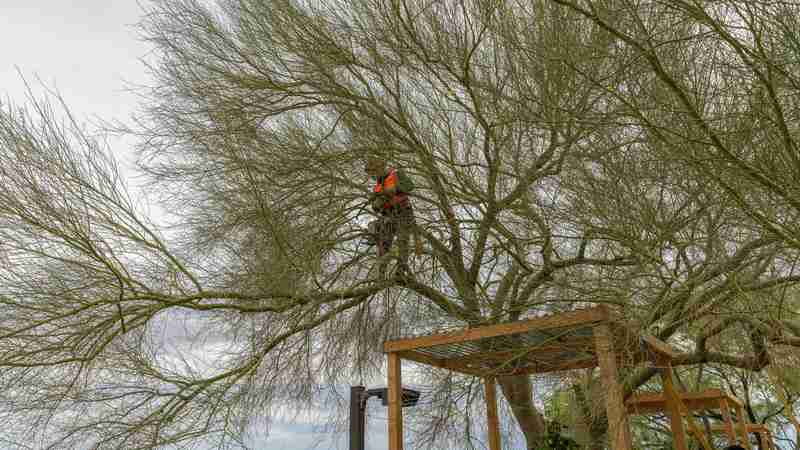
*Benjamin's Tree Service arborists bring 25+ years of Las Vegas and Clark County experience to every planting and tree care project.*
---
Second-Best Window: Late Winter (February–March) {#winter}
If you miss the fall planting window, February and March offer the next best opportunity.
In late winter, soil temperatures in Las Vegas begin rising again after the coolest months of January. This warming soil — combined with moderate air temperatures before summer heat arrives — gives newly planted trees a solid 10–12 weeks to establish roots before June.
Late winter is also when most nurseries replenish their stock with fresh, healthy specimens. You'll often find a better selection of native and adapted species in February than at any other time of year.
What to watch for: Clark County can see late freezes in January and occasionally into February. For frost-sensitive species (Bougainvillea, Palo Verde, certain palms), wait until after the last expected frost date — typically mid-February in the Las Vegas valley.
When NOT to Plant: Summer Months {#avoid-summer}
Planting trees during June, July, and August in Las Vegas is almost always a mistake.
Here's what happens when you plant during peak summer:
- Transplant shock is severe — the tree is losing water through its leaves faster than a compromised root system can absorb it
- Daily irrigation requirements spike — a newly planted tree in July may need watering every single day, sometimes twice
- Root establishment slows — when soil temperatures exceed 90°F at the root zone, root growth stops
- Mortality rates climb — even healthy, properly planted trees often fail to establish during Las Vegas summers
The only exception: established container trees (10+ gallon containers, well-rooted) planted in a heavily irrigated site with shade protection and daily monitoring. Even then, summer planting is a risk, not a recommendation.
If you've purchased a tree and can't plant it yet, keep it in its container in a shaded location, water it regularly, and wait for fall.
Spring Planting: Possible, But Narrow {#spring}
Spring planting (April–May) can work in Las Vegas — but the window is narrow.
April is generally safe, with manageable temperatures and warming soil. May becomes riskier as heat starts building, particularly after mid-month. By Memorial Day weekend, daytime highs are often in the mid-90s and climbing — approaching the threshold where transplant stress becomes significant.
If you're planting in spring, aim for April and choose drought-adapted native species over thirsty ornamentals. Ensure you have drip irrigation in place before planting, not after.
---
*Proper planting depth, watering basin, and mulching are critical for tree survival in Clark County's desert soil.*
---
Best Trees to Plant in Las Vegas by Season {#tree-species}
Different species have different establishment needs. Here's a quick guide:
Best for Fall Planting (October–November)
- Desert Willow (*Chilopsis linearis*) — fast-growing, beautiful blooms, extremely drought tolerant
- Blue Palo Verde (*Parkinsonia florida*) — iconic desert tree, minimal water once established
- Velvet Mesquite (*Prosopis velutina*) — excellent shade, deep roots, Clark County native
- Arizona Ash — fast shade, deciduous, needs slightly more water than natives
Best for Late Winter Planting (February–March)
- Shoestring Acacia (*Acacia stenophylla*) — elegant weeping form, fast grower, very drought tolerant
- African Sumac — dense shade, evergreen, one of the most popular street trees in Henderson and North Las Vegas
- Desert Museum Palo Verde (hybrid) — seedless, thornless, prolific bloomer — arguably the single best shade tree for Las Vegas
Trees That Tolerate Spring Planting (April)
- Thornless Honey Locust — excellent for larger lots in Summerlin
- Chinese Pistache — stunning fall color, extremely heat tolerant once established
Trees to Avoid in Las Vegas (regardless of season)
- Bradford Pear — brittle wood, short lifespan, invasive in some regions
- Non-native willows (weeping willow) — require enormous amounts of water and struggle in alkaline soil
- Red Maple — poor performer in high-pH desert soil
Planting Tips for Clark County Soil {#soil-tips}
Las Vegas soil is notorious — alkaline pH (7.5–8.5 is common), compacted caliche layers, low organic matter, and rapid drainage in some areas and poor drainage in others.
A few critical steps for successful planting:
1. Dig the hole wide, not deep — 2–3x the width of the root ball, same depth. Planting too deep is the #1 cause of young tree failure.
2. Break up caliche — if you hit a hard white layer (caliche), break through it with a rebar or breaker bar to allow drainage. Roots cannot penetrate intact caliche.
3. Build a watering basin — create a 3–4 inch raised ring around the drip line to concentrate irrigation water at the root zone. Ask about our deep root feeding service to give newly planted trees a nutritional head start.
4. Mulch 3–4 inches deep — keep mulch away from the trunk. Mulch conserves soil moisture and moderates temperature, critical in Las Vegas heat.
5. Water deeply, not frequently — after establishment, deep watering (18–24 inches) every 1–2 weeks is better than daily shallow watering.
Our team is ISA Certified (Certification WE-15785A), licensed, and insured. We've been planting and caring for trees across Las Vegas, Henderson, Summerlin, and Clark County since 2001. Explore our tree care services or contact us to get the right tree in the ground at the right time.
For a deeper look at related topics, read our guides on Best Trees to Plant in Las Vegas for Shade and Privacy and 4 Popular Trees to Plant in Las Vegas. For an independent walkthrough of proper technique, see the ISA's guide to planting a tree.
FAQs {#faqs}
When is the best time to plant a tree in Las Vegas?
October and November. Fall planting allows root establishment during warm soil temperatures before summer heat stress arrives. February–March is the second-best window.
Can you plant trees in summer in Las Vegas?
We strongly advise against it. Summer planting in Las Vegas leads to high transplant shock, extreme irrigation demands, and high failure rates. Wait for fall if at all possible.
How long does it take a newly planted tree to establish in Las Vegas?
Most trees need 1–2 years to fully establish a root system capable of supporting the canopy without supplemental irrigation. Desert-adapted natives establish faster than thirsty ornamentals.
Do I need a permit to plant a tree in Las Vegas?
Generally, no permit is required to plant a tree on private property in Clark County. However, planting in a right-of-way (between the sidewalk and street) may require approval from your city or HOA. Check with Clark County or your municipality if planting near a road.
What's the best shade tree for Las Vegas?
For low water use, fast growth, and heat tolerance, Desert Museum Palo Verde is hard to beat. African Sumac is excellent for dense, year-round shade. Our arborists can recommend the best option for your specific site and goals — call us at (725) 227-6160.
---
*Benjamin's Tree Service has been serving Las Vegas, Henderson, Summerlin, and North Las Vegas since 2001. ISA Certified Arborist WE-15785A. Licensed and insured. 5-star Google rated.*
Ready to plant the right tree at the right time? Call us at (725) 227-6160 or request a consultation. We also offer tree trimming & pruning and stump grinding across Clark County.
Benjamin's Tree Service
ISA Certified Arborists serving Las Vegas & the surrounding areas since 2001.
Related Reading
Tree Planting
How Deep to Plant a Tree in Caliche Soil (Clark County Guide)
Learn how deep to plant trees in Clark County caliche soil. Step-by-step guide from ISA-certified ar…
8 min read
Tree Planting
Best Trees to Plant in Las Vegas for Shade and Privacy
Discover the best shade and privacy trees for Las Vegas yards. Expert picks from ISA Certified Arbor…
9 min read
Tree Planting
Why Fall Is a Great Time to Plant Trees
See why fall is ideal for planting trees in Las Vegas, with proven steps to establish roots before p…
2 min read