
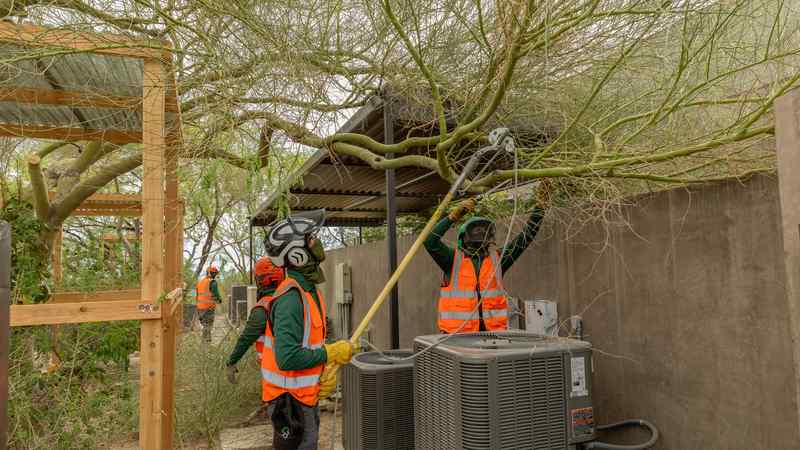
Discover the best shade and privacy trees for Las Vegas yards. Expert picks from ISA Certified Arborists for heat-tolerant, low-water species.
Choosing the right tree for your Las Vegas property is one of the smartest landscaping decisions you can make. The right shade tree can lower your summer cooling costs by up to 25 percent, add thousands of dollars to your home value, and turn a sun-blasted yard into a comfortable outdoor living space. The right privacy tree can screen out neighbors, reduce road noise, and create a genuine sense of retreat — even in the middle of the valley.
But the desert is unforgiving. Plant the wrong species and you will spend years nursing a struggling tree that drains your water bill or drops dead after its first 115°F July. Las Vegas receives under five inches of rainfall a year and sits atop caliche — a calcium-carbonate hardpan that can block root growth entirely if you do not plan for it.
At Benjamin's Tree Service, our ISA Certified Arborists (ISA Cert. WE-15785A) have been helping Las Vegas homeowners select, plant, and care for trees since 2001. Below we share the species we recommend most often for shade and privacy in Clark County, along with the planting and care tips that help them thrive.
> Quick Summary
> - Desert-adapted species like mesquite, palo verde, and desert willow deliver shade with minimal water
> - For fast privacy, consider evergreen options like Italian cypress, Arizona cypress, or oleander trees
> - Always amend caliche soil at planting time — drill through hardpan or create a wide planting basin
> - The best planting window in Las Vegas is October through March when temperatures are mild
> - Proper staking, mulching, and deep watering in the first two years determine long-term success
Top Shade Trees for Las Vegas Yards
Chilean Mesquite (*Prosopis chilensis*)
The Chilean mesquite is arguably the most popular shade tree in the Las Vegas Valley — and for good reason. It grows quickly, tolerates extreme heat, requires moderate water once established, and develops a broad, graceful canopy that can span 30 to 40 feet at maturity.
Why we recommend it: Mesquites are thoroughly desert-adapted. They have deep taproots that seek moisture far below the surface, and their feathery foliage filters light beautifully without creating dense shade that kills grass underneath. You will find them lining streets in Summerlin, shading patios in Henderson, and providing relief in backyards across North Las Vegas.
What to watch for: Mesquites grow fast, which means they benefit from regular structural pruning in the first five to ten years. Without it, branches can develop narrow attachment angles that split in monsoon winds. Our arborists see preventable storm damage on mesquites every year.
Museum Palo Verde (*Parkinsonia × 'Desert Museum'*)
The Desert Museum palo verde is a hybrid that combines the best traits of three native palo verde species. It is thornless, produces stunning yellow blooms in spring, and has a clean growth habit that requires less maintenance than its wild cousins.
Why we recommend it: This tree is tailor-made for southern Nevada. It uses very little water once established, tolerates full sun and reflected heat, and provides filtered shade with its open canopy. It matures at 20 to 25 feet tall and wide — ideal for residential lots in Spring Valley, Enterprise, and Paradise.
What to watch for: Palo verdes have green bark that photosynthesize, which means excessive trimming that exposes the trunk to intense afternoon sun can cause bark damage. Light, periodic pruning is the correct approach.
Chinese Pistache (*Pistacia chinensis*)
If you want fall color in Las Vegas — and yes, we do get fall color — the Chinese pistache delivers reliably. This deciduous tree turns brilliant shades of orange and red in November and provides dense, round-canopied shade the rest of the year.
Why we recommend it: Chinese pistache tolerates heat, alkaline soil, and moderate drought once established. It grows 30 to 40 feet tall with a symmetrical canopy that makes it an excellent street tree or front yard specimen. You will see them in many Green Valley and Anthem neighborhoods.
What to watch for: Plant female trees if you want the showy red berry clusters; plant male trees if you prefer a cleaner canopy. This species benefits from early structural pruning to develop a strong central leader.
Tipu Tree (*Tipuana tipu*)
The tipu tree is a semi-evergreen species that grows fast and creates a massive, spreading canopy — sometimes reaching 40 to 50 feet wide. It produces yellow flowers in late spring and provides heavy shade.
Why we recommend it: Homeowners in Las Vegas who want maximum shade coverage in minimum time often choose tipu trees. They perform well in the heat and create truly park-like shade for large backyards, commercial properties, and multi-family housing throughout Clark County.
What to watch for: Tipu trees need space. Do not plant one within 15 feet of a structure, pool, or hardscape. They also produce seed pods that require seasonal cleanup. Regular trimming keeps the canopy manageable and reduces wind resistance during monsoon season.
Top Privacy Trees for Las Vegas Properties
Italian Cypress (*Cupressus sempervirens*)
The classic columnar silhouette of the Italian cypress is instantly recognizable. These narrow evergreens grow 40 to 60 feet tall but only 3 to 5 feet wide, making them perfect for tight property lines.
Why we recommend it: Italian cypress creates a formal privacy screen without taking up lateral space. Plant them 4 to 6 feet apart along a fence line in Henderson, Summerlin, or Centennial Hills, and within a few years you have a living wall that blocks sightlines year-round.
What to watch for: Italian cypress are susceptible to spider mites in the dry Las Vegas air. Occasional deep watering and monitoring for browning interior foliage keeps them healthy. They rarely need pruning beyond removing occasional dead branches.
Arizona Cypress (*Cupressus arizonica*)
If you want a broader, more natural-looking evergreen screen, Arizona cypress is an excellent choice. It has blue-green foliage, grows 30 to 40 feet tall, and develops a conical shape that provides both visual screening and wind protection.
Why we recommend it: This species is native to the desert Southwest and handles Las Vegas conditions with ease — heat, alkaline soil, low humidity. It grows moderately fast and makes a beautiful backdrop along the north or west edge of a property.
What to watch for: Give Arizona cypress enough space. They can spread 15 to 20 feet wide at maturity, so plant them at least 10 feet from structures and fences.
Oleander (*Nerium oleander*) — Tree Form
While oleander is usually grown as a large shrub, tree-form oleanders trained to a single trunk can reach 15 to 20 feet and create effective mid-height screening. They are extremely heat tolerant and bloom prolifically from spring through fall.
Why we recommend it: Oleander is one of the most drought-tolerant flowering options in Las Vegas. It thrives on neglect once established, making it ideal for low-maintenance landscapes. You see oleanders used extensively along highways and in commercial landscapes throughout the valley.
What to watch for: All parts of the oleander are toxic if ingested, so it is not recommended for yards where young children or pets have unsupervised access. Also be aware of oleander leaf scorch, a bacterial disease spread by sharpshooter insects — watch for browning leaf margins.
Planting Tips for Las Vegas Success
Choosing the right species is only half the equation. How and when you plant determines whether your tree thrives or merely survives.
Deal with Caliche First
Across much of Clark County — from Boulder City to Nellis — you will hit caliche within 6 to 18 inches of the surface. This rock-hard layer prevents water drainage and root penetration. Before planting:
- Dig the hole at least twice the width of the root ball
- If you hit caliche, drill through it or use a jackhammer to break through
- Create drainage channels so water does not pool around roots
- Backfill with a mix of native soil and organic compost — avoid pure potting soil, which creates a "bathtub effect"
Plant During the Cool Season
The best planting window in Las Vegas is October through March. Trees planted in fall have the entire cool season to establish roots before facing summer heat. Planting in June, July, or August puts tremendous stress on a new tree and increases the risk of transplant shock.
Water Deeply, Not Frequently
New trees in Las Vegas need deep watering — soaking the root zone to a depth of 18 to 24 inches — rather than frequent shallow sprinkles. During the first two years:
- Cool season (Oct–Mar): Water deeply every 10 to 14 days
- Spring/Fall (Apr–May, Sep): Water deeply every 7 to 10 days
- Summer (Jun–Aug): Water deeply every 5 to 7 days
Once established (after 2 to 3 years), most desert-adapted trees can go much longer between waterings. Non-native species like Chinese pistache and tipu will always need supplemental irrigation.
Stake Properly — Then Remove Stakes
Staking keeps a new tree upright while roots establish, but leaving stakes too long prevents the trunk from developing taper and strength. Stake new trees for 6 to 12 months, then remove the stakes. If the tree cannot stand on its own after a year, there may be a deeper issue — contact an arborist for a tree assessment.
Mulch the Base
Apply 3 to 4 inches of organic mulch in a ring around the base of the tree, keeping mulch 6 inches away from the trunk. Mulch reduces soil temperature, retains moisture, and discourages weeds. In the Las Vegas heat, mulch can lower root-zone temperatures by 10 to 15 degrees.
Trees to Avoid in Las Vegas
Not every tree belongs in the desert. Silver maples have weak wood and poor heat tolerance. Weeping willows require far more water than Las Vegas can sustainably provide. Bradford pears split easily in wind and are discouraged in many communities. If you have inherited a struggling tree, our team can evaluate whether to invest in rehabilitation or consider removal and replacement with a better-adapted species.
Frequently Asked Questions
How fast do shade trees grow in Las Vegas?
Growth rates vary by species. Chilean mesquite can add 3 to 5 feet per year with adequate water. Chinese pistache and palo verde grow more moderately at 1 to 2 feet per year. Fast growth often comes with tradeoffs like weaker wood, so balance speed with long-term performance.
Can I plant a tree near my pool in Las Vegas?
Yes, but choose carefully. Avoid trees with aggressive roots or heavy leaf drop (mulberry, tipu). Desert Museum palo verde and Chinese pistache are cleaner options that provide shade without excessive pool maintenance. Plant at least 10 feet from the pool edge.
How many trees should I plant for privacy screening?
For columnar trees like Italian cypress, plant every 4 to 6 feet for a solid screen. For broader species like Arizona cypress, space them 10 to 12 feet apart. A mix of heights and species creates a more natural look and reduces risk if one species is affected by disease.
Do I need a permit to plant a tree in Las Vegas?
No permit is required to plant trees on private residential property in Las Vegas or Clark County. However, HOA communities may restrict species, height, and placement — check your CC&Rs before planting.
For a deeper look at related topics, read our guides on When Is the Best Time to Plant a Tree in Las Vegas? and 4 Popular Trees to Plant in Las Vegas. For an independent walkthrough of proper technique, see the ISA's guide to planting a tree.
Let Our Arborists Help You Choose
Selecting the right tree for your property — considering sun exposure, soil, space, and your goals — is something our team does every day. Benjamin's Tree Service is 5-star rated on Google, fully licensed and insured in Nevada, and has been serving the Las Vegas Valley since 2001.
Whether you need help choosing species, planting new trees, or developing a long-term tree service plan for your property, our ISA Certified Arborists are ready to help.
Call us at 725-227-6160 or visit [benjaminstreeservice.com/contact](/contact) to schedule your free consultation today.
Benjamin's Tree Service
ISA Certified Arborists serving Las Vegas & the surrounding areas since 2001.
Related Reading
Tree Planting
How Deep to Plant a Tree in Caliche Soil (Clark County Guide)
Learn how deep to plant trees in Clark County caliche soil. Step-by-step guide from ISA-certified ar…
8 min read
Tree Planting
When Is the Best Time to Plant a Tree in Las Vegas?
Not sure when to plant a tree in Las Vegas? Our ISA-certified arborists explain the best seasons for…
9 min read
Tree Planting
Why Fall Is a Great Time to Plant Trees
See why fall is ideal for planting trees in Las Vegas, with proven steps to establish roots before p…
2 min read