
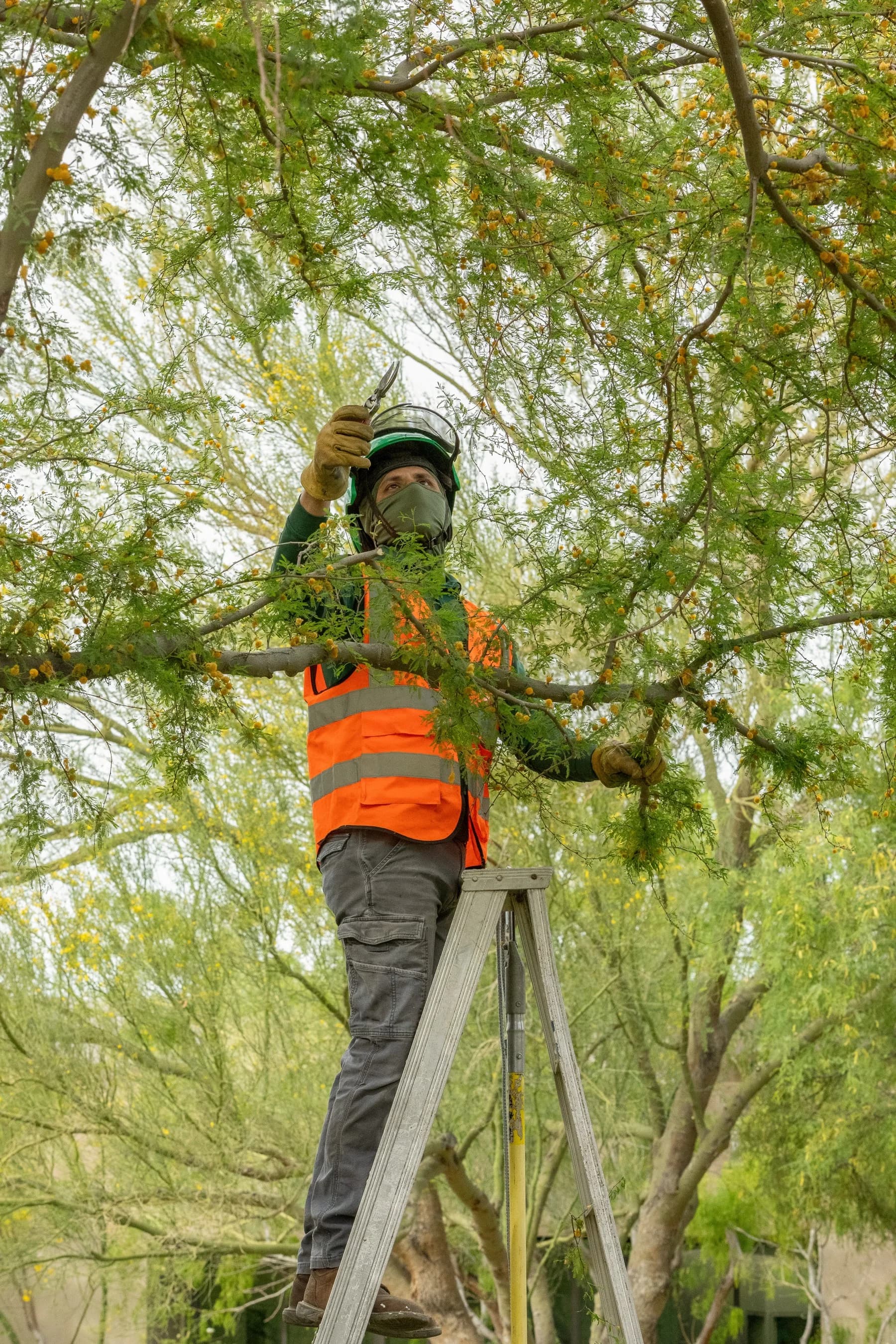
A July monsoon toppled a 40-foot African sumac onto a Summerlin home during a late-night storm. Here is how Benjamin's Tree Service responded within hours to secure the property and remove the tree safely.
At 11:40 p.m. on a Tuesday night in July, a homeowner in Summerlin South heard a sound she described as "a freight train hitting the house." A 40-foot African sumac in the front yard had uprooted during a monsoon microburst and fallen directly onto the roof, crushing a section of the front porch overhang and pinning a vehicle in the driveway.
No one was injured. The homeowner called Benjamin's Tree Service at 11:55 p.m.
The Situation at Arrival
Our emergency crew reached the property at 1:20 a.m. — roughly 90 minutes after the call. The monsoon cell had moved east, but residual wind gusts of 25 to 30 mph were still blowing through the neighborhood. Here is what we found:
- The African sumac had uprooted completely, pulling a root plate approximately six feet in diameter out of the ground
- The main trunk was resting on the roof over the front entryway. The porch overhang had partially collapsed under the weight, but the main roof structure appeared to be holding
- A large scaffold branch had landed on the homeowner's SUV, shattering the windshield and denting the roof and hood
- The tree's canopy extended across the entire front yard and into the street, blocking the sidewalk and partially blocking the residential lane
- A landscape irrigation line had been torn from the ground when the root plate lifted, sending water across the yard
The first priority was safety assessment. Our crew leader verified that no power lines were involved — the nearest utility line was on the opposite side of the street. He confirmed the roof was not at immediate risk of further collapse, though he recommended that the homeowner stay out of the front rooms until a structural inspection could be done in daylight.
Why This Tree Failed
African sumac is one of the most common shade trees in Las Vegas residential landscapes. It grows fast, develops a broad canopy, and tolerates the heat. But it also has characteristics that make it vulnerable to wind failure:
- Shallow, spreading root system — African sumac roots tend to stay in the upper 18 inches of soil. In Summerlin's rocky, caliche-underlain soil, roots often grow even shallower because they cannot penetrate the hardpan layer
- Dense canopy with high wind load — the broad leaf structure catches wind like a parachute. Without regular thinning, the canopy becomes a massive sail that puts enormous leverage on the root system
- Rapid growth outpacing root development — fast-growing trees often develop canopies that are disproportionately large relative to the root system supporting them
This particular tree had not been professionally pruned in at least four years, based on the homeowner's account. The canopy was extremely dense with no crown thinning, and several large branches had grown well beyond the drip line without reduction. The monsoon winds — estimated at 65 to 75 mph based on nearby weather station data — found the weakest link: the shallow root system in wet soil.
The Emergency Response
Phase 1 — Securing the Scene (1:20 to 2:00 a.m.)
Before any cutting began, the crew set up work lights and established a safety perimeter with cones and caution tape. The street was partially blocked, so we notified Metro dispatch to route any emergency vehicles around the area. The irrigation leak was capped at the valve box.
Phase 2 — Vehicle Extraction (2:00 to 3:15 a.m.)
The homeowner needed the SUV moved before morning. The branch resting on the vehicle was roughly 10 inches in diameter and supported by the canopy structure around it. Cutting it required precision — if the wrong supporting branch was cut first, the weight could shift and cause the trunk on the roof to roll.
Our climber used a combination of speed line and tag line rigging to control the branch as it was cut. Two sections were removed to free the vehicle, which was then moved to the street by the homeowner. The vehicle sustained significant damage but was drivable.
Phase 3 — Roof Clearing (3:15 to 6:00 a.m.)
Removing the trunk from the roof was the most critical phase. The main trunk section resting on the structure was approximately 18 inches in diameter and weighed an estimated 1,500 pounds. The porch overhang had partially failed, which meant the trunk was now resting on a compromised structure — any additional force during removal could cause further collapse.
The crew approached this in stages:
1. All branches extending from the trunk section on the roof were removed first, reducing the total weight and eliminating any lever arms that could cause the trunk to shift
2. A support crib was built under the trunk section using 6x6 timbers, transferring weight off the damaged roof structure to the crib
3. The trunk was cut into three manageable sections. Each section was rigged with a lowering line, cut with a controlled notch, and lowered to the ground
By 6:00 a.m., the roof was clear. The damaged porch overhang was exposed but stable. No additional structural damage occurred during the removal.
Phase 4 — Yard Cleanup and Root Plate (Morning)
With the emergency hazard resolved, a day crew returned at 8:00 a.m. to complete the cleanup:
- The remaining canopy and trunk sections in the yard were cut, chipped, and hauled away
- The root plate — a six-foot-diameter mass of roots and soil — was cut down with a chainsaw and removed in sections
- The hole left by the root plate was backfilled with clean fill material and compacted
- The street and sidewalk were swept clean
- Total debris removed: approximately 4 tons
The Outcome
The homeowner was able to file her insurance claim that morning with full documentation: our time-stamped photos from arrival and each phase, a detailed scope of work, and an itemized invoice. The insurance company approved the claim within a week.
Within a month, the homeowner had the porch overhang repaired, installed a new desert landscape in the front yard, and planted two smaller desert willow trees — a species with a more open canopy structure and deeper root system that is far better suited to withstand monsoon conditions.
What This Case Study Teaches
Canopy maintenance prevents catastrophic failure
If this tree had been crown-thinned on a regular schedule — every 12 to 18 months — the wind load on the canopy would have been dramatically reduced. Crown thinning alone may have prevented the uprooting entirely.
Soil saturation is the hidden trigger
Las Vegas soil drains poorly in many areas. When a monsoon drops an inch of rain in 20 minutes on top of caliche-underlain soil, the water pools around root zones and turns the top layer into mud. Trees that handle 70 mph gusts in dry soil can topple in 50 mph gusts in saturated soil.
Emergency response starts with documentation
The homeowner's insurance claim went smoothly because everything was documented from the first hour. Time-stamped photos, a professional scope of work, and an itemized invoice made the process straightforward.
Species selection matters
African sumac is a popular tree for Las Vegas, but it needs regular maintenance and is not ideal for every location. Trees planted close to homes in areas with shallow soil and monsoon exposure should be species with deeper root systems and more open canopy structures.
Schedule a Pre-Monsoon Assessment
Do not wait for a storm to find out if your trees are prepared. Benjamin's Tree Service provides comprehensive pre-monsoon tree assessments across the entire Las Vegas Valley — Summerlin, Henderson, North Las Vegas, Paradise, Spring Valley, Enterprise, and all surrounding communities. Our ISA Certified Arborists will evaluate your trees for structural weaknesses, canopy density, root system health, and species-specific risk factors. Call 725-300-0399 for a Free Tree Inspection.
Benjamin's Tree Service
ISA Certified Arborists serving Las Vegas & the surrounding areas since 2001.