
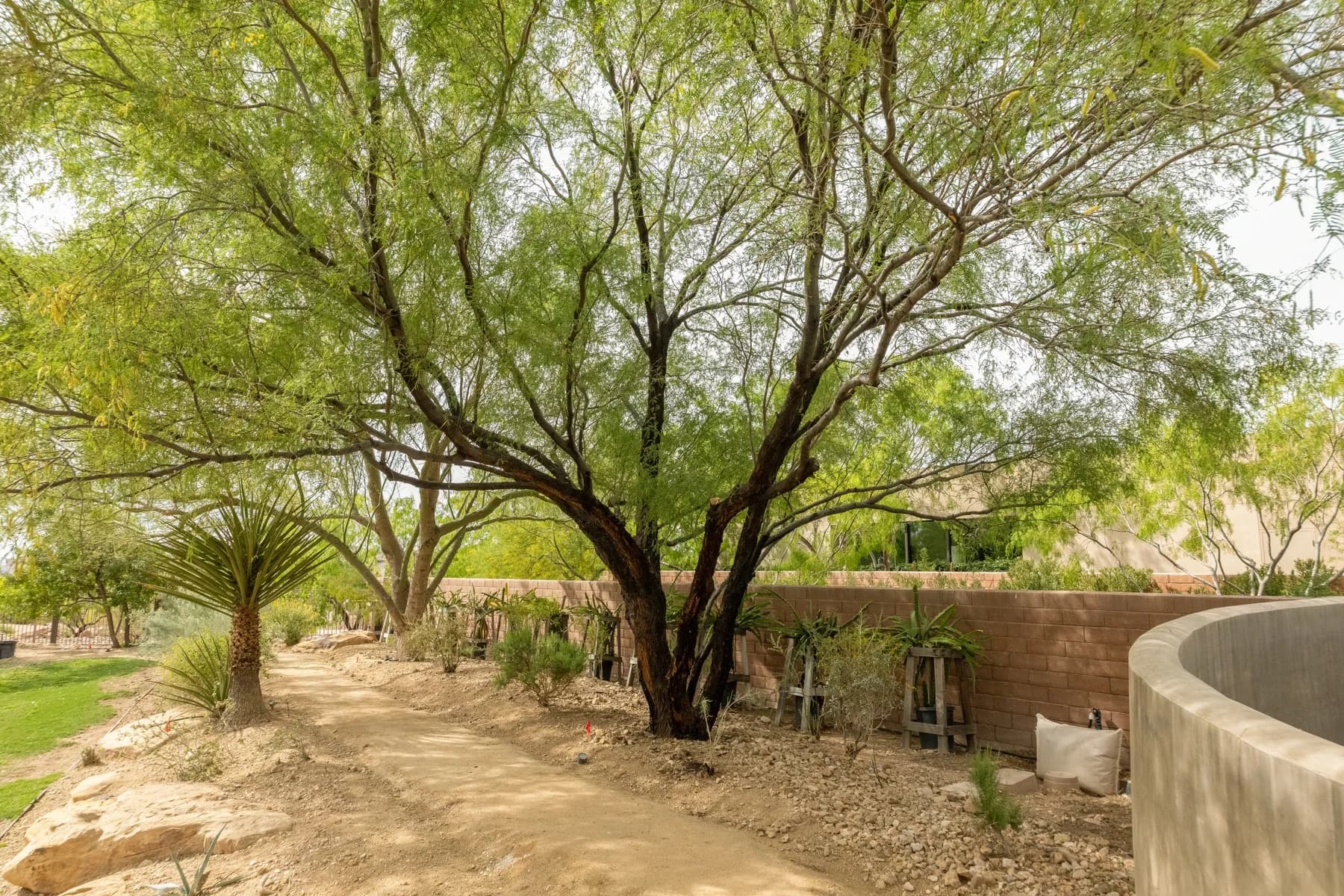
A practical guide to the best shade trees for Las Vegas yards — which species handle 115-degree summers, alkaline soil, and low water, and which ones cause more problems than they solve.
Shade is not optional in Las Vegas. Between June and September, afternoon temperatures regularly exceed 110 degrees, and direct sun on a south-facing wall can push surface temperatures past 160. A well-placed shade tree can drop the temperature under its canopy by 20 to 25 degrees, cut cooling costs by 15 to 35 percent, and make the difference between a yard people actually use and one they avoid for five months of the year.
But not every tree survives here, and not every tree that survives is worth planting. Las Vegas sits in the Mojave Desert at roughly 2,000 feet elevation. The soil is alkaline, heavily minerite, and often caliche — a calcium carbonate hardpan that can stop roots dead within 18 inches of the surface. Annual rainfall averages around 4 inches. Summer humidity runs in the single digits. These conditions eliminate most of the shade tree species that work in other parts of the country.
Benjamin's Tree Service has been planting, maintaining, and removing trees across the Las Vegas Valley since 2001. This guide reflects 25 years of observing which shade trees actually thrive here — and which ones homeowners regret planting within five years.
What Makes a Good Shade Tree for Las Vegas?
Before getting into specific species, it helps to understand the five characteristics that separate successful desert shade trees from the ones that end up as removal jobs.
Heat Tolerance
Las Vegas regularly hits 115 degrees in July and August. A tree that shows leaf scorch at 105 degrees is not going to make it. The best desert shade trees have evolved to handle extreme heat without dropping leaves, wilting, or going dormant in the middle of summer when you need shade the most.
Low Water Requirements
Southern Nevada Water Authority (SNWA) restrictions limit residential irrigation, and water costs are rising. Trees classified as "moderate" or "low" water use by SNWA are the practical choice. A tree that needs 50 gallons per day through summer is a tree that will cost you hundreds in water bills annually.
Alkaline Soil Tolerance
Las Vegas soil pH typically runs between 7.5 and 8.5. Many popular shade trees — including red maples, pin oaks, and sweetgums — develop iron chlorosis in alkaline soil. Their leaves turn yellow between the veins, growth stunts, and within a few years the tree looks sick even with supplemental iron treatments. Choosing species that naturally tolerate high-pH soil avoids this problem entirely.
Wind Resistance
Las Vegas experiences significant wind events, particularly in spring. Gusts above 60 mph are not unusual. Trees with brittle wood — like mulberry, Siberian elm, and many eucalyptus species — lose major limbs in every windstorm. A good shade tree for this valley has a strong branch structure that holds up under wind loading.
Root Behavior
Aggressive root systems are the number one source of property damage from trees in the Las Vegas Valley. Ficus, mulberry, and African sumac roots crack pool decks, lift walkways, invade sewer lines, and undermine foundations. The best shade trees for residential properties have well-behaved root systems that stay where they belong.
The Best Shade Trees for Las Vegas Yards
These are the species our arborists recommend most frequently for residential properties across Henderson, Summerlin, North Las Vegas, and every community in between.
Museum Palo Verde (Parkinsonia x 'Desert Museum')
The Desert Museum palo verde is arguably the best all-around shade tree for Las Vegas. It is a hybrid that combines the best traits of three native palo verde species while eliminating the thorns and excessive seed pod production of its parents.
Why it works here:
- Heat tolerant to 120 degrees with no leaf scorch
- Low water use once established — classified as "low" by SNWA
- Thrives in alkaline soil without supplemental amendments
- Grows 25 to 30 feet tall with a broad, spreading canopy
- Thornless (unlike native palo verde species)
- Produces stunning yellow flower displays in spring
- Clean tree — minimal litter compared to other species
What to know: Palo verdes have green bark that photosynthesizes, which means they can survive extended drought by dropping their leaves and continuing to produce energy through the trunk and branches. This is a significant advantage in water-restricted Las Vegas.
Chilean Mesquite (Prosopis chilensis)
Chilean mesquite has been a Las Vegas landscaping staple for decades, and for good reason. It produces a wide, dense canopy that provides genuine relief from desert sun. Mature Chilean mesquites can spread 30 to 40 feet across, creating enough shade to cover a patio, parking area, or significant portion of a yard.
Why it works here:
- Extremely heat and drought tolerant
- Handles Las Vegas alkaline soil without issues
- Fast-growing — can add 3 feet per year when young
- Develops a thick, spreading canopy ideal for shade
- Deep root system that does not typically damage hardscape
What to know: Chilean mesquites produce seed pods that can be messy, and they require regular trimming and pruning to maintain good structure. Without proper structural pruning in the first five to seven years, they develop co-dominant leaders that split in windstorms. Professional pruning during establishment is not optional with this species.
Thornless Honey Mesquite
A step up from Chilean mesquite for homeowners who want the same desert toughness with less maintenance. Thornless cultivars eliminate the spine hazard, and selected varieties produce fewer seed pods.
Why it works here:
- Same heat and drought tolerance as Chilean mesquite
- Thornless varieties safe for yards with children and pets
- Alkaline soil tolerant
- Provides dappled shade that allows grass to grow underneath
- Moderate growth rate — less aggressive than Chilean mesquite
Sissoo Tree (Dalbergia sissoo)
The sissoo was one of the most popular shade trees in Las Vegas through the 2000s and 2010s. It grows fast, produces dense shade, and handles heat well. However, it comes with a significant caveat.
Why homeowners plant it: Fast growth to 40 feet or more, thick canopy, green year-round in mild winters, attractive appearance.
The problem: Sissoo roots are extremely aggressive. They invade sewer lines, crack foundations, lift pool decks, and buckle driveways. Our crews in Spring Valley and Enterprise remove more sissoo trees for root damage than any other species. If you have a sissoo within 20 feet of your home's foundation, pool, or main sewer line, a tree assessment is worth scheduling.
We no longer recommend planting sissoo trees on residential properties in Las Vegas. The shade is excellent. The root damage is not worth it.
Tipu Tree (Tipuana tipu)
The tipu is a semi-evergreen tree that provides dense, broad shade and handles Las Vegas conditions reasonably well. It grows 30 to 50 feet tall with a wide, umbrella-shaped canopy.
Why it works here:
- Strong heat tolerance
- Moderate water needs (not as drought-tolerant as mesquite or palo verde, but manageable)
- Produces yellow flowers in late spring
- Attractive, spreading canopy shape
- Good branch structure — holds up in moderate wind
What to know: Tipus can develop surface roots in compacted desert soil. Plant them at least 15 feet from hardscape, and provide deep watering to encourage roots to grow down rather than laterally.
Mondell Pine (Pinus eldarica)
For homeowners who want an evergreen shade tree, the Mondell pine (also called Afghan pine) is the most reliable choice in Las Vegas. It grows 30 to 50 feet tall and provides year-round shade and wind screening.
Why it works here:
- Evergreen — provides shade in winter when deciduous trees are bare
- Heat tolerant and moderately drought tolerant once established
- Handles alkaline soil well
- Fast-growing — can add 2 to 3 feet per year
- Good wind resistance with proper structural pruning
What to know: Mondell pines are susceptible to bark beetles during extended drought stress. Consistent deep watering during summer — not frequent shallow watering — is critical for keeping these trees healthy. We see significant Mondell pine mortality in neighborhoods across Green Valley and Anthem where irrigation has been reduced too aggressively.
Trees to Avoid in Las Vegas
Experience has taught us which species cause the most problems for Las Vegas homeowners. If a landscaper or nursery recommends any of these, get a second opinion.
Mulberry
Mulberry trees grow fast, produce dense shade, and are cheap to buy. They are also one of the most problematic trees in the Las Vegas Valley. The wood is brittle and breaks in every windstorm. The roots invade everything. Male mulberries produce massive amounts of pollen that aggravate allergies across the valley. Clark County banned the planting of new fruitless mulberry trees in 1991 for pollen reasons, but existing trees — and illegal plantings — are everywhere.
Ficus (Indian Laurel Fig)
Ficus trees are beautiful in tropical climates. In Las Vegas, their root systems are a homeowner's worst nightmare. Ficus roots will crack any hardscape within reach, invade sewer lines, and lift foundations. The tree removal cost for a mature ficus with root damage often exceeds $3,000 to $5,000 when you factor in hardscape repair.
Siberian Elm
Fast-growing, weak-wooded, and an aggressive seeder. Siberian elms break apart in wind events and produce thousands of seedlings that invade every planter bed, crack, and drainage channel on the property. They are essentially a maintenance nightmare that never stops.
Eucalyptus (Most Species)
Most eucalyptus species are too brittle for Las Vegas wind conditions. Large limbs drop without warning, and the trees become increasingly hazardous as they age. There are a few exceptions (like the coolibah tree), but as a general rule, eucalyptus and Las Vegas wind do not mix.
How to Plant a Shade Tree in Las Vegas Soil
Planting technique matters more in Las Vegas than in almost any other climate because of caliche and compacted desert soil. Here is the process our crew follows:
1. Test for caliche — dig a test hole 3 feet deep before purchasing the tree. If you hit solid caliche within 24 inches, you will need to break through it or choose a different planting location. Trees planted above a caliche layer become root-bound and blow over in wind events.
2. Dig wide, not just deep — the planting hole should be 3 to 4 times wider than the root ball. In desert soil, wide holes matter more than deep ones because roots spread laterally to find moisture.
3. Backfill with native soil — do not amend the backfill with compost or potting soil. Amended backfill creates a bathtub effect where water pools in the softer soil and causes root rot. Use the soil you dug out of the hole.
4. Plant at the right depth — the root flare (where the trunk begins to spread at the base) should be at or slightly above ground level. Planting too deep is one of the most common mistakes in Las Vegas landscaping, and it leads to crown rot and slow decline.
5. Mulch the surface — 3 to 4 inches of wood chip mulch around the base (but not touching the trunk) reduces soil temperature by 10 to 15 degrees and conserves moisture. In the Las Vegas heat, mulch makes a measurable difference in establishment success.
6. Set up deep watering — shallow, frequent watering produces shallow root systems that fail in wind. Deep watering on longer intervals encourages roots to grow down where soil moisture is more stable. Use a bubbler or slow-drip system at the edge of the root ball.
When to Plant Shade Trees in Las Vegas
The best planting window in Las Vegas is October through March. Fall-planted trees have the entire cool season to establish roots before their first desert summer. Trees planted in May through August face an immediate survival challenge — trying to establish roots while air temperatures exceed 100 degrees and soil temperatures at the surface climb even higher.
If you must plant in spring, do it before mid-April and commit to an aggressive watering schedule through the first summer. Shade cloth over the canopy during the first July and August can significantly improve survival rates.
Get Professional Guidance Before You Plant
Choosing the right shade tree for your Las Vegas property depends on your specific soil conditions, sun exposure, proximity to structures, irrigation setup, and long-term goals for the yard. A species that thrives in one part of the valley can struggle two miles away because of soil differences.
Benjamin's Tree Service offers tree assessment reports that include planting recommendations tailored to your property. Our arborists evaluate your soil, assess existing trees, identify any risk factors, and recommend species that will perform well in your specific conditions.
We serve homeowners across Las Vegas, Henderson, Summerlin, North Las Vegas, Spring Valley, Paradise, Enterprise, Green Valley, Anthem, Centennial Hills, and Boulder City.
Call 725-300-0399 for a free tree inspection and planting consultation. We will help you choose the right shade tree, plant it correctly, and set it up for long-term success in the desert.
Benjamin's Tree Service
ISA Certified Arborists serving Las Vegas & the surrounding areas since 2001.