
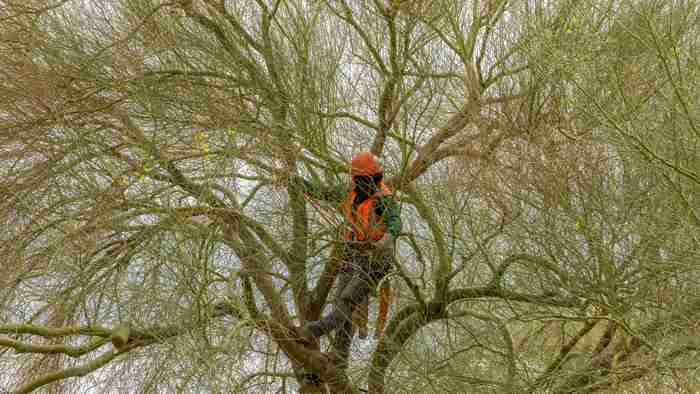
Learn the difference between crown reduction and crown thinning, and find out which pruning method is best for trees in the Las Vegas desert climate.
If you've ever been told your tree needs pruning but weren't sure what kind, you're not alone. Two of the most common structural pruning techniques — crown reduction and crown thinning — serve very different purposes, and choosing the wrong one can do more harm than good.
For homeowners across Las Vegas, Henderson, Summerlin, and North Las Vegas, understanding these two methods is especially important. Desert trees face unique stresses, from extreme summer heat to fast-drying soils, and the wrong pruning approach can leave your trees vulnerable.
Here's what you need to know about crown reduction and crown thinning, when each method makes sense, and how to decide what's best for your property.
Quick Summary
- Crown reduction shrinks the overall size of a tree's canopy by shortening branches back to healthy lateral growth
- Crown thinning removes select interior branches to improve airflow and light penetration without changing the tree's shape
- In Las Vegas, crown thinning is more commonly recommended because it reduces wind resistance and heat stress without removing too much shade
- Crown reduction is best reserved for trees that have outgrown their space or pose a structural risk
- Both methods should only be performed by a certified arborist — improper cuts can cause lasting damage
What Is Crown Reduction?
Crown reduction is a pruning technique that decreases the overall height and spread of a tree's canopy. Instead of cutting branches back to stubs (which is called topping and should never be done), a certified arborist shortens branches to a suitable lateral branch that can take over as the new leader.
The goal is to make the tree smaller in a way that looks natural and preserves its health. Crown reduction is often used when:
- A tree has grown too close to a structure, power line, or neighboring property
- Heavy limbs are creating a lopsided canopy that could lead to failure
- Storm damage has left the tree structurally compromised
- The tree's size is disproportionate to the available growing space
In the Las Vegas Valley, crown reduction is sometimes needed for large species like African sumac, mulberry, or Chinese elm that have outgrown residential lots in neighborhoods like Summerlin, Green Valley, and Centennial Hills.
How Crown Reduction Is Performed
A trained arborist evaluates the tree's overall structure and identifies branches that need to be shortened. Each cut is made just above a lateral branch that is at least one-third the diameter of the branch being removed. This ensures the remaining branch can sustain healthy growth.
Crown reduction is more time-intensive than thinning because every cut must be carefully placed. Improper crown reduction — cutting to branches that are too small or making heading cuts — can trigger excessive water-sprout growth, which creates a weaker canopy over time.
What Is Crown Thinning?
Crown thinning is a different approach. Rather than reducing the tree's size, thinning selectively removes interior branches to open up the canopy. The tree's overall shape and height stay the same, but the canopy becomes less dense.
The benefits of crown thinning include:
- Better airflow — reduces the risk of fungal disease, especially during Las Vegas's humid monsoon months in July and August
- More light penetration — allows sunlight to reach lower branches, understory plants, and your lawn
- Reduced wind resistance — a thinned canopy catches less wind, lowering the risk of branch failure during Clark County's strong spring and summer storms
- Less weight on limbs — removing excess interior growth reduces the load on structural branches
Crown thinning is the most frequently recommended pruning method for mature trees across the Las Vegas metro area. It's particularly effective for species that develop dense canopies, like mesquite, palo verde, and ash trees.
How Crown Thinning Is Performed
An arborist walks the canopy (or works from the ground for smaller trees) and removes select branches, usually targeting:
- Crossing or rubbing branches
- Water sprouts and suckers
- Weak, narrow-angle crotches
- Dead, dying, or diseased wood
- Redundant branches growing in the same direction
The industry standard is to remove no more than 15–25% of the live canopy in a single session. Removing more than that can shock the tree, especially in our desert climate where trees already deal with intense UV exposure and limited water.
Crown Reduction vs. Crown Thinning: Key Differences
Understanding the difference comes down to purpose and outcome:
Crown reduction changes the tree's size. You'll notice the tree is shorter or narrower after the work is done. It's a corrective measure used when a tree's dimensions have become a problem.
Crown thinning changes the tree's density. The tree looks the same shape and size from the outside, but the interior is more open. It's a maintenance measure used to keep a healthy tree in peak condition.
Here's a quick comparison:
- *Goal*: Reduction shrinks the canopy; thinning opens it up
- *Shape change*: Reduction alters the tree's silhouette; thinning preserves it
- *When needed*: Reduction when the tree is too large; thinning for routine maintenance
- *Frequency*: Reduction is occasional (every 3–5 years); thinning can be done every 2–3 years
- *Risk if done poorly*: Reduction can trigger excessive regrowth; overthinning can cause sunscald
Which Method Is Best for Las Vegas Trees?
For most residential properties in Las Vegas, Henderson, and North Las Vegas, crown thinning is the better choice for routine tree maintenance. Here's why:
Desert Trees Need Their Canopy
In Clark County, temperatures regularly exceed 110°F during summer. Your tree's canopy acts as its own sunscreen, shading the trunk and lower branches from direct UV radiation. Aggressive crown reduction removes a significant portion of that protective layer, which can lead to sunscald — a condition where exposed bark overheats, cracks, and becomes susceptible to disease.
Crown thinning preserves the canopy's overall coverage while still providing the structural benefits of pruning.
Wind Is a Bigger Risk Than Size
Las Vegas experiences strong, gusty winds year-round, especially during spring storms and monsoon season. A dense, unpruned canopy acts like a sail, catching wind and putting enormous stress on the trunk and root system.
Crown thinning is specifically designed to reduce wind resistance. By opening up the interior of the canopy, wind passes through the tree rather than pushing against it. This dramatically lowers the risk of branch failure or uprooting during storms.
Reduction Is Reserved for Specific Situations
Crown reduction makes sense in certain scenarios:
- Trees growing into power lines or utility easements
- Large trees planted too close to homes, pools, or block walls
- Trees with significant structural damage from storms — see our monsoon tree care and storm damage guide
- Overgrown trees in HOA communities with height or setback requirements (common in Summerlin and Anthem)
If your tree doesn't fall into one of these categories, thinning is almost always the safer and more beneficial choice.
Common Mistakes Homeowners Should Avoid
Whether your tree needs reduction or thinning, the biggest risk is improper pruning. Here are mistakes we see regularly across the Las Vegas Valley:
Topping (Never Acceptable)
Topping — cutting large branches back to stubs — is not the same as crown reduction. Topping destroys the tree's natural structure, triggers a flush of weak water-sprout growth, and leaves the tree more vulnerable than before. It's one of the most damaging things you can do to a tree, and no ISA Certified Arborist would recommend it.
Over-thinning (Lion's Tailing)
Removing too many interior branches while leaving growth only at the tips is called lion's tailing. This shifts all the weight to the ends of branches, making them more likely to break. A proper thinning removes branches evenly throughout the canopy.
Pruning at the Wrong Time
In the Las Vegas desert climate, the best time to prune most trees is late winter through early spring, before the intense summer heat arrives. Pruning during peak summer can stress trees that are already working hard to stay hydrated. There are exceptions — dead or hazardous branches should be removed immediately regardless of season.
When to Call a Certified Arborist
If you're unsure whether your tree needs crown reduction, crown thinning, or another type of pruning entirely, the safest move is to schedule a tree assessment. A certified arborist can evaluate your tree's health, structure, and growing conditions, then recommend the right approach.
Benjamin's Tree Service has been serving the Las Vegas Valley since 2001. Our team includes ISA Certified Arborists (ISA Cert. WE-15785A), and we're fully licensed and insured in Nevada. We've pruned thousands of trees across Las Vegas, Henderson, Summerlin, North Las Vegas, and every community in Clark County.
We'll tell you exactly what your tree needs — and just as importantly, what it doesn't.
FAQs
Is crown reduction the same as topping?
No. Crown reduction shortens branches to healthy lateral growth points, maintaining the tree's natural form. Topping cuts branches back to stubs with no regard for structure. Topping is harmful and is never recommended by certified arborists.
How often should I have my trees thinned in Las Vegas?
Most mature trees in the Las Vegas area benefit from crown thinning every two to three years. Young trees may need lighter, more frequent pruning to establish good structure. Your arborist can recommend a tree service plan based on your specific species and property.
Can I do crown thinning myself?
For small ornamental trees, light thinning of lower branches is manageable for handy homeowners. However, for any tree that requires a ladder or involves branches larger than two inches in diameter, it's much safer and more effective to hire a professional. Improper cuts can introduce disease and create structural weaknesses.
Will crown reduction stop my tree from growing back?
No. Trees continue to grow after crown reduction. In fact, aggressive reduction often stimulates a burst of rapid, weak regrowth. That's why proper technique — cutting to adequate lateral branches — is critical. It directs the tree's energy into healthy growth patterns rather than stress responses.
How much does tree pruning cost in Las Vegas?
Pricing varies based on tree size, species, location, and the scope of work. We provide free, no-obligation estimates. Call us at (725) 227-6160 or visit benjaminstreeservice.com/contact to schedule your assessment.
Schedule Your Tree Pruning Assessment
Not sure if your trees need crown reduction, crown thinning, or both? Benjamin's Tree Service provides free on-site assessments for homeowners throughout the Las Vegas Valley.
Call us today at (725) 227-6160 or schedule online at benjaminstreeservice.com. We're your neighbors, and we've been keeping Las Vegas trees healthy for over 25 years.
Benjamin's Tree Service
ISA Certified Arborists serving Las Vegas & the surrounding areas since 2001.
Related Reading
Trimming & Pruning
Tree Topping in Las Vegas: Why It Hurts Trees
Tree topping can leave Las Vegas trees with weak regrowth and large wounds. Learn safer pruning opti…
9 min read
Trimming & Pruning
Palm Tree Trimming in Las Vegas: Homeowner's Guide
Learn when to trim palm trees in Las Vegas, how the process works, and why professional palm tree tr…
7 min read
Trimming & Pruning
Tree Pruning in Las Vegas: When, How & Why It Matters
Tree pruning in Las Vegas: best timing by season, species tips for mesquite, palo verde, and palms. …
7 min read