
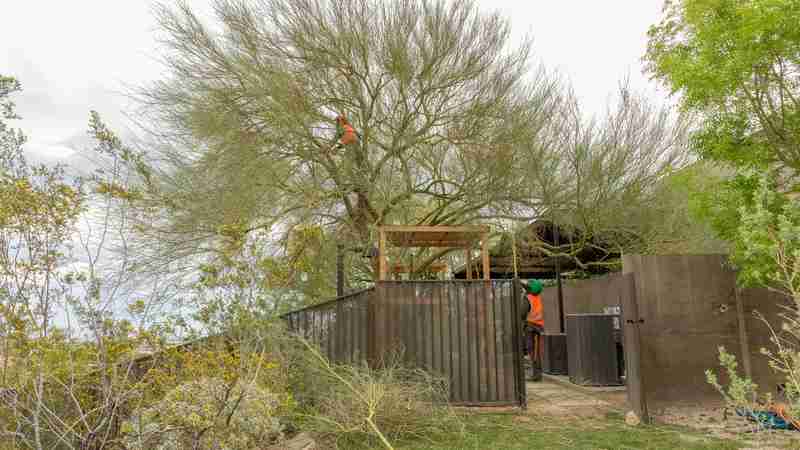
Tree pruning in Las Vegas: best timing by season, species tips for mesquite, palo verde, and palms. ISA Certified Arborist. Call 725-227-6160.
Why Desert Pruning Is Different
If you've moved to Las Vegas from a wetter climate, the tree care advice you're used to probably doesn't apply here. The Mojave Desert puts trees under a fundamentally different set of stresses — extreme heat, alkaline caliche soil, low humidity, and a monsoon season that arrives suddenly and with serious wind. Pruning decisions that are safe in Seattle or Atlanta can be genuinely harmful in Las Vegas.
Desert-adapted trees have evolved specific strategies for surviving these conditions. They grow slowly and deliberately. They concentrate energy in the right branches at the right times. When you prune them incorrectly — wrong timing, wrong cuts, wrong amount removed — you're not just creating an aesthetic problem. You're removing the canopy shade that protects the trunk and roots from 110°F summer heat, opening wound sites that don't close properly in arid conditions, and potentially triggering stress responses that can take years to recover from.
Done correctly, professional tree pruning in Las Vegas accomplishes something remarkable: it makes your trees structurally stronger, healthier, longer-lived, and safer — all while keeping them in compliance with HOA standards. That's what our ISA Certified Arborist (Certification WE-15785A) brings to every job. If you're ready to schedule service, visit our Tree Trimming & Pruning Service page or call 725-227-6160.
---
Best Timing by Las Vegas Season
Pruning timing in Las Vegas follows a logic shaped by our desert climate — not a generic national calendar.
Late Fall and Winter (November–February): The Primary Pruning Window
For most deciduous trees in Las Vegas — mesquite, ash, Chinese pistache, desert willow — late fall through winter is the ideal time to prune. Here's why it works:
- Trees are dormant or near-dormant, meaning pruning stress is minimized
- Wounds can begin callusing before the stress of summer
- Without leaves, the tree's structure is fully visible, making it far easier to identify crossing branches, weak attachments, and structural problems
- No active growth means pruning cuts don't stimulate a flush of soft, heat-vulnerable new growth heading into summer
This is also the window when most Henderson Tree Service calls for structural pruning occur — the trees are cooperative, the weather is comfortable for crews, and the work sets the tree up for a strong spring.
Early Spring (March–April): Acceptable for Light Pruning
Early spring is acceptable for light shaping and removal of winter-damaged wood, but it's a narrowing window. As temperatures climb through April and May, pruning large amounts of canopy exposes previously shaded bark to rapidly intensifying sun — a recipe for sunscald. Limit spring pruning to clearly dead wood, crossing branches creating obvious structural problems, and HOA compliance trimming that can't wait.
Summer (June–September): Caution Required
Summer pruning is not ideal for most species, but there are important exceptions:
- Dead, diseased, or hazardous branches should always be removed regardless of season — never leave a structurally dangerous branch because the timing isn't perfect
- Monsoon season preparation (May–June) is actually an important reason to have a professional assess your trees for weak branch attachments before the summer storms arrive
- Palm trees are best trimmed in summer — more on that below
If you have a tree damaged by a monsoon storm and need immediate help, our Emergency Tree Service is available year-round.
Pre-Monsoon (May–June): Safety Assessment Window
The Las Vegas monsoon season runs roughly June through September, bringing sudden high winds, microbursts, and occasional downbursts that can top 60 mph. Before monsoon arrives, it's worth having an arborist look at any trees with large canopies, those overhanging structures, or any tree that seemed stressed over the previous year. Removing weak attachments and reducing wind sail before the storms arrive is far better than dealing with the aftermath. Our North Las Vegas Tree Service team handles pre-monsoon assessments throughout the valley.
---
Species Guide: Pruning Las Vegas Trees Correctly
Mesquite
Mesquite is the workhouse of Las Vegas tree canopies — tough, drought-tolerant, and excellent for shade. But improperly pruned mesquite becomes a liability. The key: structural pruning in the first five to ten years is critical. Young mesquites grow with multiple competing leaders and weak branch angles that, if left uncorrected, result in splitting failures under wind load or the weight of mature canopy.
For established mesquites, prune in winter for structural work. Remove any branches with tight V-shaped crotches — these have included bark and will eventually fail. Never remove more than 25% of the canopy in a single season. Lion-tailing (stripping interior branches and leaving only end growth) is a common mistake that creates top-heavy trees highly vulnerable to wind — avoid any service that recommends it.
Palo Verde
Palo verde trees, including the popular Desert Museum hybrid, need minimal pruning once their basic structure is established. They're naturally graceful and branchy — heavy pruning ruins their form. Limit pruning to:
- Removal of dead or crossing interior branches
- Clearance over walkways and driveways (typically requires only minor annual trimming)
- Any branches that experienced frost damage in winter
Never top a palo verde. It destroys the natural branching structure and triggers excessive, weakly-attached regrowth.
Palms
Palms follow completely different rules than broadleaf trees. They have no secondary growth — every frond emerges from a single growing point at the top. Pruning best practices for Las Vegas palms:
- Trim in summer (June–August) when the palm is actively growing
- Remove only brown, fully dead fronds — not green or yellow-green fronds. Green fronds provide nutrition to the tree
- Never cut into the "green zone" — the boot-shaped frond bases above the crown. This practice, called "hurricane cutting," is harmful and leaves the palm vulnerable to the Fusarium wilt fungus
- Remove seed pods and fruiting structures to reduce weight and pest attraction
- Monitor for red palm weevil, an invasive pest now established in the Las Vegas Valley
Our Tree Trimming & Pruning Service includes full palm care with species-appropriate technique.
African Sumac
African sumac is one of the most common street and yard trees in Henderson and Las Vegas, valued for its dense, evergreen canopy and heat tolerance. It can be pruned year-round for light shaping, but major structural work is best done in late fall or winter. African sumac bleeds sap heavily when cut in spring and summer — not harmful to the tree, but it attracts pests and can stain hardscape.
One important note: African sumac produces an irritant similar to poison ivy for some people. Our crews wear gloves and use appropriate precautions — if you're pruning it yourself, do the same.
Olive Trees
Olive trees in Las Vegas are sturdy and drought-tolerant, but they require more consistent pruning than most other desert-adapted species to maintain a manageable form. Left unpruned, olives develop into thicket-like masses with hundreds of interior crossing branches and dense, impenetrable canopies. Prune annually in late winter to:
- Open the canopy for air circulation (reduces fungal pressure)
- Remove suckers and water sprouts from the base and major limbs
- Maintain a clean trunk to 6–8 feet for clearance and aesthetics
- Reduce fruiting branch density if you're dealing with olive fruit drop on hardscape
---
Warning Signs Your Trees Need Professional Pruning Now
Don't wait for annual maintenance if you notice any of these:
- Dead branches larger than 2 inches in diameter — these won't shed cleanly and will eventually fall with unpredictable timing
- Crossing branches rubbing together — creates wound sites where decay and pests enter
- Branches overhanging your roofline — a monsoon wind event is all it takes for a branch to cause thousands of dollars in roof damage
- Tight V-crotches with included bark visible — these are structural failure points waiting to happen
- Branches leaning heavily to one side — indicates an unbalanced weight distribution that a windstorm will exploit
- Sparse leafing on one section of an otherwise healthy-looking tree — often a sign of a blocked or dying branch that needs removal
If you're seeing any of these, schedule a professional assessment before monsoon season. Emergency Tree Service is available for urgent situations, but prevention is far less expensive than storm damage.
---
DIY vs. Professional Pruning in Las Vegas
For small, accessible cuts on low branches, a homeowner with the right tools and basic knowledge can handle light maintenance pruning. That means:
- Removing dead twigs and small branches under 1 inch in diameter
- Trimming low limbs within easy reach of a 6-foot ladder
- Shaping young shrubby trees in their first couple of growing seasons
Beyond that, professional pruning is the right call. Here's why it matters specifically in Las Vegas:
Improper cuts don't heal well in arid climates. In humid regions, trees callus over pruning wounds relatively quickly. In the Mojave Desert, wounds take longer to close and are more vulnerable to wood-boring beetles and fungal entry during that period. An ISA-trained arborist makes cuts at the correct angle and location (just outside the branch collar) to maximize wound closure — a flush cut or stub left by an untrained cutter can remain open for years.
Height and canopy work is dangerous. Any pruning that requires climbing, a ladder above 8 feet, or cutting near utility lines should be done by a licensed and insured professional. The risk isn't just to you — a falling branch can damage your home, your neighbor's property, or injure someone on the ground.
HOA compliance requires documentation. Many Henderson and Las Vegas Valley HOAs require proof that tree work was performed by a licensed contractor. Our team provides written service records that satisfy HOA documentation requirements.
---
What a Professional Pruning Service Includes
When you hire Benjamin's Tree Service for tree pruning in Las Vegas, here's what the service covers:
- Site assessment by ISA Certified Arborist WE-15785A — we evaluate the tree's structure, health, and the specific goals for the pruning visit before any cuts are made
- Species-appropriate pruning technique — the approach we use for a mesquite is different from a palo verde, which is different from a palm
- Structural pruning for long-term health — not just aesthetic shaping, but correcting structural issues that will compound over time if left unaddressed
- Dead and hazardous branch removal — clearing anything that poses an immediate risk
- HOA clearance compliance — we can work to specific clearance heights and canopy reduction specs if your HOA has issued requirements
- Full debris cleanup — all cuttings chipped or hauled away
- Written service record — documentation of work performed for your records
We serve Las Vegas, Henderson, North Las Vegas, Summerlin, and all of Clark County. If a tree needs removal rather than pruning, our Tree Removal Las Vegas team handles that as well.
---
To keep learning, see our articles on How Often to Trim Trees in Las Vegas and Why Proper Tree Trimming Is Important. For an independent reference on technique, the International Society of Arboriculture's guide to pruning your trees is an excellent place to start.
Frequently Asked Questions
How often should I have my trees pruned in Las Vegas?
Most mature desert-adapted trees (mesquite, palo verde, African sumac) benefit from professional pruning every 2–3 years for structural maintenance. Palms typically need annual trimming. Young trees in their first 5–10 years benefit from annual structural pruning to establish good branch architecture. If a tree has been neglected for many years, it may need corrective pruning over multiple seasons — removing too much at once stresses the tree.
Will pruning my tree hurt it?
Correct pruning does not harm a healthy tree — it helps it. The key word is "correct." Improper pruning (topping, flush cuts, removing too much canopy at once, cutting at the wrong time of year for the species) can stress or permanently damage trees. That's why ISA certification matters — it's the credential that indicates an arborist has been trained in evidence-based pruning standards.
Can I prune trees near power lines myself?
No. Pruning within 10 feet of utility lines should only be done by a certified line-clearance arborist or the utility company. NV Energy has specific protocols for tree work near their lines. Attempting this work yourself is dangerous and potentially a liability issue. Contact us at 725-227-6160 and we'll advise on the right approach for your situation.
---
Ready to schedule professional tree pruning in Las Vegas? Call Benjamin's Tree Service at [725-227-6160](tel:7252276160) or visit our Tree Trimming & Pruning Service page to request a free estimate. ISA Certified Arborist WE-15785A | Licensed & Insured | Serving Las Vegas Since 2001.
Benjamin's Tree Service
ISA Certified Arborists serving Las Vegas & the surrounding areas since 2001.
Related Reading
Trimming & Pruning
Crape Myrtle Pruning in Las Vegas: Avoid Crape Murder
Crape myrtle pruning in Las Vegas done wrong causes crape murder and weak regrowth. Learn the right …
9 min read
Trimming & Pruning
Mesquite Tree Trimming in Las Vegas: A Homeowner's Guide
Mesquite tree trimming in Las Vegas needs species-specific timing. Learn when to prune, mistakes to …
10 min read
Trimming & Pruning
Tree Topping in Las Vegas: Why It Hurts Trees
Tree topping can leave Las Vegas trees with weak regrowth and large wounds. Learn safer pruning opti…
9 min read