
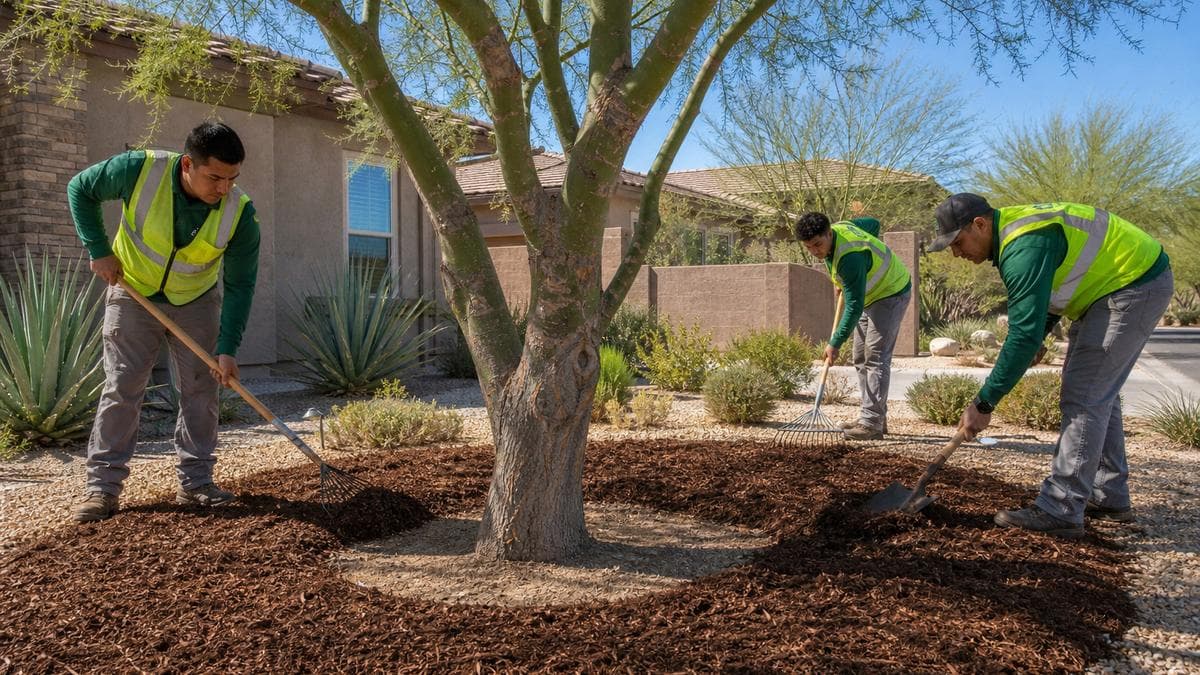
Learn the right way to mulch trees in the Las Vegas heat, plus the two mistakes — rock beds and mulch volcanoes — that quietly damage roots and trunks in the Mojave sun.
If we could give every Las Vegas homeowner one tip to protect their yard from the Mojave sun, it would be this: mulch. A 3–4 inch layer of wood chips acts as an insulating blanket over your root zone, keeping ground temperatures 20–30°F cooler and locking in moisture your trees would otherwise lose to evaporation within hours.
At Benjamin's Tree Service, our ISA Certified Arborists (ISA Cert. WE-15785A) have spent over two decades helping homeowners across the Las Vegas Valley get the most out of their landscaping. Mulching sounds simple, but we see the same two mistakes on almost every property we visit — and both of them work against the very thing mulch is supposed to do.
Quick Summary
- A 3–4 inch layer of wood mulch keeps root-zone soil 20–30°F cooler and slows moisture loss
- The Rock Trap: gravel against the trunk absorbs and radiates heat instead of blocking it
- The Mulch Volcano: piling mulch against the trunk traps moisture and causes rot
- Correct mulching works together with a deep, infrequent watering schedule
- Root zoning is a science — a professional Tree Check-up can tell you if your setup is helping or hurting
Why Mulch Matters More in the Mojave Desert
Summer soil temperatures in unshaded Las Vegas yards can climb well past what most tree roots can tolerate for long. Bare, compacted dirt bakes in direct sun all day and radiates that heat back at night, stressing the fine feeder roots that do most of a tree's water and nutrient uptake. A proper mulch layer breaks that cycle — it shades the soil surface, slows evaporation, and moderates the wild day-to-night temperature swings that are so extreme in our caliche soil.
The right way to do it: spread wood chips 3–4 inches deep in a wide, flat ring out to at least the tree's drip line. Think donut, not mountain — level mulch, not a pile against the bark.
Mistake 1: The Rock Trap
Decorative gravel is everywhere in Las Vegas landscaping, and it looks clean against a trunk. The problem is physics: rock absorbs solar heat all day and radiates it back into the root zone well after the sun goes down, raising soil temperature instead of moderating it. Gravel also does not break down into organic matter the way wood mulch does, so it never improves the compacted caliche beneath it. If your trees are ringed in rock, pull it back at least a foot and replace it with organic mulch.
Mistake 2: The Mulch Volcano
The opposite mistake is piling mulch up against the trunk in a cone — a look we call the "mulch volcano." It seems generous, but bark is not built to sit in constant moisture. A mulch volcano holds humidity against the trunk, softens the bark, and creates ideal conditions for rot and fungal decay to set in at the base of the tree. We cover the warning signs of that kind of decay in our guide to signs your tree is diseased or dying — trunk softness and fungal growth at the base are two of the clearest red flags, and a mulch volcano is one of the most common causes we find.
Keep mulch pulled back 3–6 inches from the trunk on every tree, no matter the species or age.
Mulch Works With Your Watering Schedule, Not Instead of It
Mulch reduces how fast water evaporates from the soil surface, but it is not a substitute for watering correctly. Deep, infrequent watering at the drip line is still the foundation of desert tree care — mulch just helps that water stay where your roots can use it longer. If you are not sure how much or how often to water, our guide on watering trees in the desert walks through the screwdriver test and seasonal adjustments we recommend to clients.
Root Zoning Is a Science
Every yard is different. Soil depth, caliche hardpan, irrigation layout, and tree age all change how wide and how deep a mulch ring should be. A setup that works perfectly for a mature shade tree can smother a young sapling's root flare, and a ring sized for one soil type can be too shallow in another. This is exactly the kind of detail that is easy to get wrong from a bag of mulch and a guess.
When to Get a Professional Root Zone Check
If you are not sure whether your yard's mulch and soil setup is helping or hurting your trees, let us take a look before the heat climbs even higher. Our comprehensive tree assessment includes an inspection of your soil and mulch zones — root flare, drainage, compaction, and depth — so you know exactly what your trees need instead of guessing.
According to the International Society of Arboriculture's guidance on proper mulching techniques, correct mulch depth and placement are among the simplest, highest-impact things a homeowner can do for tree health — which matches what we see in yards across Henderson, Summerlin, and North Las Vegas every summer.
Call Benjamin's Tree Service at (725) 227-6160 today to book a Tree Check-up, or visit benjaminstreeservice.com/contact to schedule online. We'll inspect your soil and mulch zones and put together a plan to keep your trees thriving through the hottest months.
Benjamin's Tree Service
ISA Certified Arborists serving Las Vegas & the surrounding areas since 2001.
Related Reading
Tree Care Tips
Dead or Dormant Tree in Las Vegas? 4 Easy Ways to Tell
Not sure if you have a dead or dormant tree in Las Vegas? Use the scratch test, bud check, and flex …
9 min read
Tree Care Tips
Common Tree Pests in Las Vegas: A Homeowner's Guide
Aphids, spider mites, and palo verde root borers are common tree pests in Las Vegas. Learn the warni…
10 min read
Tree Care Tips
Palo Verde Tree Care in Las Vegas: A Seasonal Guide
Learn palo verde tree care in Las Vegas, including watering, pruning, monsoon safety, warning signs,…
9 min read