
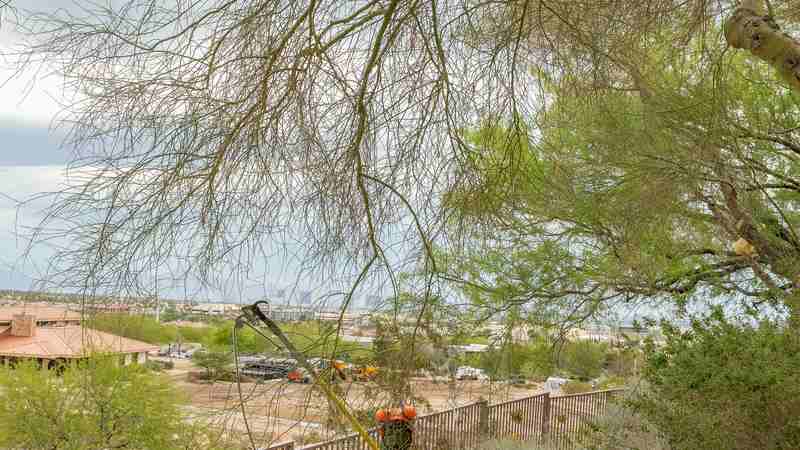
Protect your trees from Las Vegas summer heat with proven arborist tips. Benjamin's Tree Service, ISA certified, serving Clark County. Call 725-227-6160.
How to Protect Your Trees During Las Vegas Summer Heat
Las Vegas summers are relentless. When temperatures routinely climb past 110°F and the desert sun beats down without mercy for months on end, the trees on your Clark County property face a level of heat stress that most plants simply were not designed to handle. Yet every summer, we see homeowners in Henderson, Summerlin, and North Las Vegas watching their trees slowly decline — and wondering why.
The truth is, desert trees need active care during summer, not just water and hope. After more than two decades of serving Las Vegas homeowners — and as ISA Certified Arborists (ISA Cert. WE-15785A) — our team at Benjamin's Tree Service has learned exactly what separates trees that thrive through a Las Vegas summer from those that don't.
> Quick Summary
> - Las Vegas summer heat causes stress, leaf scorch, bark splitting, and root damage in trees
> - Deep, infrequent watering is far more effective than shallow daily irrigation
> - Mulching around the base of your trees is one of the highest-impact things you can do
> - Avoid heavy pruning in peak summer — it removes the very shade that protects your tree
> - If your tree shows signs of distress, a professional tree assessment can identify the problem before it becomes irreversible
Estimated reading time: 7 minutes
---
Why Las Vegas Summer Heat Is Hard on Trees
Before we get into the protective steps, it helps to understand what summer is actually doing to your trees at a biological level.
Heat Stress and Transpiration Overload
Trees regulate their temperature through transpiration — releasing water vapor through their leaves, similar to how humans sweat. When ambient temperatures push above 100°F, a tree must release enormous amounts of water to stay cool. If the roots cannot keep pace with demand, the tree begins to shut down non-essential functions: leaves wilt, then scorch, then drop.
This is why you might see perfectly healthy-looking mesquite trees dropping leaves in July — it's not disease. It's the tree triaging its own resources.
Soil Temperature and Root Damage
Most Las Vegas homeowners think about air temperature, but soil temperature is equally damaging. Unshaded desert soil in Clark County can reach 150°F or hotter at the surface in July. Tree roots near the surface — which is where much of the feeder root system lives — can be literally cooked in these conditions.
UV Bark Damage
Trees with thin or smooth bark (young trees, eucalyptus, crape myrtles, and some acacias) are vulnerable to sunscald — a condition where intense UV radiation causes bark to split, blister, or crack. Once bark is damaged, the tree becomes an easy entry point for pests and fungal pathogens.
---
7 Steps to Protect Your Trees This Las Vegas Summer
Step 1: Deep Water, Not Shallow Water
The most important thing you can do for your trees in summer is water correctly. Shallow, frequent watering — like a 10-minute drip cycle every day — trains roots to stay near the surface where soil temperatures are dangerous. Deep, infrequent watering pushes moisture down into the cooler soil layers and encourages roots to follow.
How to deep water a tree in Las Vegas:
- Run drip emitters for 2–4 hours at a time, 1–2 times per week for established trees
- The goal is to wet soil 18–24 inches deep
- Water in the early morning (5–7 a.m.) before temperatures climb — night watering can promote fungal growth
- Expand your drip emitters to the full drip line of the canopy — roots extend well beyond what you see above ground
Young trees (planted within the last 2 years) need more frequent watering than established trees. During a heat wave above 110°F, even established mature trees benefit from an extra mid-week deep watering session.
Step 2: Mulch the Root Zone
If we had to name one single thing that makes the biggest difference in tree survival during a Las Vegas summer, it would be mulch.
A 3–4 inch layer of wood chip mulch spread from 6 inches away from the trunk out to the drip line does three critical things at once:
1. Insulates roots from extreme soil temperatures — a mulched soil surface can be 20–30°F cooler than bare soil
2. Retains moisture by dramatically reducing evaporation from the soil surface
3. Prevents compaction by protecting the soil from foot traffic and the beating sun
Use shredded wood chips or arborist chips — not rocks or gravel. Rock mulch absorbs and radiates heat, making conditions worse, not better. Unfortunately, rock is a very common choice in Las Vegas landscaping, and we see it contributing to tree stress regularly.
Keep mulch away from direct contact with the trunk. "Volcano mulching" — piling mulch up against the bark — traps moisture against the trunk and creates ideal conditions for crown rot.
Step 3: Hold Off on Heavy Pruning
Summer is not the time for aggressive pruning. This is one of the most common mistakes we see Las Vegas homeowners make, often because the tree looks overgrown and they want it cleaned up before summer parties or HOA walkthroughs.
The problem: the leaves and branches you remove are the tree's own shade canopy. A full, leafy canopy shades the trunk, the interior branches, and the root zone. Removing significant portions of a tree's canopy in summer exposes previously shaded bark and roots to direct sun — exactly the conditions that cause sunscald and heat stress.
If you have branches that are dead, broken, or posing a safety hazard, those should absolutely be removed by a certified tree trimming professional regardless of season. But aesthetic shaping and significant crown reduction are better scheduled for late fall or early spring when the tree is not already under maximum heat stress.
Step 4: Check Your Irrigation System Monthly
Las Vegas homeowners rely on drip irrigation systems, and those systems are running constantly in summer. A single clogged emitter, a kinked line, or a coverage gap can mean one tree is receiving 20% of the water it needs while you assume everything is fine.
Once a month through the summer, walk your entire irrigation system while it is running. Check every emitter for flow. Look for wet spots that indicate a broken line. Verify that emitters are positioned at the drip line, not just at the trunk.
If you notice one area of your yard drying out faster than others, or one tree showing earlier signs of stress, irrigation is usually the first place to investigate.
Step 5: Protect Young Trees and Thin-Barked Species
Young trees and certain species — including young crape myrtles, eucalyptus, citrus, and many ornamental trees — need extra protection from direct sun on their trunks.
Tree wrap for sunscald prevention:
Apply white tree wrap or light-colored burlap around the trunk during peak summer months. The goal is to reflect UV radiation and prevent bark temperatures from spiking. This is especially important for newly planted trees in their first two Las Vegas summers before bark has thickened and toughened.
Temporary shading:
For newly planted trees in Summerlin or Henderson subdivisions where there is no existing canopy shade, a simple shade cloth structure (50–60% shade cloth) positioned on the west and southwest sides can reduce bark temperatures by 15–20°F during peak afternoon sun.
Step 6: Watch for Heat Stress Symptoms
Catching problems early is the difference between a tree that recovers and a tree that declines past the point of no return. Know what to look for:
- Leaf scorch: Brown, crispy edges on leaves (not full leaf color change — just edges browning)
- Premature leaf drop: Healthy trees may drop some leaves in extreme heat as a protective response
- Wilting that doesn't recover overnight: A tree that wilts in afternoon heat and doesn't bounce back by morning is a serious warning sign
- Bark cracking or splitting: Indicates sunscald damage on the trunk or main branches
- Sparse new growth: A tree putting out significantly less new growth than in prior years is a stress indicator
If you notice any of these symptoms persisting beyond a few days, it is worth having a professional look at the tree. Many issues that seem catastrophic in summer are completely treatable with the right intervention — but the window closes quickly in 110°F heat. You can schedule a professional tree assessment with our team to get a clear diagnosis.
Step 7: Be Cautious With Fertilizer in Summer
It is tempting to fertilize a stressed-looking tree to perk it up, but summer is generally the wrong time to apply fertilizer to trees in Las Vegas.
Fertilizers — especially nitrogen-heavy formulas — stimulate new growth. New growth requires water and is tender and vulnerable to heat. Pushing a tree to produce new growth when it is already working hard to survive summer heat can actually worsen stress.
The exception is iron, which many Las Vegas trees are chronically deficient in due to the alkaline caliche soil that is common throughout Clark County. An iron supplement applied correctly in summer can address yellowing (chlorosis) without pushing unwanted growth. Talk to an ISA Certified Arborist before applying anything to a visibly stressed tree — what looks like a fertilizer deficiency is sometimes actually a root or irrigation problem.
---
Heat-Tolerant Trees That Do Well in Las Vegas Summers
Even with perfect care, some trees are simply not well-adapted to Clark County's climate. If you are losing a tree to summer heat repeatedly, it may be worth considering a replacement species that is better suited to the Mojave Desert.
Some of the most heat-resilient trees for Las Vegas include:
- Desert willow (Chilopsis linearis): Native to the Mojave, extremely heat-tolerant, gorgeous summer blooms
- Blue palo verde (Parkinsonia florida): Drought-tolerant, heat-adapted, supports native pollinators
- Texas ebony (Ebenopsis ebano): Slow-growing but extremely tough in desert heat
- Velvet mesquite (Prosopis velutina): Las Vegas staple, deep-rooted, extremely heat-tolerant
- African sumac (Rhus lancea): Fast-growing, dense shade, handles Las Vegas heat well
Our team can help you choose the right replacement tree and get it planted at the right time of year. See our tree planting and service guidance for more detail.
---
When to Call a Professional Arborist
You should not wait until a tree is visibly dying to call for professional help. These situations warrant a call to Benjamin's Tree Service sooner rather than later:
- A tree showing persistent wilting or leaf drop despite correct watering
- Bark cracking, splitting, or oozing on the trunk
- Signs of pest infestation (sawdust-like frass, weeping sap, visible boring holes)
- Any branch that appears structurally compromised and could fall
- A tree that failed to leaf out fully in spring and is entering summer already stressed
Our ISA Certified Arborists (ISA Cert. WE-15785A) have been diagnosing and treating Las Vegas trees since 2001. We're fully licensed and insured in Nevada, and we're 5-star rated on Google because we take the time to assess what your tree actually needs — not just what looks good on an invoice. If you're concerned about a tree on your Henderson, Summerlin, North Las Vegas, or broader Clark County property, call us at 725-227-6160 or visit benjaminstreeservice.com to schedule a consultation.
---
Frequently Asked Questions
How often should I water my trees during a Las Vegas summer?
Most established trees in Las Vegas need deep watering 1–2 times per week in summer. Young trees (under 2 years old) need more frequent watering — every 2–3 days during heat waves above 110°F. Frequency should be based on soil moisture checks, not a fixed schedule. If soil is still wet 3–4 inches down from the last watering, you can wait another day.
Can a tree recover from summer heat stress?
Yes — many trees that look alarming in summer recover fully once temperatures drop in fall. The key is providing consistent deep irrigation throughout the stress period, not overreacting by fertilizing or heavy pruning. If the tree shows bark damage or significant dieback, a professional assessment will tell you whether the damage is superficial or structural.
Should I cover my trees with shade cloth in Las Vegas summer?
Shade cloth is most beneficial for newly planted trees and thin-barked species. For established mature trees, proper watering and mulching is more effective than shade cloth. If you do use shade cloth, use 30–50% density and position it on the west and southwest sides — the afternoon sun is the primary heat stress factor.
Is it safe to do tree trimming in Las Vegas summer?
Removing dead, broken, or hazardous branches is always appropriate regardless of season. Cosmetic pruning or significant crown reduction, however, is best done in late fall or early spring when trees are not already under heat stress. When in doubt, call a certified tree trimming service for guidance specific to your tree and species.
What are the signs my tree needs emergency tree service in summer?
Contact an emergency tree service immediately if you see: a large limb cracking or hanging, significant lean that has changed suddenly, bark that is actively splitting with exposed wood, or a tree that appears to have died rapidly over a few days. For urgent situations in Las Vegas and Clark County, call Benjamin's Tree Service at 725-227-6160 — we offer emergency tree service year-round.
---
For more Las Vegas tree care guidance, explore Winter Tree Care Tips for Las Vegas Trees and How to Prepare Your Trees for Las Vegas Summer. The Southern Nevada Water Authority's watering guidance covers how and when to water trees in our climate.
Get Expert Help for Your Las Vegas Trees This Summer
Benjamin's Tree Service has been caring for trees across Las Vegas, Henderson, Summerlin, North Las Vegas, and all of Clark County since 2001. Our ISA Certified Arborists (ISA Cert. WE-15785A) understand exactly what Las Vegas summers do to trees — because we've spent over two decades helping homeowners protect them.
Whether you need a summer health check, professional pruning, a tree removal, or just want an expert eye on a tree you're worried about, we're here to help.
📞 Call 725-227-6160
🌐 Schedule service at benjaminstreeservice.com
*Serving Las Vegas, Henderson, Summerlin, North Las Vegas, and all of Clark County — fully licensed and insured in Nevada.*
Benjamin's Tree Service
ISA Certified Arborists serving Las Vegas & the surrounding areas since 2001.
Related Reading
Tree Care Tips
Dead or Dormant Tree in Las Vegas? 4 Easy Ways to Tell
Not sure if you have a dead or dormant tree in Las Vegas? Use the scratch test, bud check, and flex …
9 min read
Tree Care Tips
Common Tree Pests in Las Vegas: A Homeowner's Guide
Aphids, spider mites, and palo verde root borers are common tree pests in Las Vegas. Learn the warni…
10 min read
Tree Care Tips
Palo Verde Tree Care in Las Vegas: A Seasonal Guide
Learn palo verde tree care in Las Vegas, including watering, pruning, monsoon safety, warning signs,…
9 min read