
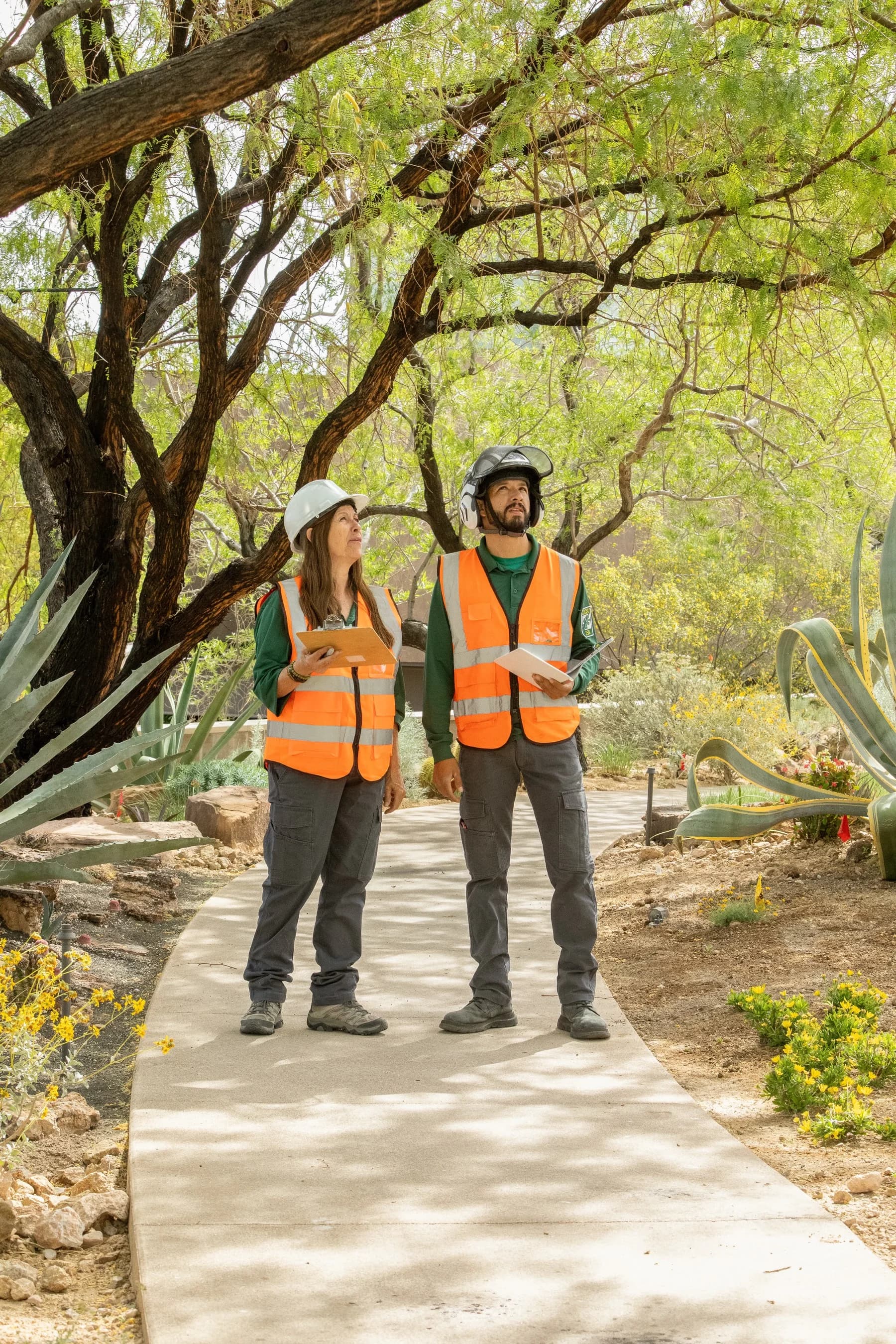
Learn how to spot the warning signs of a dying tree in Las Vegas — from leaf scorch and bark splitting to branch dieback and root decay. A guide for desert homeowners on when to save a tree and when to call for removal.
A dying tree in Las Vegas does not always look the way you expect. In humid climates, a declining tree turns brown, drops leaves, and makes its condition obvious within weeks. In the Mojave Desert, trees can look marginally acceptable for months — even years — while serious internal decline is already underway. By the time most Las Vegas homeowners realize something is wrong, the tree has often passed the point where intervention can save it.
That gap between early warning signs and obvious failure is where the real cost accumulates. A tree that could have been saved with a $300 treatment becomes a $2,500 emergency removal after it drops a major limb across the driveway during a monsoon. A slow decline that goes unaddressed for two seasons turns into a hazard tree that threatens the house, the fence, or the neighbor's property.
Benjamin's Tree Service has been diagnosing and treating declining trees across the Las Vegas Valley since 2001. This guide covers the specific warning signs that indicate a tree is dying in the desert environment, what causes decline in each case, and what you can realistically do about it — including when the honest answer is that the tree needs to come down.
Why Trees Die Differently in Las Vegas
Before walking through the specific signs, it helps to understand why tree decline in the Las Vegas Valley follows patterns that homeowners who moved here from other climates may not recognize.
The Desert Masks Decline
In a climate that receives 30 to 40 inches of rain per year, a tree under stress shows it quickly. Leaves wilt, growth slows visibly, and the contrast between a healthy tree and a struggling one is hard to miss. In Las Vegas, where the baseline conditions are already extreme — 4 inches of annual rainfall, soil pH above 8.0, summer temperatures regularly exceeding 110 degrees — even healthy trees look stressed compared to their counterparts in wetter regions.
This makes it harder to distinguish between a tree that is tolerating desert conditions normally and one that is actively declining. A mesquite that drops some leaves in July might be conserving water (normal) or might be responding to a severed irrigation line (critical). A pine with yellowing needles might have seasonal chlorosis (manageable) or might have a bark beetle infestation (potentially fatal). Context and experience matter more here than in almost any other climate.
Multiple Stressors Stack Up
Trees in Las Vegas rarely die from a single cause. Instead, they decline through a cascade of compounding stressors. A tree weakened by underwatering becomes more susceptible to bark beetles. A tree with iron chlorosis from alkaline soil produces less energy, which weakens its ability to heal pruning wounds, which opens the door to fungal infection. A tree with root damage from construction loses its ability to uptake water efficiently, which mimics drought stress even when the irrigation is running.
Understanding this stacking effect is important because it means the visible symptom you notice — dead branches, discolored leaves, bark damage — is often the final expression of a problem that started months or years earlier with a different root cause entirely.
The Warning Signs: How to Tell If Your Tree Is Dying
These are the symptoms our arborists see most frequently on declining trees across Henderson, Summerlin, Spring Valley, and every neighborhood in the Las Vegas Valley.
1. Leaf Scorch and Premature Leaf Drop
What it looks like: Brown, crispy edges on leaves — especially on the south and west sides of the canopy where sun exposure is greatest. In severe cases, entire leaves turn brown and drop months before the normal fall leaf-drop period.
What it means in Las Vegas: Leaf scorch is the most common visible symptom of tree stress in the valley, and it has multiple possible causes:
- Underwatering — the most frequent cause. The tree cannot pull enough moisture from the soil to replace what evaporates through the leaves during 110-degree days. Scorch appears first on the most exposed leaves and works inward.
- Salt burn — Las Vegas municipal water has high dissolved mineral content. Over time, salts accumulate in the soil and damage fine root tips, reducing the tree's ability to absorb water even when moisture is present. This is particularly common in older neighborhoods in Paradise and central Las Vegas where soil has not been flushed in decades.
- Wind damage — spring wind events with sustained speeds above 40 mph strip moisture from leaves faster than roots can replace it. This causes rapid scorch that appears within 24 to 48 hours of the wind event.
What to do: Check soil moisture at 4 to 6 inches deep at the drip line. If the soil is dry, increase watering depth and volume immediately. If the soil is moist and scorch continues, the problem may be root damage or salt accumulation — a tree assessment can identify the actual cause.
2. Dead Branches and Crown Dieback
What it looks like: Branches in the upper canopy that have no leaves, no buds, and brittle wood that snaps cleanly when bent. The dieback often starts at the branch tips and works back toward the trunk over successive seasons.
What it means in Las Vegas: Crown dieback indicates that the tree is withdrawing resources from its extremities to protect the core. This is a survival mechanism — when a tree cannot sustain its full canopy, it sacrifices outer branches first. In the desert, the most common drivers are:
- Chronic underwatering — the tree has been receiving insufficient water for an extended period, possibly years
- Root loss — from construction damage, soil compaction, or root disease
- Vascular disease — pathogens that block the tree's internal water transport system
If more than 50 percent of the crown shows dieback, the tree is unlikely to recover even with aggressive intervention. Below 50 percent, there is usually a window for treatment if the underlying cause is addressed quickly.
What to do: Have a certified arborist evaluate the extent of dieback and identify the cause. Dead branches should be removed through professional trimming and pruning to reduce weight, improve structure, and eliminate habitat for boring insects. But pruning alone does not fix the underlying problem — it buys time while you address the root cause.
3. Bark Splitting, Cracking, and Peeling
What it looks like: Vertical cracks in the bark, sections of bark peeling away from the trunk, or large areas of exposed wood beneath the bark. In some cases, the exposed wood appears dark, wet, or has a sour smell.
What it means in Las Vegas: Bark damage in the desert has several potential causes:
- Sunscald — the most common cause on young or recently transplanted trees. The intense UV radiation and extreme surface temperatures on the south and west sides of the trunk literally cook the cambium (the living tissue beneath the bark). Surface temperatures on a sun-exposed trunk can exceed 140 degrees in July.
- Frost cracks — Las Vegas winter temperatures occasionally drop into the low 20s. Rapid temperature swings — warm days followed by freezing nights — cause the outer bark to contract faster than the inner wood, creating vertical splits.
- Boring insects — bark beetles, flatheaded borers, and other wood-boring insects create entry holes and galleries beneath the bark. As the infestation progresses, bark loosens and separates from the trunk. Frass (fine sawdust) at the base of the tree or in bark crevices is a telltale sign.
- Internal decay — when bark falls away and reveals soft, punky wood beneath, the tree has internal rot. This is a structural concern, not just a health concern, because it means the trunk or major limbs may fail under wind loading.
What to do: Minor sunscald on young trees can be managed with trunk wraps or shade paint. Frost cracks often heal on their own if the tree is otherwise healthy. Boring insect infestations require professional treatment — and in severe cases, the tree may need to be removed before it becomes a falling hazard. If bark is separating from large sections of the trunk and the wood beneath is soft or dark, call for a professional assessment immediately.
4. Yellowing Leaves (Chlorosis)
What it looks like: Leaves that turn yellow while the veins remain green — a pattern called interveinal chlorosis. The yellowing typically appears first on new growth and can eventually affect the entire canopy.
What it means in Las Vegas: Iron chlorosis is arguably the single most common tree health issue in the Las Vegas Valley. It is caused by the highly alkaline soil (pH 7.5 to 8.5+) that locks up iron in a form that tree roots cannot absorb. Without iron, trees cannot produce chlorophyll, which is why the leaves turn yellow.
Species most affected in Las Vegas include:
- Red maples and silver maples
- Pin oaks and red oaks
- Sweet gums
- Photinia
- Some ash varieties
Desert-adapted species like mesquite, palo verde, and desert willow rarely develop chlorosis because they evolved in alkaline soil conditions.
What to do: Mild chlorosis can be treated with chelated iron soil applications in early spring. Severe or persistent chlorosis often requires trunk injections that deliver iron directly into the tree's vascular system — these work faster and bypass the soil chemistry problem entirely. If chlorosis has persisted untreated for multiple years and the tree has significant canopy loss, recovery becomes uncertain. A tree assessment report can determine whether treatment is viable or whether the tree has declined too far.
5. Fungal Growth on the Trunk or Root Flare
What it looks like: Mushrooms, conks (shelf-like fungal brackets), or white fungal mats growing on the trunk, at the base of the tree, or on exposed roots. The growths may appear after irrigation or the rare Las Vegas rain event.
What it means in Las Vegas: Visible fungal fruiting bodies on a tree almost always indicate internal decay. The fungus is breaking down dead or dying wood inside the tree, and the mushrooms or conks you see on the surface are the reproductive structures that appear when the internal colony is well established.
This is a serious finding because:
- By the time fruiting bodies are visible, the internal decay is typically advanced
- Decay compromises structural integrity — the tree may look fine from the outside but be hollow or structurally weakened inside
- In a valley where monsoon winds regularly exceed 60 mph, a structurally compromised tree is a genuine safety hazard
Common decay fungi in Las Vegas include Ganoderma species (which produce shelf-like conks at the base) and various root rot organisms that thrive when irrigation creates persistent moisture at the root crown.
What to do: Do not ignore fungal growth on any tree. Have an arborist assess the extent of internal decay — this may involve a resistograph or sonic tomography test that maps the wood density inside the trunk without cutting into it. Depending on the extent of decay, the tree may need to be removed. If the decay is limited to one area and the overall structure is still sound, monitoring and risk mitigation (like cabling) may be appropriate.
6. Leaning or Shifting Root Plate
What it looks like: A tree that was previously upright begins to lean, or the soil on one side of the trunk heaves upward while the opposite side shows a gap between the root flare and the ground. After wind events, you may notice the lean has increased.
What it means in Las Vegas: A shifting root plate means the tree's anchorage system is failing. In the desert, this happens for several reasons:
- Shallow root development — trees watered with shallow, frequent irrigation develop root systems concentrated in the top 6 to 12 inches of soil. These shallow roots do not provide adequate anchorage when monsoon winds hit.
- Caliche restriction — in neighborhoods across Henderson, Anthem, and Green Valley, the caliche hardpan layer can prevent roots from growing deeper than 18 inches. Trees planted above unbroken caliche are essentially sitting in a shallow bowl and are vulnerable to uprooting.
- Root rot — persistent moisture at the root crown (from over-irrigation, poor drainage, or buried trunk flare) causes root decay that weakens the anchorage system from below.
What to do: A leaning tree with a shifting root plate is an immediate safety concern. If the lean is new or has increased after a wind event, keep people and vehicles away from the fall zone and call for emergency assessment. In many cases, trees with progressive lean and root plate failure need removal because the anchorage system cannot be rebuilt. Early-stage lean on younger trees can sometimes be addressed with structural support, but this requires professional evaluation.
7. No New Growth in Spring
What it looks like: Deciduous trees that fail to leaf out on schedule, or leaf out with noticeably smaller, fewer, or delayed leaves compared to previous years. Evergreen trees that produce little or no new needle growth at the branch tips.
What it means in Las Vegas: Healthy desert trees respond strongly to the warming temperatures in February and March. When a tree fails to produce normal spring growth, it indicates that the tree's energy reserves are depleted. This happens when:
- The tree did not photosynthesize enough during the previous growing season (due to canopy loss, chlorosis, or defoliation)
- Root damage has reduced the tree's ability to take up water and nutrients
- Vascular disease has impaired internal transport
- The tree is simply dead — and what appeared to be dormancy through winter was actually the end
What to do: Wait until mid-April before concluding a tree has failed to leaf out — some species are slow to break dormancy, and late cold snaps can delay growth. If the tree shows no new growth by late April, scratch the bark on a few branches with your thumbnail. Green tissue beneath the bark means the branch is still alive. Brown, dry tissue means the branch — and possibly the tree — is dead. An arborist can determine whether the tree is recoverable or whether it is time for removal.
What Causes Trees to Die in Las Vegas? The Root Causes
Understanding why trees die in this climate helps you catch problems earlier and make better decisions about which trees to invest in saving.
Irrigation Failure
The number one killer of established trees in the Las Vegas Valley is irrigation failure — not drought in the traditional sense, but broken emitters, disconnected lines, misprogrammed timers, and valves that fail silently. A tree can go from healthy to critically stressed in as little as three weeks during July if its water supply is interrupted.
The problem is compounded by the fact that most Las Vegas irrigation systems were designed for turf and shrubs, not trees. Spray heads that water grass to a depth of 2 inches do nothing for a tree that needs moisture at 12 to 24 inches deep. Trees need dedicated bubbler or drip emitters that deliver water slowly and deeply at the drip line — not at the trunk.
Alkaline Soil and Nutrient Lockout
Las Vegas soil pH typically runs between 7.5 and 8.5, and in some areas exceeds 9.0. At these pH levels, iron, manganese, and zinc are chemically unavailable to plant roots even when they are present in the soil. Trees that are not adapted to alkaline conditions — red maples, pin oaks, sweet gums — slowly starve from micronutrient deficiency even though the nutrients are technically in the ground.
Construction and Landscape Damage
Root damage from trenching, grading, soil compaction, and landscape renovation kills more mature trees in Las Vegas than most homeowners realize. Tree root systems extend far beyond the drip line — often 2 to 3 times the canopy radius — and the majority of absorbing roots are in the top 12 inches of soil. A trenching project that cuts through roots on one side of a tree can eliminate 25 to 40 percent of the root system in a single day. The tree may not show symptoms for 6 to 18 months, by which time the homeowner has forgotten about the trenching and attributes the decline to other causes.
Heat and UV Radiation
Las Vegas receives roughly 294 days of sunshine per year, with UV index regularly reaching 11+ (extreme) during summer. This level of UV radiation damages bark tissue, accelerates moisture loss through leaves, and raises surface temperatures on hard surfaces (including tree bark) to levels that can cook living tissue. Trees that are not adapted to extreme UV — particularly those transplanted from nurseries in milder climates — face a significant disadvantage from day one.
Pests and Disease
While Las Vegas has fewer pest and disease issues than humid climates, the pests that thrive here are aggressive:
- Bark beetles target stressed trees — particularly pines and elms. An established beetle infestation in a Mondell pine can kill the tree within a single season.
- Flatheaded borers attack a range of hardwood species, targeting trees weakened by drought or transplant stress.
- Sooty canker is a fungal disease that enters through pruning wounds and sunscald damage. It is particularly common on mulberry and ash trees in the valley.
- Texas root rot (Phymatotrichopsis omnivora) kills trees rapidly by destroying the root system. It is present in southern Nevada soils and can take down a mature tree in weeks once symptoms appear.
When to Save a Tree vs. When to Remove It
This is the question our arborists answer most often on tree assessment calls across the Las Vegas Valley. The answer depends on several factors.
Save the Tree When:
- Less than 50 percent canopy loss — trees with more than half their canopy intact generally have enough energy reserves to recover if the stressor is removed
- Root system is intact — if the roots are healthy and the problem is above-ground (chlorosis, pest infestation, storm damage), recovery is usually possible
- The cause is correctable — a broken irrigation line, treatable chlorosis, or a manageable pest issue can be fixed. If the cause is the tree's fundamental incompatibility with Las Vegas conditions (wrong species for the climate), treatment is a holding action, not a cure.
- The tree provides significant value — mature shade trees that reduce cooling costs, screen views, or contribute meaningfully to property value are worth investing in. A 30-year-old mesquite that shades the entire back patio is worth a $500 treatment budget that a 5-year-old ornamental is not.
Remove the Tree When:
- More than 50 percent canopy loss with ongoing decline — at this point, recovery is unlikely even with aggressive treatment
- Structural failure is imminent — leaning trunk, major cracks, significant internal decay, or root plate failure. Safety overrides all other considerations.
- The species is fundamentally wrong for the location — a ficus with roots destroying the foundation, a mulberry dropping limbs every windstorm, or a tree that will require expensive iron treatments every year indefinitely. At some point, removing and replanting with an appropriate species is the better long-term investment.
- The tree poses a hazard to structures or people — dead branches over the house, a trunk leaning toward the power line, or root damage threatening the pool deck or foundation. If the risk cannot be adequately reduced through trimming or cabling, removal is the responsible choice.
What to Do Right Now If You Think Your Tree Is Dying
If you have read through these warning signs and recognized one or more in a tree on your property, here is the immediate action plan:
1. Check your irrigation — verify that the tree's dedicated emitters are functioning, the timer is set correctly, and water is actually reaching the root zone at 12 to 24 inches deep. Fix any irrigation issues immediately.
2. Stop unnecessary pruning — a stressed tree needs every leaf it has to produce energy. Do not remove live branches from a struggling tree unless they pose an immediate safety hazard. Let the arborist make pruning decisions.
3. Document what you see — take photos of the symptoms from multiple angles. Note when you first noticed the problem and whether it has progressed. This information helps the arborist diagnose the issue faster.
4. Call for a professional assessment — a certified arborist can diagnose the specific cause of decline, assess whether the tree is saveable, and recommend the most effective treatment. Guessing at the cause and applying the wrong treatment wastes time and money while the tree continues to decline.
Neighborhoods Where We See the Most Tree Decline
Certain areas of the Las Vegas Valley consistently present more tree health challenges due to soil conditions, elevation, wind exposure, or the age of the landscaping.
Summerlin and the western valley experience the most severe wind conditions in the metro area. Trees here face higher mechanical stress, faster moisture loss, and more frequent storm damage than properties in the central valley.
Henderson and Anthem sit on some of the hardest caliche in the region. Root restriction is a constant issue, and trees planted without proper caliche preparation frequently stall and decline within 5 to 10 years.
Paradise and central Las Vegas have the oldest residential landscapes in the valley. Mature trees planted 30 to 50 years ago are aging out of their structural lifespan, and decades of salt accumulation in the soil compound the challenge.
North Las Vegas and Enterprise include large swaths of newer development where builders planted inexpensive, fast-growing species (often ficus, mulberry, or Siberian elm) that are now causing root damage, structural failures, and ongoing maintenance headaches.
Spring Valley and Green Valley have dense residential neighborhoods where trees were planted too close to block walls, driveways, and foundations during the construction boom of the 1990s and 2000s. Root conflicts and space restrictions contribute to chronic decline in these areas.
Frequently Asked Questions
How can I tell if my tree is dead or just dormant?
Scratch the bark on a few branches with your thumbnail or a small knife. If the tissue beneath the bark is green and moist, the branch is alive. If it is brown and dry, the branch is dead. Test branches in several areas of the canopy — a tree can be alive in the lower canopy while the upper crown has died. If every branch you test shows brown tissue, the tree is likely dead. Wait until mid-April before making a final determination, as some species break dormancy late in Las Vegas.
Can a tree recover from losing more than half its canopy?
It is possible but unlikely without professional intervention and correction of the underlying cause. Trees that have lost more than 50 percent of their canopy have depleted energy reserves and reduced ability to photosynthesize. Recovery requires identifying and eliminating the stressor, providing supplemental care (deep watering, soil amendments, targeted fertilization), and patience — it can take 2 to 3 growing seasons to see meaningful recovery. A tree assessment by a certified arborist can give you a realistic prognosis.
Should I fertilize a dying tree to help it recover?
Not without professional guidance. Fertilizing a stressed tree is like feeding a patient with a broken jaw — the intent is right but the delivery method matters. If the tree's root system is compromised, it cannot uptake fertilizer effectively, and excess nutrients in the soil can actually damage remaining roots through salt burn. An arborist can determine whether fertilization is appropriate and which specific nutrients the tree needs based on its condition and soil chemistry.
Is it cheaper to treat a dying tree or remove it and plant a new one?
It depends on the tree's size, species, condition, and location. As a general guide, treating a moderately declining mature shade tree typically costs $200 to $800 per year in Las Vegas (iron treatments, deep root watering, pest management). Removing a mature tree runs $1,500 to $5,000+ depending on size, access, and complexity, plus $200 to $500 for a replacement tree and planting. If the mature tree provides significant shade that reduces cooling costs by $500 to $1,500 per summer, treatment is often the better investment as long as the tree has a realistic chance of recovery. If the prognosis is poor, early planned removal is more cost-effective than years of treatment followed by emergency removal after a failure.
How often should I have my trees professionally inspected in Las Vegas?
Annual inspections are the standard recommendation for the Las Vegas Valley, given the number of simultaneous stressors trees face here. For trees over 30 years old, trees near structures, or trees showing any signs of decline, twice-annual inspections (spring and late summer) provide the best early detection of problems. The cost of an annual tree assessment is a fraction of what emergency removal or property damage repair costs when a problem goes undetected.
Schedule a Free Tree Inspection
Catching a dying tree early is the difference between a treatable condition and an expensive emergency. The warning signs covered in this guide — leaf scorch, crown dieback, bark damage, chlorosis, fungal growth, root plate shifting, and absent spring growth — are all problems that a certified arborist can assess, diagnose, and often treat when caught in time.
Benjamin's Tree Service has been diagnosing and treating tree decline across the Las Vegas Valley since 2001. Our ISA Certified Arborists work in Las Vegas, Henderson, Summerlin, North Las Vegas, Spring Valley, Paradise, Enterprise, Green Valley, Anthem, Centennial Hills, and Boulder City.
Call 725-300-0399 for a Free Tree Inspection. We will assess your trees, identify exactly what is causing the decline, and give you an honest recommendation — whether that is a targeted treatment plan or a straightforward removal. Either way, you will know exactly where your trees stand.
Benjamin's Tree Service
ISA Certified Arborists serving Las Vegas & the surrounding areas since 2001.