
Las Vegas trees face challenges that don't exist anywhere else in the country. Extreme heat, caliche soil, single-digit humidity, and monsoon winds create conditions where standard tree care advice can actually harm your trees.
Most tree care advice in the United States is written for places where it rains regularly, the soil is slightly acidic, and summer temperatures top out around 95 degrees. Las Vegas is none of those things. The Mojave Desert presents a combination of environmental stressors so severe that many of the care practices taught in arborist programs — practices that work perfectly in the Southeast, Midwest, and Pacific Northwest — can damage or kill trees when applied here without modification.
This is not a matter of opinion. It is measurable, observable, and backed by decades of field experience. Benjamin's Tree Service has been working with trees across the Las Vegas Valley since 2001, and the single most common issue we encounter is damage caused by well-meaning homeowners following advice that was never designed for the desert.
Understanding why Las Vegas trees need fundamentally different care is the first step toward keeping them healthy. This guide covers the science behind that difference.
The Desert Is Not Just Hot — It Is Hostile
When people think about what makes Las Vegas hard on trees, they usually start and stop with heat. Temperatures reaching 115 degrees in July and August are obviously extreme. But heat alone does not explain why tree care here requires a completely different approach. Five environmental factors work simultaneously to create conditions unlike any other major metro area in the country.
Extreme Heat Combined With Intense UV Radiation
Surface temperatures on exposed Las Vegas soil routinely exceed 140 degrees during summer. This is not air temperature — this is what the ground itself reaches under direct sun. Tree roots in the top 6 inches of soil are cooking. Meanwhile, the UV index in the Las Vegas Valley regularly hits 11, the maximum on the scale. UV radiation at this intensity breaks down bark tissue on the south and southwest sides of tree trunks, a condition called sunscald. Young trees and recently pruned trees are especially vulnerable because they have less canopy to shade their own structure.
In a humid climate like Houston or Miami, cloud cover and atmospheric moisture filter a significant portion of UV. Las Vegas gets over 300 days of sunshine per year with virtually no atmospheric filtration. The radiation that reaches your trees here is more intense than almost anywhere else people live in the United States.
Single-Digit Humidity and Rapid Moisture Loss
Relative humidity in Las Vegas drops below 10 percent during summer — sometimes falling to 4 or 5 percent. To put that in perspective, the Sahara Desert averages around 25 percent humidity. At 5 percent humidity, trees lose water through their leaves at a rate that would be impossible in most other climates.
A mature shade tree in Henderson or Summerlin can transpire 50 to 100 gallons of water per day during peak summer. That water has to come from somewhere — and with annual rainfall averaging just 4.2 inches, it comes entirely from irrigation. Any failure in the watering system during July or August — a clogged emitter, a broken timer, a missed cycle — can put a tree into irreversible decline within a single week.
Caliche Soil — The Concrete Under Your Yard
Much of the Las Vegas Valley sits on caliche, a layer of calcium carbonate hardpan that can be as dense as concrete. Caliche exists at varying depths across the valley, from 6 inches below grade in parts of North Las Vegas to several feet down in Enterprise and Green Valley. When tree roots hit caliche, they stop. They cannot penetrate it without mechanical intervention.
This creates two problems. First, trees develop shallow, laterally spreading root systems because they have nowhere to go but sideways. Shallow roots make trees vulnerable to wind throw and more likely to damage driveways, block walls, sidewalks, and foundations. Second, caliche raises soil pH to 7.5 or higher. At this pH, iron, manganese, and zinc become chemically locked in the soil. Trees cannot absorb these micronutrients even when they are physically present. The result is iron chlorosis — yellowing leaves with green veins — which is the single most common tree health issue in the Las Vegas Valley.
Monsoon Winds and Microbursts
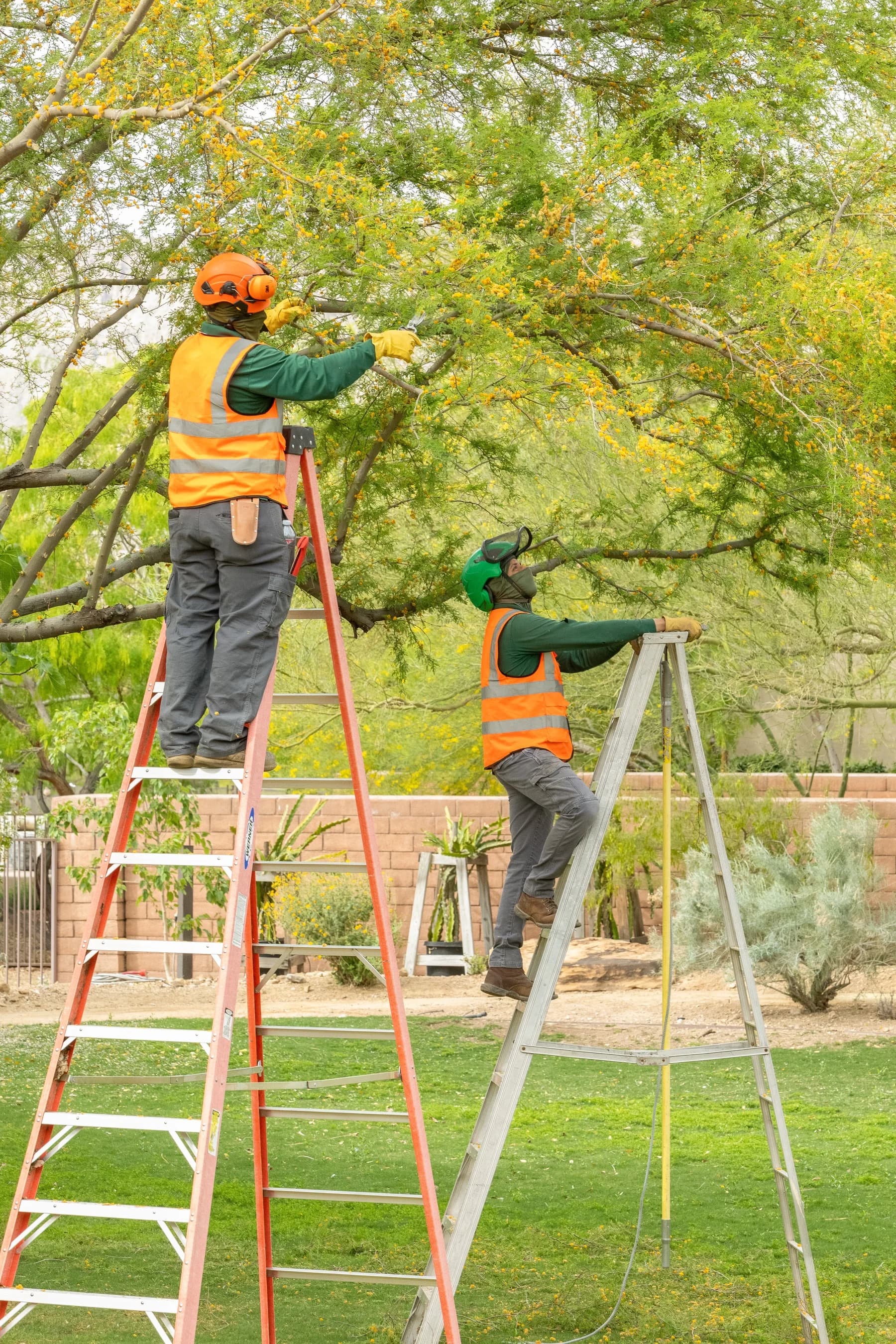
The Las Vegas monsoon season runs from roughly July through September, bringing sudden, violent wind events that can shift from calm to 70 mph gusts in minutes. These events are not like the steady winds that trees in the Great Plains or coastal areas adapt to over time. Monsoon microbursts deliver massive, sudden force that exploits every structural weakness a tree has — codominant stems, included bark, top-heavy canopies, shallow root plates.
The Spring Valley and western Las Vegas Valley are particularly exposed. In a single monsoon event, Benjamin's Tree Service has responded to dozens of calls for trees that snapped, uprooted, or dropped major limbs. In nearly every case, the failure point was a structural defect that was identifiable months or years before the storm, but went unaddressed because the tree looked fine from the outside.
Water Restrictions and Policy Pressure
Nevada law (AB 356, enacted in 2021) mandates the removal of all non-functional turf in the Las Vegas Valley by 2027. The Southern Nevada Water Authority continues to tighten irrigation budgets and enforce watering schedules. For trees, this creates an increasingly narrow margin — they need consistent deep watering to survive, but the infrastructure and regulations around water use keep changing. Homeowners who set their irrigation and forget it risk both wasting water and underwatering their trees as rules shift.
Why Standard Tree Care Advice Fails in Las Vegas
The disconnect between mainstream tree care advice and Las Vegas reality is not a small gap — it is a chasm. Here are the most common examples of sound advice from other climates that causes real harm when applied in the Mojave Desert.
"Water Your Trees Twice a Week"
This is reasonable in a climate with 30 to 50 inches of annual rainfall and soil that holds moisture. In Las Vegas, twice-weekly shallow watering encourages roots to stay near the surface where the soil dries out fastest. The correct approach is deep, infrequent watering — delivering large volumes of water every 5 to 7 days in summer, applied at the drip line, not the trunk. Deep watering pushes roots downward, where soil stays cooler and retains moisture longer.
"Prune in Late Winter Before Spring Growth"
This is excellent advice for deciduous trees in temperate climates. In Las Vegas, it is only partially correct. Winter pruning is fine for structural work on most deciduous species. But the timing matters more precisely here because the Las Vegas growing season starts earlier. By mid-February, many trees are already breaking dormancy. Prune too late and you cut into actively growing tissue. Prune too early and unseasonable cold snaps — not uncommon in the northwest valley — can damage exposed wood. The window is narrower than what textbooks suggest.
"Mulch Around the Base of the Tree"
Organic mulch is beneficial in most climates because it retains moisture and moderates soil temperature. In Las Vegas, organic mulch piled against tree trunks can trap moisture against the bark in a climate where bark needs to dry quickly. The combination of trapped moisture and extreme heat creates conditions for crown rot and fungal disease. Mulch should be applied in a donut shape — not touching the trunk — and desert-adapted gravel or decomposed granite is often a better choice than organic material in the hottest exposures.
"Fertilize in Spring and Fall"
Generic fertilizer programs miss the point in Las Vegas. The primary nutrient issue here is not nitrogen, phosphorus, or potassium — it is micronutrient lockout caused by alkaline soil pH. Dumping standard NPK fertilizer on a tree with iron chlorosis does nothing for the chlorosis and can actually promote weak, leggy growth that is more vulnerable to heat and wind stress. What Las Vegas trees need is chelated iron applications, sometimes delivered by trunk injection when soil pH is too high for root uptake to be effective.
The Economic Reality of Ignoring Desert-Specific Care
Neglecting proper tree care in Las Vegas does not just affect tree health — it hits property values and maintenance budgets.
Property Value Impact
The USDA Forest Service estimates that mature trees increase residential property values by 7 to 19 percent. In a Las Vegas housing market where the median home price exceeds $400,000 (per the Las Vegas Realtors association, 2025), that translates to $28,000 to $76,000 in value tied directly to your landscape. A dead or dying tree in the front yard does the opposite — it signals neglect and reduces curb appeal.
Emergency Removal Costs
An emergency tree removal after a monsoon event or structural failure costs significantly more than planned removal. Emergency work requires immediate response, often involves hazardous conditions (downed power lines, damaged structures), and frequently happens during the busiest time of year for tree service companies. A planned tree removal with adequate lead time is far more cost-effective than a crisis response.
Infrastructure Damage From Root Conflicts
Trees planted too close to structures — or species with aggressive root systems planted without root barriers — cause thousands of dollars in damage to driveways, block walls, sewer lines, and foundations across the valley every year. A tree assessment report that identifies root conflicts early costs a fraction of the hardscape or foundation repair that results from ignoring the problem.
Cooling Cost Savings at Risk
Properly placed shade trees in Las Vegas reduce residential cooling costs by 15 to 35 percent during summer, according to the U.S. Department of Energy. When those trees decline and lose canopy coverage — whether from improper pruning, underwatering, or untreated chlorosis — energy bills climb. Protecting your trees protects your utility budget.
What Proper Las Vegas Tree Care Actually Looks Like
Given everything above, what does tree care look like when it is calibrated for the Mojave Desert?
Deep Watering on a Desert Schedule
Water deeply every 5 to 7 days in summer, every 7 to 14 days in spring and fall, and every 14 to 21 days in winter. Apply 15 to 20 gallons per inch of trunk diameter at each session. Water at the drip line — not the trunk. Use bubblers or deep-root watering systems rather than standard sprinkler heads. Check the irrigation system monthly because a single failed emitter in July can kill a tree.
Structural Pruning by a Certified Arborist
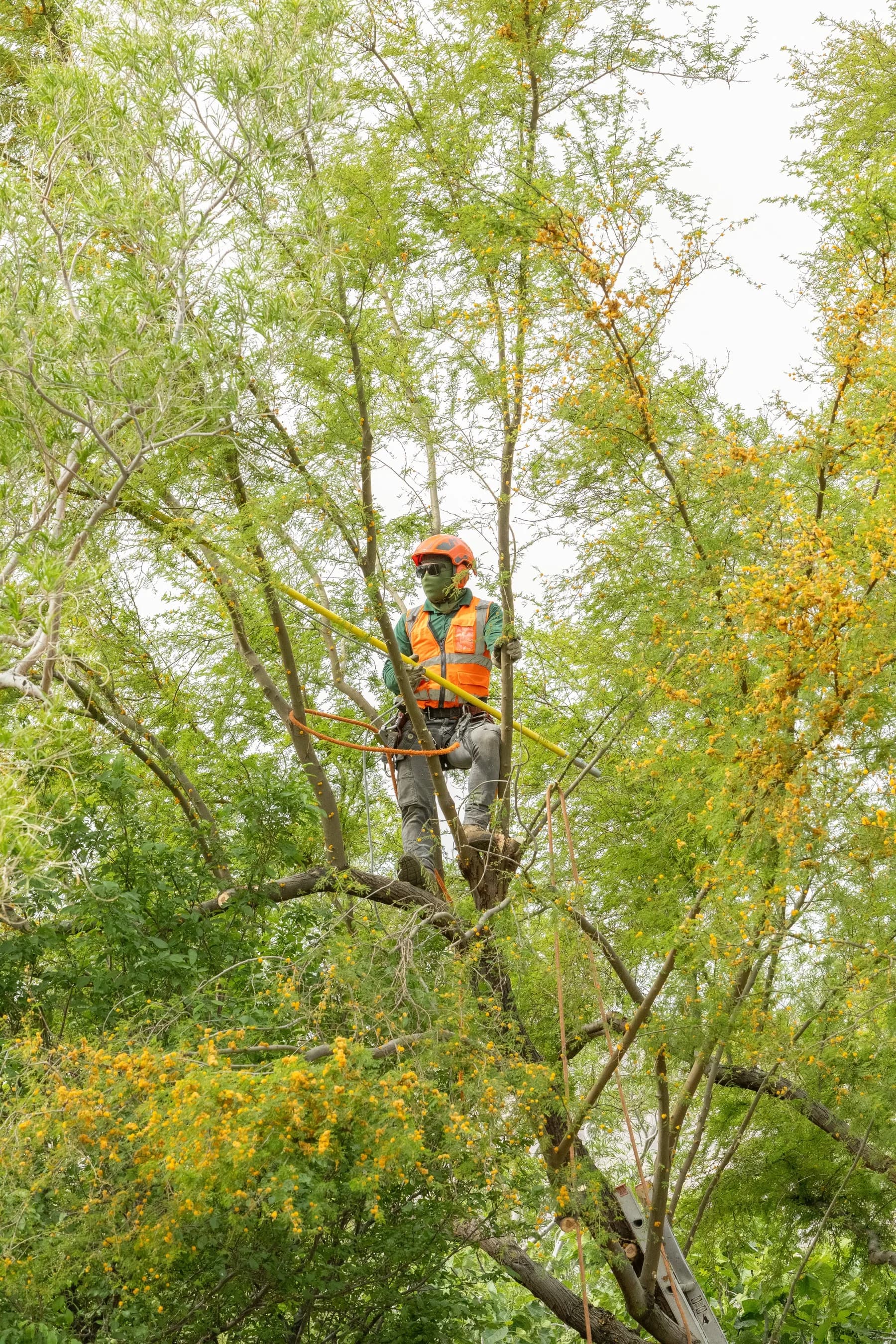
Desert trees need structural pruning to reduce wind resistance and prevent the catastrophic failures that monsoon events cause. This means thinning canopies to allow wind to pass through, removing codominant stems or installing cabling, and maintaining a balanced crown-to-root ratio. This is skilled work that requires understanding how trees respond to the specific wind patterns and heat loads of the Las Vegas Valley. Professional trimming and pruning is not a luxury here — it is storm damage prevention.
Soil Amendment and Micronutrient Management
Address alkaline soil with chelated iron applications in spring. For severe chlorosis, trunk injections deliver iron directly to the vascular system. Test soil pH before planting new trees and amend with sulfur if needed. When planting in caliche, break through the hardpan or create a planting well that allows roots to establish below the restrictive layer.
Species-Appropriate Planting and Placement
Choose trees that are proven performers in the Mojave Desert — mesquite, palo verde, desert willow, ironwood, African sumac, and Chinese pistache among them. Plant at least 15 to 20 feet from foundations, 10 feet from driveways and block walls, and with full consideration of the mature canopy size. A tree service plan that maps out your property's landscape goals, soil conditions, and irrigation capacity is the smartest investment you can make before putting a tree in the ground.
Regular Professional Assessments
An annual tree assessment by a certified arborist catches problems — root conflicts, structural defects, early chlorosis, pest infestations — before they become expensive emergencies. In a climate where trees face this many simultaneous stressors, annual checkups are not optional. They are the difference between a tree that thrives for 50 years and one that becomes a removal job in 10.
The Neighborhoods That Face the Toughest Conditions
While every part of the Las Vegas Valley deals with heat, alkaline soil, and low humidity, some areas present additional challenges.
Summerlin and the western valley sit at higher elevation and face the most severe wind exposure. Trees here need more aggressive structural pruning to withstand spring and monsoon wind events.
Henderson and Anthem sit on some of the hardest caliche in the valley. Planting and root management require extra attention in these communities.
North Las Vegas and Paradise include some of the oldest residential neighborhoods in the valley, where mature trees planted 30 to 50 years ago are reaching the end of their structural lifespan and need assessment for safety.
Spring Valley and Enterprise have high concentrations of residential properties with trees planted too close to block walls and property lines — a legacy of 1990s and 2000s landscape design that did not account for mature root spread.
Frequently Asked Questions
Why do my trees look healthy in one part of Las Vegas but struggle in another?
Soil composition, elevation, wind exposure, and irrigation infrastructure vary significantly across the Las Vegas Valley. A tree that thrives in the clay-loam pockets of Paradise may struggle in the heavy caliche of Henderson. Microclimates created by buildings, walls, and neighboring properties also affect temperature and wind patterns at the individual tree level.
Can I use the same tree care schedule as someone in Phoenix or Tucson?
Phoenix and Tucson share some similarities with Las Vegas — heat, low rainfall, alkaline soil — but the differences matter. Las Vegas sits at higher elevation (2,000 feet vs. 1,100 feet for Phoenix), gets less total rainfall, has harder caliche, and experiences more extreme wind events. Care schedules should be calibrated specifically for the Las Vegas Valley, not borrowed from other desert cities.
How do I know if my trees are getting enough water?
Check soil moisture at 4 to 6 inches deep near the drip line. If the soil is dry at that depth, your tree needs water regardless of what your timer says. Other signs of underwatering include leaf scorch (brown, crispy leaf edges), premature leaf drop, and wilting that does not recover overnight. If you see these symptoms during summer, increase watering volume and frequency immediately.
Is it worth saving a struggling tree or should I just remove it and start over?
It depends on the species, the root system condition, and the canopy loss. A mature shade tree that provides significant cooling value is almost always worth trying to save if the root system is intact and less than 50 percent of the canopy has died back. A certified arborist can evaluate the specific situation and give you an honest answer. Call 725-300-0399 for a Free Tree Inspection and we will tell you exactly where your tree stands.
What is the single most important thing I can do for my trees in Las Vegas?
Water correctly. Not more often — more deeply. Deep, infrequent watering at the drip line on a desert-calibrated schedule prevents more tree problems in Las Vegas than any other single practice. If you do nothing else, get your irrigation dialed in.
Get Your Trees Inspected by a Las Vegas Specialist
Every tree in the Las Vegas Valley faces conditions that trees in other cities simply do not encounter. The combination of extreme heat, UV radiation, alkaline caliche soil, single-digit humidity, and violent monsoon winds creates an environment where generic tree care is not enough. Your trees need care designed specifically for the Mojave Desert, delivered by arborists who understand what the desert demands.
Benjamin's Tree Service has been caring for Las Vegas trees since 2001. Our ISA Certified Arborists work across Las Vegas, Henderson, Summerlin, North Las Vegas, Spring Valley, Paradise, Enterprise, Green Valley, Anthem, Centennial Hills, and Boulder City.
Call 725-300-0399 for a Free Tree Inspection. We will assess your trees, explain exactly what they need, and make sure they are getting the right care for the right climate.
Benjamin's Tree Service
ISA Certified Arborists serving Las Vegas & the surrounding areas since 2001.