
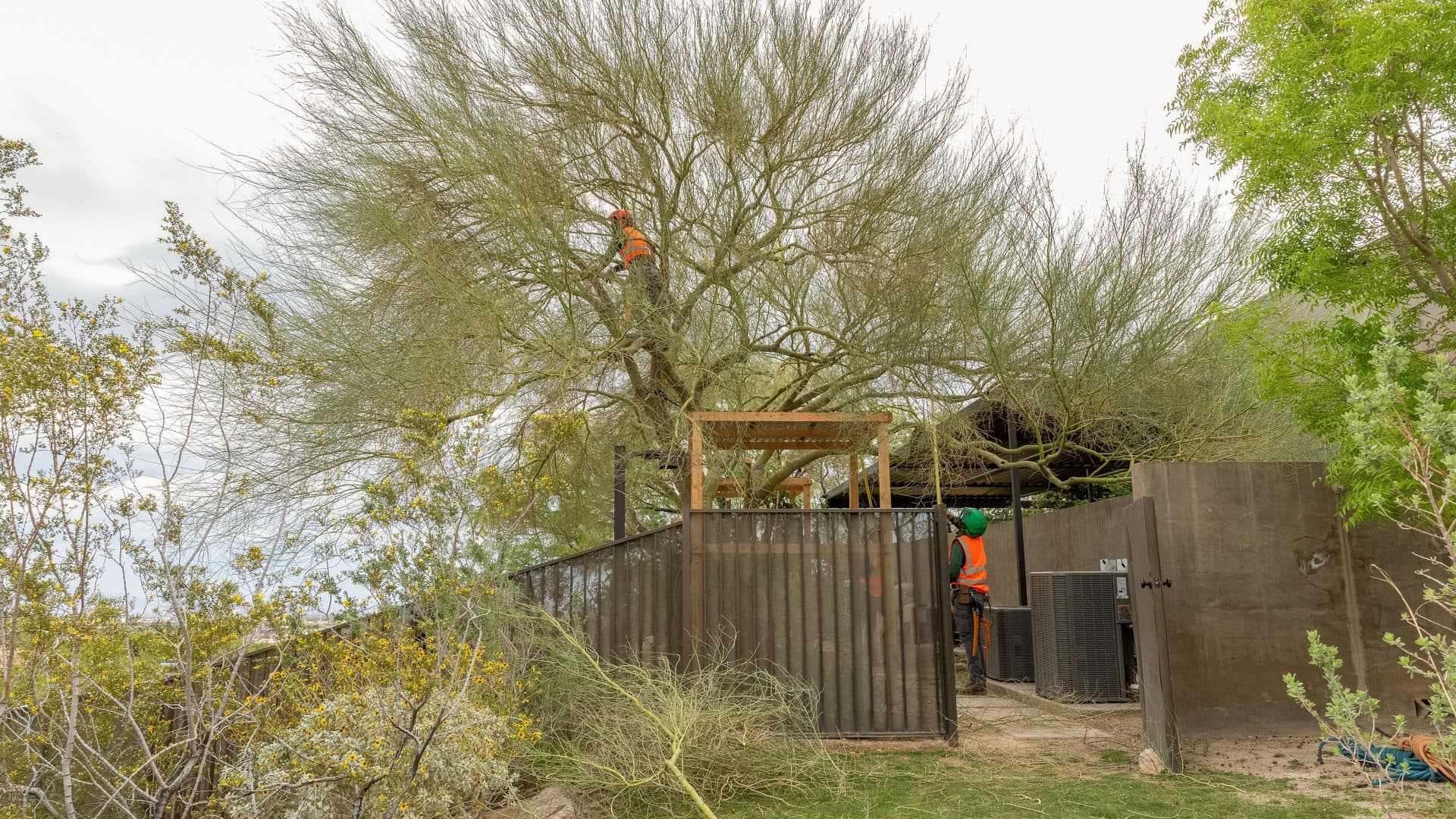
Tree removal cost in Las Vegas runs $300-$2,200. See 2026 price ranges, what drives your quote up or down, and how to compare bids without overpaying.
Tree removal cost in Las Vegas usually falls between $300 and $2,200, with most single-tree residential jobs landing in the $600 to $1,400 range. The spread is wide for a reason: a 20-foot ornamental in an open front yard is a completely different job from a 60-foot mesquite leaning over a pool enclosure behind a narrow gate.
Benjamin's Tree Service has removed trees across the Las Vegas Valley since 2001. Our licensed and insured crews work under an ISA Certified Arborist (ISA Cert. WE-15785A), and our 5-star Google-rated team provides free written estimates before any work begins. This guide explains what actually drives the number on your quote, where homeowners overpay, and how to compare bids without getting burned.
Quick Summary
- Most valley single-tree removals fall between $600 and $1,400; small trees can start near $300, and large or high-risk removals can exceed $2,500
- Height, trunk diameter, and canopy spread are the biggest cost drivers, followed by access and what sits underneath the tree
- A backyard tree behind a narrow gate costs more than an identical front-yard tree with direct truck access
- Stump grinding is almost always a separate line item, commonly $75 to $400
- Confirm general liability and workers' compensation insurance before accepting any bid
- Only an on-site estimate is binding — a phone quote is an educated guess
Table of Contents
- Typical price ranges in the Las Vegas Valley
- What drives the cost up or down
- What a professional quote should include
- Where homeowners overpay
- How to compare estimates fairly
- Frequently asked questions
What Tree Removal Cost in Las Vegas Looks Like in 2026
The ranges below reflect what we typically see for residential removals across Clark County. Treat them as planning numbers rather than quotes. Each assumes normal working conditions, standard business hours, and no crane requirement.
- Small trees under 25 feet — roughly $300 to $650. Ornamental pears, young acacias, small citrus, and multi-trunk shrubs that outgrew their space.
- Medium trees 25 to 50 feet — roughly $600 to $1,300. This covers most mature mesquites, palo verdes, and ash trees in established valley neighborhoods.
- Large trees 50 to 80 feet — roughly $1,200 to $2,400. Mature pines, eucalyptus, and cottonwoods usually land here.
- Very large or high-risk removals — $2,200 and up. Trees over 80 feet, severely compromised trunks, or jobs requiring a crane or extended traffic control.
- Palm removal — roughly $300 to $1,200 depending on height. Tall Mexican fan palms in tight side yards can exceed that range.
- Stump grinding — typically $75 to $400 as a separate line item. Our stump grinding cost guide breaks that down in detail.
Two trees of identical height can price very differently. The rest of this guide explains why.
What Drives the Cost Up or Down
Height and Trunk Diameter
Height determines how the tree comes down. A crew can often fell a small tree in one or two cuts. A tall tree near a structure has to be climbed and dismantled in sections, with each piece rigged and lowered by rope. That is slower, more technical work and requires more crew on site.
Trunk diameter matters just as much. Doubling the diameter roughly quadruples the wood volume, which increases cutting time, equipment wear, and the number of loads hauled away.
Species and Wood Density
Desert species behave differently on the saw. Mesquite and olive are dense and heavy, which slows cutting and adds weight to every load. Palo verde and acacia are lighter but often grow sprawling multi-trunk forms that require many individual cuts. Palms are their own category — a fan palm is mostly water weight, and the debris is bulky and awkward rather than dense. Height drives palm pricing more than trunk size, which is why our palm tree service quotes them separately.
Access to the Tree
This is where quotes diverge most, and it is the factor homeowners most often overlook.
A front-yard tree the chipper can park beside is the least expensive scenario. A backyard tree behind a 36-inch gate means every branch is carried by hand through the side yard. On some valley properties the only path runs through the house or over a block wall. Each obstacle adds labor hours to an otherwise identical removal.
- Direct truck and chipper access — lowest cost
- Standard side-gate access with a clear path — modest increase
- Narrow gate, stairs, retaining walls, or steep grade — significant increase
- No ground access, requiring a crane or lift — largest increase
What Sits Underneath and Around the Tree
Pools, patio covers, block walls, HVAC units, irrigation lines, and neighboring property all raise technical difficulty, and so do overhead utility lines. Work near energized conductors is regulated and may require coordination with the utility. A tree that could be felled in ten minutes in an open lot may need three hours of careful rigging when it overhangs a pool deck. Our guide to tree removal near a house covers those safety considerations in more depth.
Tree Condition
A structurally sound tree is predictable. A dead, hollow, or storm-damaged tree is not. Compromised wood cannot be trusted to hold a climber's weight or a rigging load, so the crew may need a lift, additional rigging points, or a different dismantling sequence. Hazardous condition often increases cost even when the tree is small. If you are unsure whether a tree is failing, a tree assessment report documents its condition before you commit to removal.
Debris Volume and Disposal
Hauling and disposal are real costs. Most quotes include chipping brush and removing wood, but confirm it in writing. Some homeowners keep firewood rounds on site to reduce the haul, which can lower the total modestly. Ask whether the crew will rake and blow the work area afterward.
Emergency and After-Hours Timing
A tree that fails during monsoon season and lands on a roof is priced differently from a scheduled removal. Emergency response involves after-hours mobilization, crew reassignment, and hazard stabilization. If the situation is urgent, our emergency tree service team responds throughout Clark County. If the tree is not an active hazard, scheduling normally will cost less.
Permits, HOAs, and Property Type
Most private residential removals in the valley do not require a municipal permit, but requirements vary by jurisdiction and can apply to trees in the public right-of-way, on commercial parcels, or within certain developments. HOAs frequently run their own approval process. Our post on tree removal permits in Clark County walks through when to check. Commercial and multi-family sites often need traffic control, night work, or phased scheduling, which our commercial tree service and HOA and property manager crews handle routinely.
What a Professional Quote Should Include
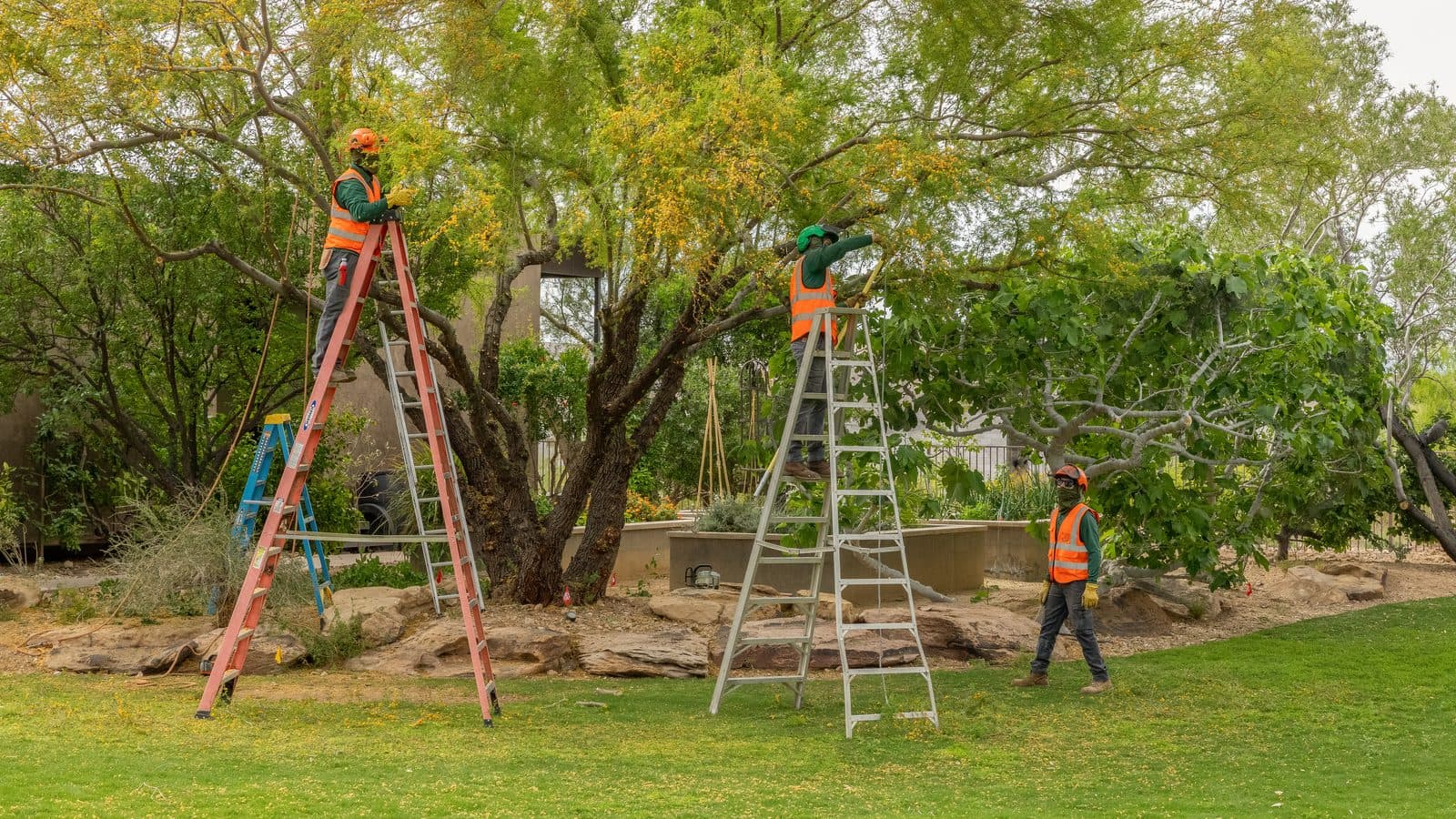
A written estimate should leave nothing ambiguous. Before you sign, confirm the document states:
- The specific tree or trees, identified by location and species
- Whether the price covers full removal or only partial work such as canopy reduction
- The cut height of the remaining stump, and whether grinding is included or separate
- Grinding depth, if stump work is included
- Whether wood, brush, and chips will be hauled away or left on site
- Cleanup expectations for the work area
- Proof of general liability and workers' compensation insurance
- Whether a certified arborist supervises the crew
The International Society of Arboriculture's guidance on hiring an arborist is a useful checklist, and you can confirm a credential through the ISA find an arborist directory.
Where Las Vegas Homeowners Overpay
Taking the Lowest Bid Without Checking Insurance
An uninsured crew can quote well below a licensed competitor because it is not carrying the cost of coverage. If an uninsured worker is injured on your property, or a dropped limb damages your roof, you may be the one exposed. Ask for certificates of insurance and confirm they are current.
Storm-Chasing Door Knockers
After a monsoon event, unsolicited crews canvass valley neighborhoods offering same-day work at pressure-discounted prices. Some are legitimate. Others collect a deposit and disappear, or start a removal and abandon it half-finished. Do not hand a large up-front deposit to a crew you did not seek out.
Paying for Topping Instead of Proper Care
Homeowners sometimes accept a cheap topping job as an alternative to removal. Topping is not a legitimate practice — it disfigures the tree, triggers weak regrowth, and often leads to a more expensive removal within a few years. Our post on why tree topping hurts trees explains the damage. When a tree can be saved, proper trimming and pruning is the correct alternative.
Removing a Tree That Did Not Need to Come Down
Removal is permanent, and mature shade is genuinely valuable in a climate like ours. A declining tree is sometimes recoverable through corrective pruning, irrigation changes, or deep root feeding. Get an arborist's opinion before assuming removal is the only path.
How to Compare Estimates Fairly
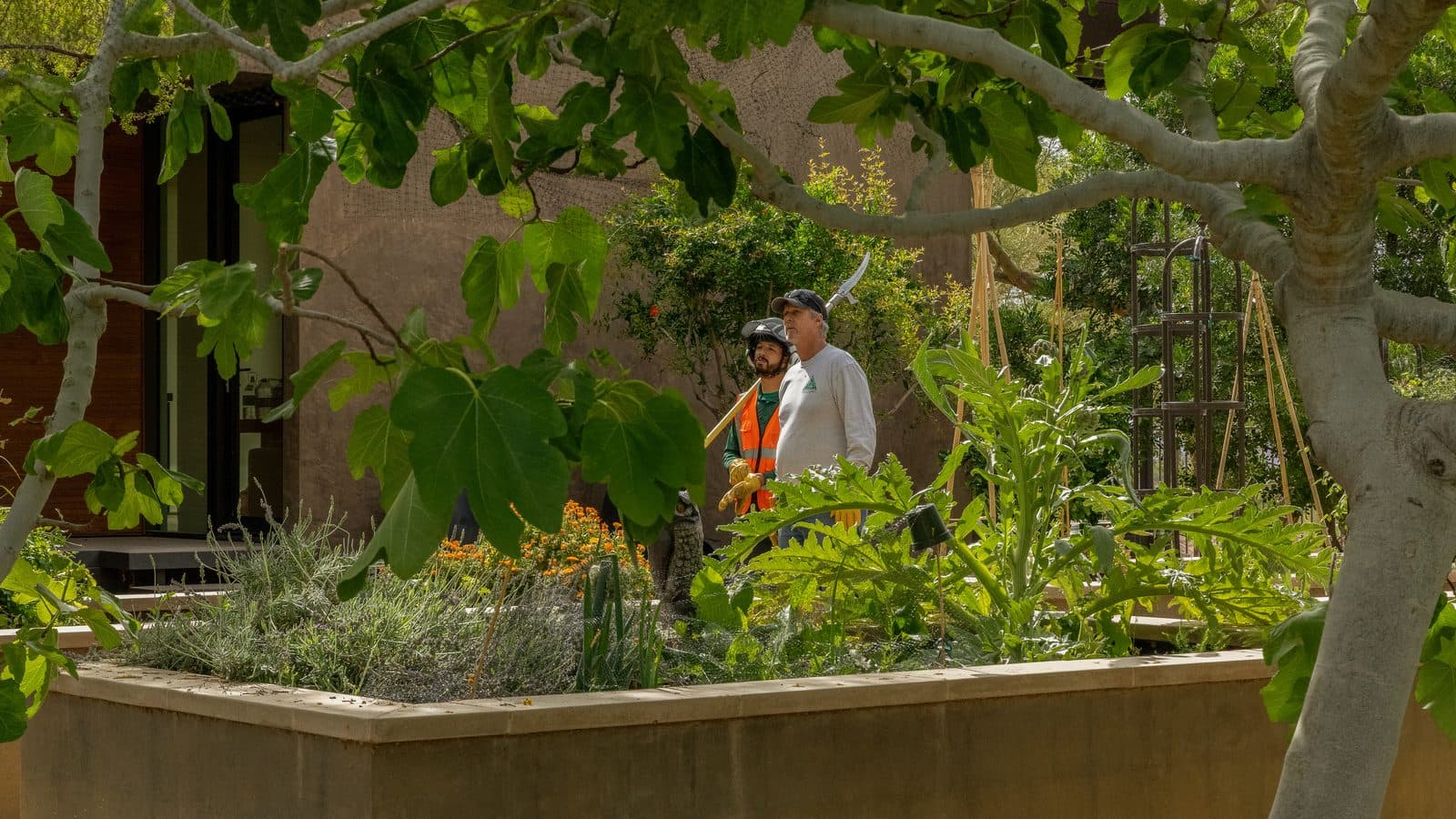
Collect two or three written estimates and compare scope, not just the bottom line.
- Confirm each bid covers the same work — removal only, or removal plus grinding and haul-away
- Check stump handling; one bid may grind to 8 inches while another leaves a 12-inch stub
- Ask who performs the work: an employed crew or a subcontractor
- Confirm the timeline and whether it depends on weather
- Verify insurance for every bidder, not only the cheapest
- Ask whether the price is fixed or subject to change once work begins
When one bid comes in dramatically lower than the rest, the usual explanation is a narrower scope or missing insurance rather than superior efficiency.
Frequently Asked Questions
How much does tree removal cost in Las Vegas on average?
Most single-tree residential removals in the valley run between $600 and $1,400. Small trees can start near $300, and large or high-risk removals requiring a crane can exceed $2,500. Only an on-site estimate can price your specific tree.
Is stump grinding included in tree removal?
Usually not. Grinding is typically quoted separately, commonly $75 to $400 depending on diameter, depth, and caliche conditions. Ask for it as its own line item so you can compare bids accurately.
Does removing several trees at once cost less per tree?
Generally yes. Mobilization, equipment transport, and site setup are shared across the visit, so the per-tree cost usually drops when the work happens in one trip.
Do I need a permit to remove a tree in Clark County?
Most private residential removals do not require one, but rules differ by jurisdiction and can apply to right-of-way, commercial, or HOA-governed properties. Confirm with your city and your HOA before scheduling.
Why is my backyard tree more expensive than my neighbor's front-yard tree?
Access. If the crew cannot reach the tree with a truck and chipper, every branch and round is carried out by hand, which adds hours of labor to an otherwise identical removal.
Is it cheaper to schedule removal in winter?
Scheduling flexibility can help, since demand spikes after monsoon storms. Winter is generally a good window for planned work, though size, access, and condition still dominate the price.
Get a Free Written Estimate
Tree removal cost in Las Vegas comes down to specifics no phone quote can capture: what the tree is, where it stands, what sits underneath it, and how a crew can reach it. The most reliable number comes from an arborist standing in your yard.
Call 725-227-6160 or request a free estimate online. Benjamin's Tree Service provides licensed, insured tree removal and stump grinding throughout Las Vegas, Henderson, Summerlin, North Las Vegas, and Clark County — backed by ISA-certified expertise and 5-star Google reviews since 2001.
Benjamin's Tree Service
ISA Certified Arborists serving Las Vegas & the surrounding areas since 2001.
Related Reading
Cost Guides
Tree Trimming Cost in Las Vegas: Your 2026 Price Guide
Tree trimming cost in Las Vegas ranges from $75 to $3,000+. See 2026 price ranges by tree size, what…
9 min read
Cost Guides
Stump Grinding Cost in Las Vegas: 2026 Price Guide
Stump grinding cost in Las Vegas: real 2026 prices, what drives cost up or down, and why caliche soi…
6 min read
Tree Removal
Palm Tree Removal in Las Vegas: A Homeowner's Guide
Thinking about palm tree removal in Las Vegas? Learn the warning signs, what professional removal in…
8 min read