
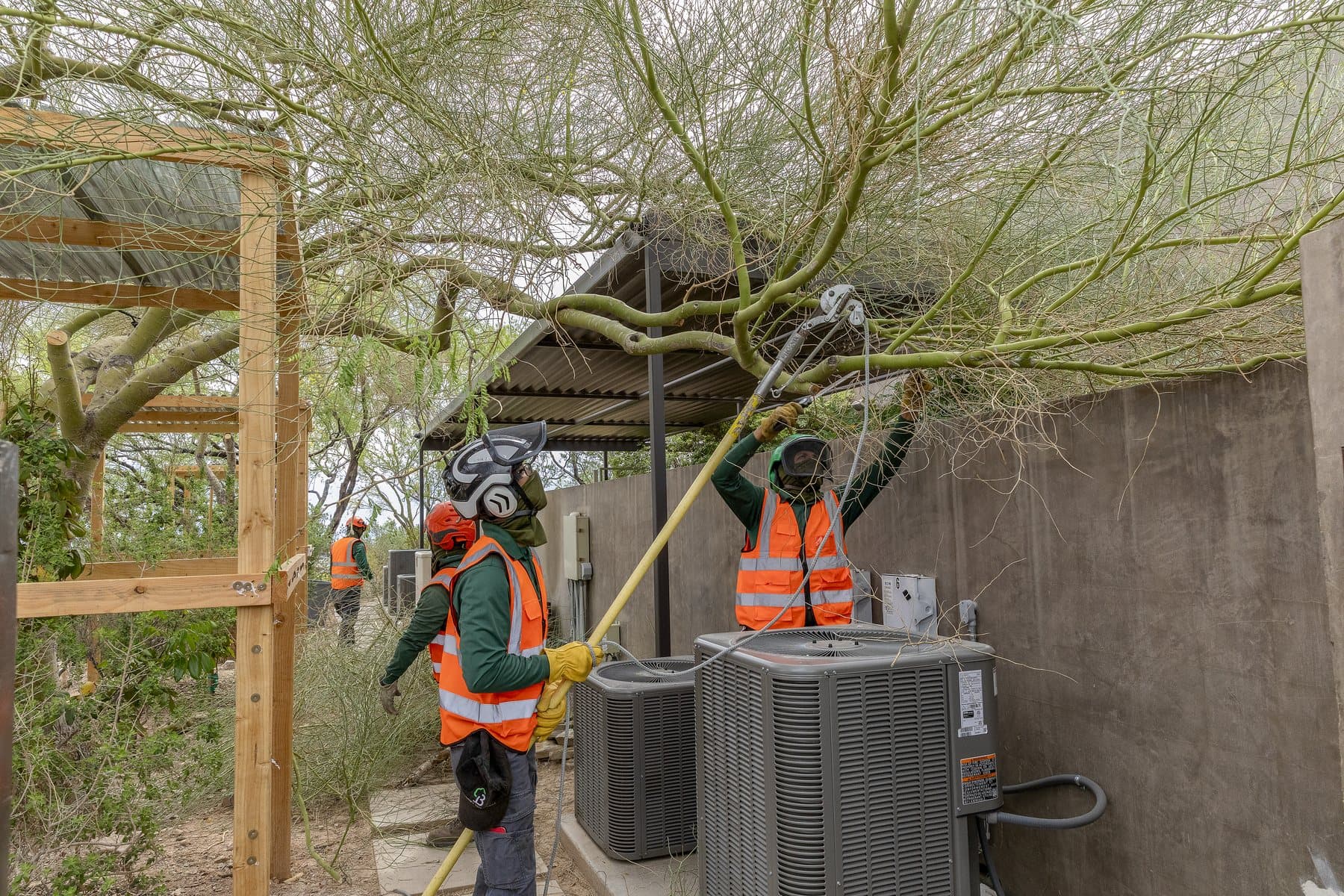
Learn how professionals plan tree removal near Las Vegas homes, pools, walls, and utilities—and what homeowners should do before the crew arrives.
Tree removal near a house in Las Vegas requires more than cutting a trunk and choosing a direction for the tree to fall. Homes in the valley often place mature trees close to block walls, pools, patios, air-conditioning equipment, driveways, irrigation lines, and neighboring properties. A safe removal plan accounts for every one of those targets before the first cut is made.
Benjamin's Tree Service has served the Las Vegas Valley since 2001. Our ISA Certified Arborist (ISA Cert. WE-15785A) evaluates the tree, the surrounding property, and the consequences of each cut before recommending professional tree removal.
Quick Summary
- Trees close to structures are usually removed in controlled sections rather than felled in one piece
- A site assessment should identify power lines, roofs, pools, walls, vehicles, irrigation, access limits, and escape routes
- Rigging equipment can lower branches and trunk sections into a planned landing zone
- Homeowners should clear vehicles, furniture, pets, and people from the work area before the crew arrives
- Utility-line conflicts, storm-loaded limbs, and unstable root plates require specialized handling—never a DIY attempt
Why Tree Removal Near a House Needs a Detailed Plan
A tree growing in an open field may offer a broad, unobstructed drop zone. A tree beside a Las Vegas home rarely does. Even when the trunk appears to lean away from the building, the canopy may extend over a roof, branches may be weighted unevenly, and the root system may be restricted by hardscape or caliche soil.
The risk is not limited to the tree itself. Crews must also account for workers at height, ropes under load, saws, falling material, ground personnel, equipment movement, and anyone who could enter the work zone. The Occupational Safety and Health Administration identifies falls, falling objects, energized power lines, and equipment hazards among the serious risks in tree-care operations. OSHA's tree-care hazard guidance is one reason professional crews treat planning and site control as essential—not optional.
A careful plan also protects the parts of your property that may not be obvious from the canopy: drip irrigation, landscape lighting, pool plumbing, septic components, gates, low-voltage wiring, and decorative stone. Pointing these out during the estimate helps the crew define equipment routes and landing zones.
Step 1: Evaluate the Tree and Everything Around It
The first step is a tree and site assessment. An arborist looks at the trunk, major branch unions, visible roots, canopy balance, deadwood, decay indicators, recent storm damage, and the tree's proximity to people and property.
The surrounding targets matter just as much as the tree's condition. The assessment should identify:
- Roofs, windows, solar panels, patio covers, and exterior walls
- Swimming pools, spas, pumps, and water features
- Block walls, fences, gates, sheds, and play equipment
- Parked vehicles, driveways, walkways, and public streets
- Overhead and underground utilities
- Irrigation valves, emitters, lighting, and other landscape infrastructure
- Neighboring property and shared access points
Not every concerning tree must be removed. Depending on the defect and the targets below it, an arborist may recommend monitoring, selective trimming and pruning, cabling, moving a movable target, or improving routine care. The International Society of Arboriculture's guidance on managing tree hazards and risk explains that risk-reduction options can include pruning, support systems, routine care, target management, or removal when the risk is unacceptable.
A documented tree assessment report can be especially useful when a tree affects a shared wall, HOA area, commercial property, or neighboring parcel.
Step 2: Choose the Removal Method
Whole-Tree Felling
Whole-tree felling means cutting the tree near its base and directing it into a clear drop zone. This can be efficient when there is ample open space and the tree's condition allows the crew to control the fall. It is usually not appropriate when the canopy overlaps a home, wall, pool, utility line, or other high-value target.
Sectional Dismantling
For tight residential sites, crews commonly dismantle the tree from the top down. A climber or aerial-lift operator removes manageable branch sections first, then cuts the trunk into pieces. This reduces the size and movement of each load.
Sections that cannot fall freely may be tied with ropes and lowered into a controlled landing zone. The rigging plan considers the weight of the wood, available anchor points, rope angles, friction, swing potential, and the capacity of the equipment. This is one reason tree removal near a house should not be treated like ordinary yard work.
Our guide to what happens during professional tree removal provides a broader look at the process from estimate through cleanup.
Crane or Specialized Equipment
Some large, compromised, or inaccessible trees may require a crane, compact lift, or other specialized equipment. The decision depends on the tree, access, soil and pavement conditions, nearby targets, and whether equipment can be positioned without creating a new hazard. A crane is not automatically the safest or most economical choice; it is one tool within a site-specific plan.
Step 3: Establish Work, Drop, and Exclusion Zones
Before cutting begins, the crew defines where people, equipment, and material will move. The work zone may include a branch-lowering area, a chipper staging area, a log-loading path, and an exclusion zone that keeps residents and bystanders away from falling material and tensioned ropes.
For homeowners, the rule is simple: if the crew asks you to remain inside, move to another part of the property, or stay away from a window or patio, follow that direction until the area is released. Children and pets should remain completely outside the active work zone. Do not step out to take a closer photo or retrieve an item while cutting is underway.
If the work affects a sidewalk, driveway, or street, traffic and pedestrian control may also be necessary. Dense neighborhoods in Summerlin, Henderson, North Las Vegas, and Enterprise can have different access constraints even when the trees are similar.
Step 4: Protect the House, Pool, Walls, and Landscape
Protection begins with the removal sequence. Crews generally remove the branches that create the greatest conflict first, creating space for later sections to move. Ropes can guide or lower material away from roofs, windows, pool decks, HVAC units, and walls.
Ground protection may be used where logs or equipment could damage pavers, turf, decorative concrete, or irrigation. In some cases, lightweight landscape items can be moved; in others, the landing zone is padded or repositioned. Pool covers, glass features, fragile pots, and outdoor electronics should be discussed before work begins rather than discovered after the crew is set up.
Las Vegas block walls deserve special attention. They can limit access and may not tolerate impact from a branch or log. If a trunk is growing against a wall, the crew must also determine whether roots, embedded materials, or previous construction complicate the cut.
Step 5: Identify Utility and Emergency Hazards
Branches near overhead power lines are not a homeowner project. Never use a ladder, pole saw, rope, or chainsaw near an energized line. The appropriate utility provider and qualified line-clearance personnel may need to be involved before tree work proceeds.
A damaged tree can also change while you are waiting for service. Fresh cracking, rapid movement at the root plate, a hanging limb, or storm-loaded branches can turn a planned removal into an urgent situation. Keep people and vehicles away and contact 24/7 emergency tree service if the condition is actively threatening an occupied area or access route. Our guide to emergency tree-removal warning signs can help you recognize when to stop approaching the tree.
Do not try to stabilize a damaged tree with a vehicle, improvised cable, or rope tied to a structure. Stored tension and shifting wood can create hazards that are difficult to see from the ground.
How Homeowners Can Prepare Before Removal Day
A little preparation can make the work safer and more efficient:
- Move vehicles early. Relocate cars, trailers, and recreational vehicles before equipment blocks the driveway.
- Clear movable items. Remove patio furniture, grills, toys, hoses, decorations, and fragile pots from the agreed work area.
- Mark hidden infrastructure. Show the estimator and crew any known irrigation valves, lighting wires, pool lines, cleanouts, or shallow utilities.
- Arrange access. Unlock gates, disable automatic sprinklers, and confirm where equipment may enter.
- Secure pets and children. Keep them indoors or off-site, away from gates the crew may need to open.
- Notify affected neighbors. If equipment, noise, temporary access, or falling debris control could affect a neighboring parcel, communicate before work starts.
- Confirm the cleanup scope. Ask whether hauling, wood-chip handling, log removal, and stump grinding are included or quoted separately.
For properties with multiple trees, a tree service plan can help prioritize removals, pruning, feeding, and inspections rather than treating each issue as an isolated emergency.
What Not to Do
Do not climb the tree, cut elevated limbs, use a ladder with a chainsaw, or attempt to pull branches away from a house with a vehicle. Do not assume a branch will fall straight down; limbs can roll, swing, split, or remain attached under tension.
Also avoid hiring based only on the lowest number. Confirm that the company is properly licensed and insured for the work, ask how the tree will be dismantled near the structure, and make sure the estimate defines debris and stump handling. Tree-removal permit requirements can vary by jurisdiction and project conditions; review our Clark County tree-removal permit guide and confirm current requirements for your property before work begins.
When Pruning May Be Enough—and When Removal Makes Sense
Removal is not the first answer for every tree near a house. Healthy trees can often be managed through structural pruning, clearance pruning, irrigation correction, monitoring, or other care. The decision depends on the defect, the tree's remaining strength and vitality, the targets within reach, and whether practical mitigation can reduce the risk.
Removal may be recommended when a tree has severe structural damage, extensive decay, major root failure, an unstable lean, repeated large-limb failure, or an unacceptable risk that cannot be reduced reasonably. The goal is not to remove every imperfect tree; it is to make an informed decision that balances benefits, condition, and consequences.
Frequently Asked Questions
Can a tree be removed without damaging the landscaping?
Often, yes. The crew can plan access, lower sections, protect surfaces, and define a landing zone. Some temporary disturbance may still be unavoidable, especially around a large trunk or stump. Discuss high-value plants, irrigation, hardscape, and restoration expectations during the estimate.
Do I need to be home during tree removal?
That depends on property access and the scope of work. Many removals can proceed after access, parking, pets, utilities, and decision points are confirmed in advance. Ask the company what it requires and make sure someone can be reached if an unexpected condition is discovered.
Is stump grinding included with tree removal?
Not always. Removing the tree and grinding the stump are separate operations in many estimates. Confirm the grinding depth, surface-root scope, debris handling, and whether underground utilities or irrigation limit the work.
How long does removal near a house take?
Time depends on tree size, condition, access, rigging complexity, equipment needs, debris volume, and nearby targets. A small accessible tree may be completed quickly, while a large sectional removal can require substantially more setup and controlled cutting. A site visit is the best way to establish realistic timing.
What if the tree is on or near the property line?
Confirm ownership and access before authorizing work. Shared walls, overhanging branches, and boundary trees can involve neighbor or HOA considerations. A survey, property records, or legal guidance may be needed when ownership is disputed; the tree crew should not be expected to decide a property-line disagreement.
Schedule a Safe Tree-Removal Assessment
Tree removal near a Las Vegas home should begin with a plan—not a saw. Benjamin's Tree Service is fully licensed and insured in Nevada, and our ISA Certified Arborist helps property owners understand the tree's condition, the safest removal method, and the steps needed to protect surrounding property.
Call 725-227-6160 or request a free estimate online. We serve homeowners, HOAs, and businesses throughout Las Vegas, Clark County, Henderson, Summerlin, North Las Vegas, and the surrounding valley. For larger sites, our commercial tree service team can coordinate phased work and access planning.
Benjamin's Tree Service
ISA Certified Arborists serving Las Vegas & the surrounding areas since 2001.
Related Reading
Tree Removal
Palm Tree Removal in Las Vegas: A Homeowner's Guide
Thinking about palm tree removal in Las Vegas? Learn the warning signs, what professional removal in…
8 min read
Tree Removal
HOA Tree Removal Rules in Las Vegas: What You Need to Know
Removing a tree in a Las Vegas HOA community involves more than county rules. Learn the approval pro…
10 min read
Tree Removal
Tree Removal Permits in Clark County: What to Know
Learn when you need a tree removal permit in Clark County and Las Vegas, which trees are protected, …
8 min read