
A step-by-step guide to preparing your trees for Las Vegas summer heat — deep watering schedules, mulching, pruning timing, sunscald prevention, and the warning signs that your trees are already stressed.
Las Vegas summer heat does not arrive gradually. One week it is 85 degrees, and two weeks later it is 105 with no rain in the forecast until September. If you wait until June to prepare your trees for summer, you are already behind. The best time to prepare trees for summer in Las Vegas is mid-April through mid-May — right now — when temperatures are still manageable and your trees have time to build the root reserves they need to survive four months of extreme heat.
Every summer, Benjamin's Tree Service responds to calls from homeowners across Henderson, Summerlin, Spring Valley, and throughout the Las Vegas Valley who are watching their trees drop leaves, split bark, or die back from the canopy down. In most cases, the damage started weeks or months earlier because the tree was not properly prepared for what Las Vegas summer demands.
This guide covers the specific steps you should take now to give your trees the best chance of coming through summer healthy, and the warning signs that indicate a tree is already in trouble.
Adjust Your Watering Schedule Before the Heat Arrives
Water is the single most important factor in summer tree survival in the Mojave Desert. A tree that enters June with a deep, established moisture reservoir handles heat dramatically better than one running on shallow irrigation. The difference is often the difference between a tree that thrives and one that drops half its canopy by August.
How Deep Watering Works
Most residential irrigation systems in Las Vegas water at the surface. Spray heads put down a quarter inch of water across the lawn zone, drip emitters deliver small amounts near the trunk, and bubblers run for 10 minutes and shut off. None of these approaches get water deep enough for mature tree roots.
Tree roots in Las Vegas extend 12 to 36 inches below the surface, and the feeder roots that absorb the most water are concentrated at the outer edge of the canopy — the drip line — not near the trunk. Effective deep watering means getting water down 2 to 3 feet at the drip line, on a schedule that allows the soil to partially dry between waterings.
Here is the watering schedule our arborists recommend for established trees heading into Las Vegas summer:
- April through May — water deeply every 10 to 14 days. This builds root-zone moisture reserves before extreme heat arrives.
- June through August — water deeply every 5 to 7 days. During peak heat, soil moisture evaporates rapidly even at depth.
- September — begin tapering back to every 10 to 14 days as temperatures moderate.
For mature trees, each deep watering session should deliver 10 to 15 gallons per inch of trunk diameter. A tree with an 8-inch trunk needs roughly 80 to 120 gallons per session, delivered slowly so it penetrates rather than running off.
Common Watering Mistakes
The most common watering mistake we see across Paradise, Enterprise, and the rest of the valley is watering too frequently and too shallowly. Daily shallow watering trains roots to stay near the surface where soil temperatures can exceed 130 degrees in July. Those shallow roots cook, the tree loses its ability to take up water, and it declines even though the homeowner is watering every day.
The second most common mistake is watering at the trunk. Mature tree roots extend far beyond the trunk — often as far as the tree is tall. Water delivered at the base misses 80 percent of the absorbing root system.
Mulch Your Trees Properly
Mulch is one of the most effective and least expensive things you can do to prepare your trees for Las Vegas summer. A 3- to 4-inch layer of organic mulch — wood chips, shredded bark, or arborist chips — spread from 6 inches away from the trunk out to the drip line reduces soil temperature by 10 to 20 degrees, cuts water evaporation by 25 to 50 percent, and adds organic matter to Las Vegas's mineral-heavy soil as it decomposes.
Mulching Rules for Desert Trees
- Never pile mulch against the trunk. Mulch volcanoes — the cone-shaped piles of mulch banked against tree trunks — trap moisture against the bark and create conditions for crown rot and fungal disease. Leave a 6-inch gap between the mulch and the trunk.
- Use wood-based mulch, not rock. Decorative rock is everywhere in Las Vegas landscaping, but rock absorbs and radiates heat. Rock mulch around a tree base can actually increase soil temperatures rather than reducing them. Wood chips are the better choice within the drip line of any tree.
- Replenish annually. Desert conditions break down organic mulch faster than humid climates. Check mulch depth in April and top off as needed before summer.
Time Your Pruning Correctly
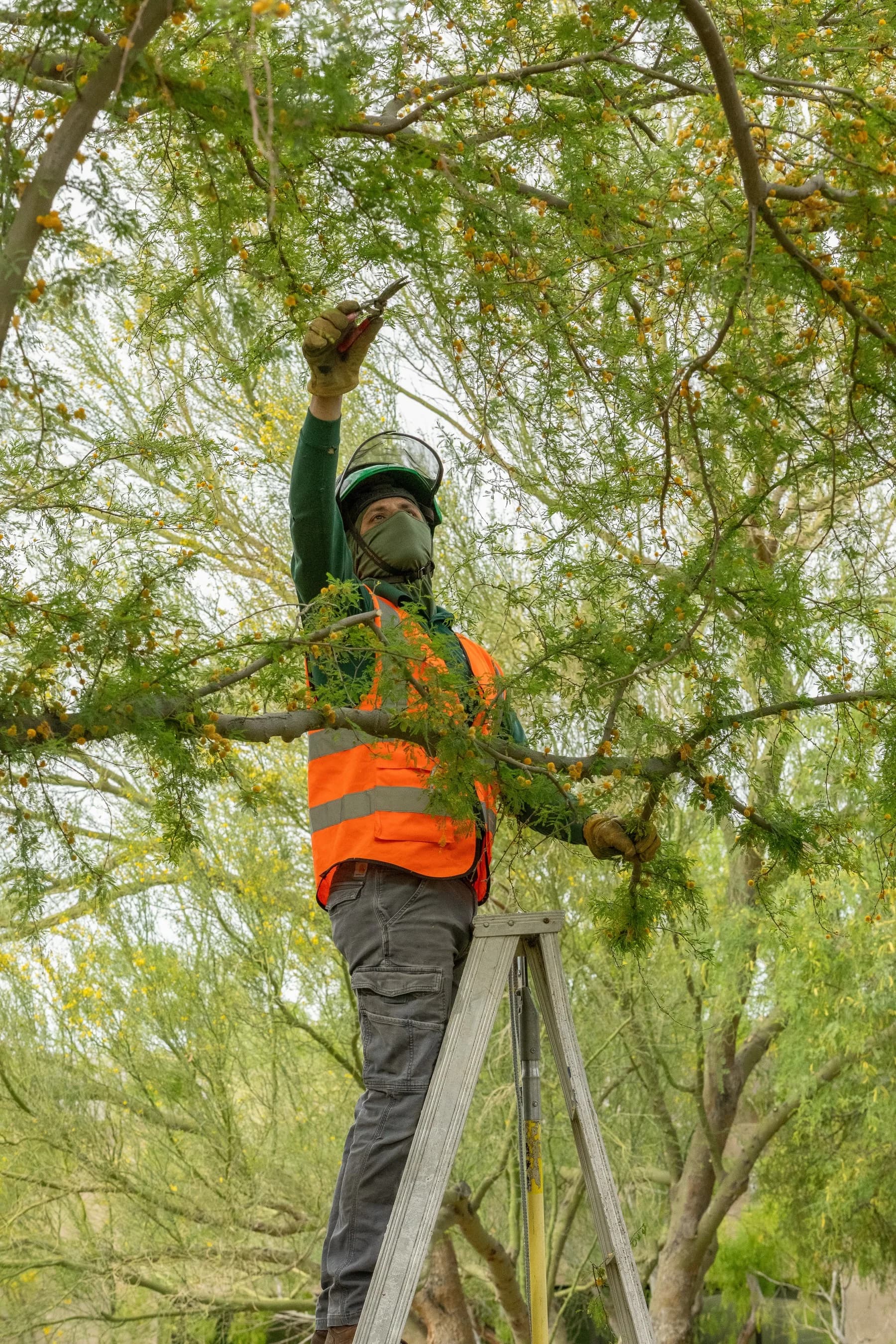
Pruning at the wrong time before summer can expose bark to direct sun and remove the canopy density your tree needs to shade its own trunk and root zone. The general rule for Las Vegas is: do your structural pruning in winter, and only do light maintenance pruning in spring.
What to Prune Now (April–May)
- Dead, broken, or diseased branches — remove these any time of year
- Crossing branches that rub against each other and create wound sites
- Suckers growing from the base or interior of the canopy
- Low-hanging branches that obstruct walkways or sight lines
What NOT to Prune Before Summer
- Do not thin the canopy heavily. A tree heading into Las Vegas summer needs its leaf mass to shade the trunk, branches, and root zone. Heavy thinning before summer exposes interior wood to direct sun, which can cause sunscald — a condition where bark cracks and peels on the sun-facing side, creating entry points for borers and disease.
- Do not top trees. Topping — cutting main branches back to stubs — is the most damaging thing you can do to a tree before summer. It removes the majority of the tree's food-producing leaves, triggers a stress response of weak sucker growth, and exposes large wounds during the season when bark beetles and borers are most active.
Protect Against Sunscald
Sunscald is far more common in Las Vegas than most homeowners realize. It affects trees that have been recently pruned, recently transplanted, or that naturally have thin bark — including many fruit trees, ornamental maples, and young shade trees.
Signs of Sunscald
- Cracked, peeling, or blistered bark on the south or west-facing side of the trunk
- Long vertical splits running up the trunk
- Bark that appears dried out and papery
Prevention
- Tree wrap — for young or thin-barked trees, apply a breathable tree wrap to the trunk from the soil line to the first major branch. This reflects sunlight and insulates the bark. Leave the wrap in place through the first two to three summers after planting.
- Maintain canopy density — the best sun protection for a tree's trunk is its own canopy. Avoid heavy pruning that opens the interior to direct light during the growing season.
- White tree paint — diluted white latex paint (50/50 with water) applied to exposed trunk sections reflects solar radiation and prevents bark temperatures from reaching damaging levels. This is an old orchard technique that works well on fruit trees in the Las Vegas Valley.
Check for Stress Signs Before Summer Arrives
A tree that enters summer already stressed is a tree at high risk of serious decline or death during the hottest months. Walk your property now and look for these warning signs:
- Sparse or undersized leaves — if the spring leaf-out produced fewer or smaller leaves than normal, the tree may have root damage, a nutrient deficiency, or insufficient water reserves
- Early leaf drop — trees dropping green leaves in April or May are signaling significant stress
- Wilting during cool periods — a tree that wilts in the morning before temperatures climb is not getting enough water at the root level
- Bark cracks or cankers — open wounds on the trunk are entry points for borers and fungal infections that will accelerate under summer heat stress
- Discolored leaves — yellowing between leaf veins often indicates iron chlorosis, which is common in Las Vegas's alkaline soil and worsens under heat stress
If you notice any of these signs, address them now. Once Las Vegas hits 110 degrees, a stressed tree's options narrow quickly. An arborist assessment in April or May gives you time to correct problems — supplemental iron for chlorosis, adjusted watering, targeted fertilization, or pest treatment — before the heat removes that window.
Special Considerations by Tree Type
Palm Trees
Palms handle Las Vegas heat better than most broadleaf trees, but they still need preparation. Deep water palms thoroughly in late spring, apply a palm-specific fertilizer with manganese and magnesium (palms are heavy feeders of these micronutrients in alkaline soil), and remove only fully brown fronds. Never remove green or yellow fronds before summer — palms translocate nutrients from older fronds to new growth, and removing them prematurely weakens the tree.
Fruit Trees
Fruit trees are among the most heat-sensitive trees in Las Vegas landscapes. Citrus, stone fruit, and fig trees all benefit from afternoon shade during peak summer. If your fruit trees are in full sun, consider shade cloth (30 to 50 percent shade factor) over the canopy during July and August. Deep water fruit trees more frequently than other species — every 4 to 5 days during peak heat — and mulch heavily.
Recently Planted Trees
Any tree planted within the last two years is still establishing its root system and is especially vulnerable to summer heat stress. These trees need more frequent watering (every 3 to 5 days in summer), trunk protection from sunscald, and monitoring for signs of transplant stress. If a young tree is struggling in its second summer, it may need supplemental irrigation beyond what your automatic system provides.
Do Not Wait Until June
The pattern our crews see every year is the same: homeowners notice tree problems in July when leaves are dropping and bark is cracking, but the damage started in May when the tree entered the heat season unprepared. By July, treatment options are limited. Heat-stressed trees cannot absorb nutrients efficiently. Root systems compromised by shallow watering cannot be retrained overnight. Sunscald damage from heavy spring pruning cannot be reversed.
The work you do in April and May — adjusting irrigation depth, adding mulch, correcting pruning mistakes, addressing nutrient deficiencies, and identifying stressed trees before the heat compounds their problems — is the work that determines whether your trees come through summer healthy or become emergency removal calls in August.
Get a Pre-Summer Tree Inspection
Benjamin's Tree Service offers pre-summer tree inspections for homeowners across the Las Vegas Valley. Our ISA Certified Arborists evaluate your trees' health, check for pest or disease issues, assess your irrigation setup, and provide specific recommendations for getting each tree through the summer safely.
We serve Las Vegas, Henderson, Summerlin, North Las Vegas, Spring Valley, Paradise, Enterprise, Green Valley, Anthem, Centennial Hills, and Boulder City.
Call 725-300-0399 for a Free Tree Inspection. We will walk your property, assess every tree, and tell you exactly what needs to happen before June. The inspection takes less than an hour, and it can save you thousands in emergency tree work later this summer.
Benjamin's Tree Service
ISA Certified Arborists serving Las Vegas & the surrounding areas since 2001.