
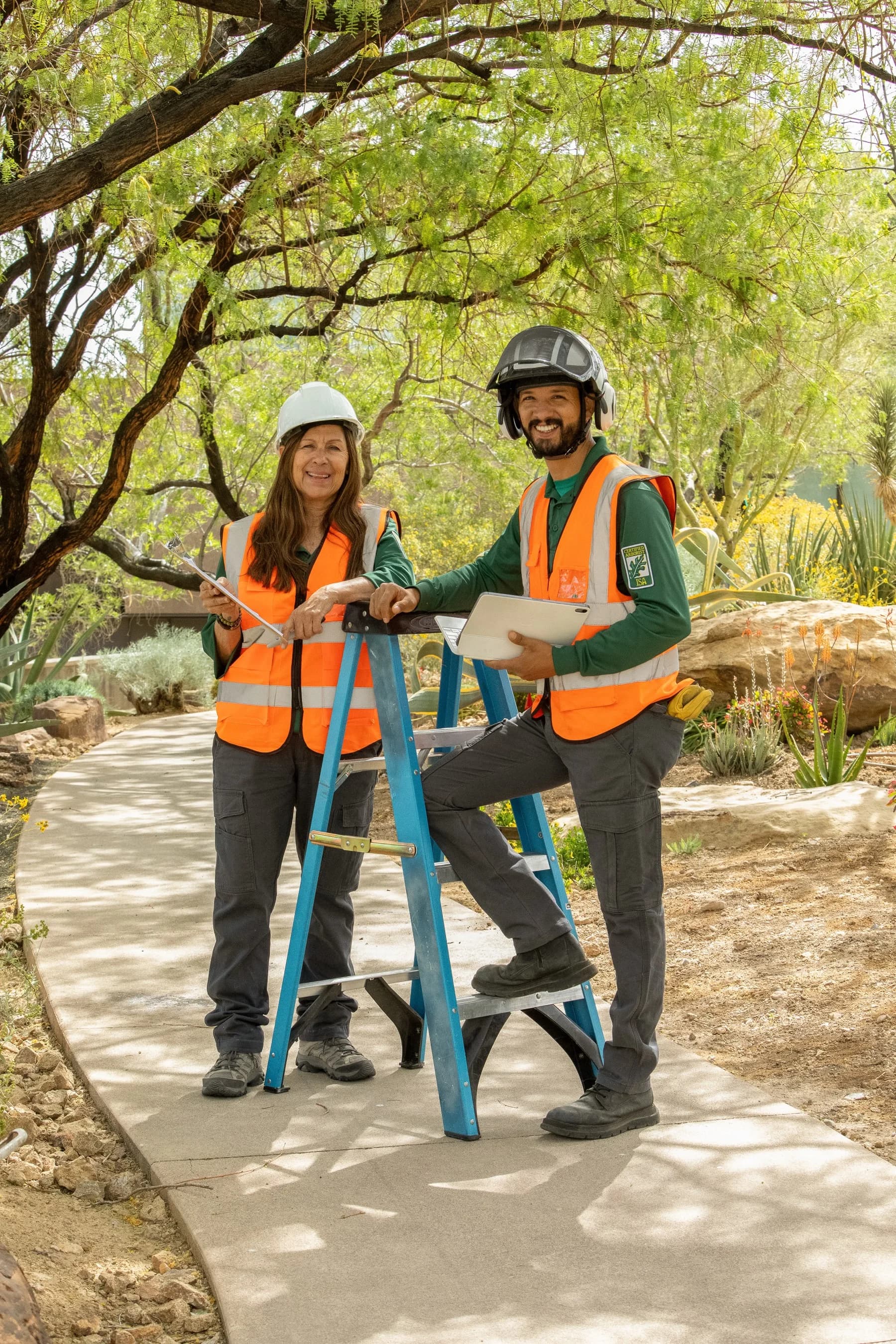
Identify the most common tree pests and diseases in Las Vegas — from bark beetles and spider mites to sooty canker and Texas root rot. Learn what to watch for, which trees are most vulnerable, and when to call a professional.
Tree pests in Las Vegas operate under a different set of rules than they do in the rest of the country. In wetter climates, trees have the advantage — steady rainfall, moderate temperatures, and rich soil give them the energy reserves to fight off most insect infestations and fungal infections on their own. In the Mojave Desert, that advantage disappears. Trees here are already running on thin margins, dealing with alkaline soil, extreme heat, and limited water. When pests or disease show up, they are attacking a tree that may already be stressed — and that combination is what turns a manageable problem into a dead tree.
Benjamin's Tree Service has been diagnosing and treating pest and disease problems across the Las Vegas Valley since 2001. In 25 years of working in Henderson, Summerlin, North Las Vegas, Spring Valley, and every neighborhood in between, we have seen the same pests and diseases come up over and over. This guide covers the ones that actually matter for Las Vegas homeowners — the ones that damage trees, cost money, and require action.
Why Tree Pests and Diseases Hit Harder in the Desert
Before getting into specific organisms, it helps to understand why the Las Vegas environment makes trees more vulnerable to pest and disease pressure than they would be in other parts of the country.
Heat Stress Weakens Natural Defenses
Trees defend themselves against boring insects by producing resin or sap that physically pushes the insect out of the wood. This defense mechanism requires energy and water — both of which are in short supply during a Las Vegas summer. A tree that is drought-stressed in July has significantly reduced sap flow, which means bark beetles and borers can penetrate the wood without triggering the tree's normal defense response. The same tree in a well-watered landscape in Portland would likely fight off the same beetle without any intervention.
Alkaline Soil Creates Nutrient Deficiencies
Las Vegas soil pH typically runs between 7.5 and 8.5. At those levels, iron, zinc, and manganese become chemically unavailable to tree roots, even when those minerals are physically present in the soil. Trees with nutrient deficiencies produce less chlorophyll, generate less energy through photosynthesis, and grow more slowly. Slower growth means less ability to compartmentalize wounds, close over pruning cuts, or outgrow minor infestations. A nutrient-deficient tree is essentially immunocompromised.
Low Humidity Favors Certain Pests
Spider mites, one of the most damaging tree pests in Las Vegas, thrive in hot, dry conditions. In humid climates, natural fungal pathogens keep mite populations in check. In the desert, those fungal controls are largely absent. The same conditions that make Las Vegas inhospitable for many tree diseases make it a paradise for drought-loving pests.
The Most Common Tree Pests in Las Vegas
These are the insects our arborists encounter most frequently on residential and commercial properties across the Las Vegas Valley.
Bark Beetles
Bark beetles are the single most destructive insect pest of trees in Southern Nevada. Multiple species are active here, including the Arizona cypress bark beetle, the Mediterranean pine engraver beetle, and several species of Ips beetles that attack pine trees.
How they work: Adult beetles bore through the bark and create galleries in the cambium layer — the thin tissue between the bark and the wood where the tree transports water and nutrients. Females lay eggs in these galleries. When the larvae hatch, they feed on the cambium, effectively girdling the tree from the inside. Once a bark beetle infestation is established throughout the canopy, the tree cannot be saved.
What to watch for:
- Small round holes in the bark, roughly the diameter of a pencil lead
- Fine sawdust (called frass) collecting in bark crevices or at the base of the tree
- Pitch tubes — small blobs of resin on the bark surface where the tree attempted to push the beetle out
- Fading foliage that turns from green to yellow to reddish-brown, starting at the top of the tree
- Bark that peels away easily, revealing S-shaped or fan-shaped tunnels underneath
Which trees are most vulnerable: Mondell pines, Aleppo pines, Italian stone pines, and Arizona cypress are the most commonly affected species in the Las Vegas Valley. Stressed pines — those that are underwatered, recently transplanted, or growing in compacted soil — are significantly more susceptible than healthy ones.
What to do: If you catch the infestation early (limited to one or two branches), an arborist can remove the affected branches and apply preventive treatments to protect the rest of the tree. If the beetles have spread throughout the trunk and main scaffold branches, removal is usually the only option. Dead beetle-infested trees should be removed promptly because they serve as breeding sites for the next generation of beetles, which then attack nearby healthy trees.
Spider Mites
Spider mites are not insects — they are arachnids, related to spiders and ticks. They are also one of the most common and persistent tree pests in Las Vegas, partly because the hot, dry climate that stresses trees is exactly what mites prefer.
How they work: Mites feed by piercing individual plant cells and sucking out the contents. A single mite does negligible damage, but mite populations can explode from a few dozen to tens of thousands in a matter of weeks during summer. At high population levels, mites cause visible stippling, bronzing, and leaf drop. Heavy infestations can defoliate an entire tree by mid-summer.
What to watch for:
- Fine stippling on leaves — tiny yellow or white dots visible when you hold the leaf up to light
- Leaves that look dusty or bronzed, especially on the underside
- Fine webbing on leaf surfaces and between branches (look for it in morning light)
- Premature leaf drop in mid-summer that is not explained by water stress
Which trees are most vulnerable: Nearly all broadleaf trees in Las Vegas are susceptible, but mites are especially common on ash trees, elms, mulberries, and Italian cypress. Fruit trees including citrus, pomegranate, and fig are also frequent targets.
What to do: A strong blast of water from a garden hose aimed at the undersides of leaves can knock mite populations down significantly. For severe infestations, horticultural oil or insecticidal soap applications are effective when applied correctly. Avoid broad-spectrum insecticides — they kill the predatory insects (ladybugs, lacewings, predatory mites) that help keep mite populations in check, and can actually make mite problems worse.
Whiteflies
Whiteflies are small, white-winged insects that congregate on the undersides of leaves and fly up in clouds when disturbed. They became a significant problem in the Las Vegas Valley in the 2010s, particularly on ash trees, and remain a persistent seasonal pest.
How they work: Like mites, whiteflies feed by piercing leaf tissue and extracting sap. They also excrete a sticky substance called honeydew, which coats leaves, cars, patio furniture, and anything else under the tree. Honeydew then supports the growth of black sooty mold — a secondary fungus that blocks sunlight from reaching the leaf surface and further stresses the tree.
What to watch for:
- Clouds of tiny white insects flying up when you shake a branch
- Sticky residue on leaves, deck surfaces, or vehicles parked under the tree
- Black sooty mold growing on leaves and branches
- Yellowing and curling of leaves, especially new growth
- Ant trails on the trunk — ants farm honeydew and will actively protect whitefly colonies
Which trees are most vulnerable: Ash trees (especially Arizona ash and Modesto ash) are by far the most commonly affected in Las Vegas. Mulberry, ficus, and pomegranate are also frequent hosts.
What to do: Systemic insecticide treatments applied to the soil around the tree's root zone are the most effective long-term control. The tree absorbs the treatment through its roots and distributes it through the leaves, killing whiteflies as they feed. These treatments should be applied by a professional to ensure correct dosage and timing. As with mites, avoid broad-spectrum foliar sprays that eliminate beneficial predators.
Borers
Several species of wood-boring insects attack trees in Las Vegas beyond bark beetles. The most common are flatheaded borers (including the flatheaded appletree borer) and longhorned beetles. These insects target stressed trees — particularly those that have been recently planted, damaged by construction, or weakened by drought.
How they work: Adult beetles lay eggs in bark crevices. Larvae bore into the wood and feed on the cambium and sapwood for months or years, creating tunnels that disrupt water and nutrient transport. Exit holes from emerging adults are often the first visible sign of an infestation that has been underway for a long time.
What to watch for:
- Oval or D-shaped exit holes in bark (flatheaded borers) or round holes (longhorned beetles)
- Branch dieback that progresses over months, seemingly without explanation
- Bark that appears sunken or discolored over tunneled areas
- Sawdust or frass accumulating on branches or at the base of the tree
Which trees are most vulnerable: Newly planted trees of any species are highly vulnerable during their first two to three years. Among established trees, birch, ash, willow, and fruit trees are most commonly attacked.
What to do: Prevention is far more effective than treatment. Keeping trees properly watered and maintained with regular pruning is the single best defense against borers. Once larvae are inside the wood, they are difficult to reach with insecticides. Heavily infested branches should be removed and destroyed. If the main trunk is compromised, the tree may need to be removed.
Scale Insects
Scale insects look nothing like typical bugs — they appear as small bumps or waxy deposits on bark and leaves. There are two categories: armored scale (hard, shell-like covering) and soft scale (waxy or cottony covering that produces honeydew). Both types are common in the Las Vegas Valley.
What to watch for:
- Small raised bumps on bark, stems, or leaf undersides that do not brush off easily
- Sticky honeydew and black sooty mold (soft scale)
- Yellowing leaves and general canopy thinning
- Branch dieback in severe cases
Which trees are most vulnerable: Oleander, citrus, mulberry, ash, and pine trees are the most common hosts in Las Vegas.
What to do: Horticultural oil applied during the dormant season (December through February) smothers overwintering scale and is the most effective single treatment. Systemic treatments during the growing season provide longer-term control. Rubbing alcohol applied directly to small-scale infestations on individual branches can provide spot treatment.
The Most Common Tree Diseases in Las Vegas
While Las Vegas has fewer tree diseases than humid climates, the ones that do occur here tend to be aggressive and difficult to treat once established.
Sooty Canker (Hendersonula toruloidea)
Sooty canker is the most common and destructive fungal disease of shade trees in the Las Vegas Valley. It earned its name from the dark, sooty-black spore masses that develop under peeling bark on infected branches.
How it works: The fungus enters trees through wounds — pruning cuts, sunscald damage, mechanical injuries from lawn equipment, or storm damage. It colonizes the wood underneath the bark, killing the cambium and creating cankers that expand over time. As the bark over the canker dies and peels away, it reveals the characteristic black, powdery spore layer underneath.
What to watch for:
- Bark peeling away from branches to reveal dark black or dark brown wood underneath
- Branch dieback that progresses from the tips inward
- Cankers — sunken, discolored areas on branches or the trunk
- Increased sunscald damage on the south and west sides of the tree (sunscald wounds are a primary entry point for the fungus)
Which trees are most vulnerable: Mulberry is the number one host for sooty canker in Las Vegas, followed by ash, Chinese elm, and cottonwood. These are all common residential trees in the valley, which is why sooty canker is so prevalent.
What to do: There is no chemical cure for sooty canker. Management focuses on removing infected branches with proper pruning cuts (at least 12 inches below the visible edge of the canker), sterilizing pruning tools between cuts, and reducing the tree's stress through proper watering and nutrition. If the trunk is infected, the tree usually cannot be saved. The best prevention is minimizing wounds — avoid unnecessary pruning during summer heat, protect trunks from sunscald with proper canopy coverage, and keep lawn equipment away from tree bark.
Texas Root Rot (Phymatotrichopsis omnivora)
Texas root rot is a soil-borne fungal disease that kills trees and shrubs quickly and with little warning. It is active in alkaline soils throughout the southwestern United States, including the Las Vegas Valley.
How it works: The fungus lives in the soil and attacks the root systems of susceptible plants. It destroys feeder roots first, then progressively rots larger structural roots. The first symptom most homeowners notice is sudden wilting of the entire canopy — often over the course of just a few days during hot weather. By the time the foliage wilts, the root system has already been severely damaged.
What to watch for:
- Sudden, rapid wilting of an apparently healthy tree during summer
- Leaves that turn brown but remain attached to branches (unlike drought stress, where leaves typically drop)
- White or tan fungal mats visible on the soil surface near the base of the tree after monsoon rains
- Roots that are brown, soft, and decayed when exposed
Which trees are most vulnerable: Mulberry, cottonwood, Arizona ash, fruit trees (especially apple and peach), and many ornamental shrubs. Notably, desert-adapted species like mesquite and palo verde are resistant to Texas root rot, which is one of many reasons they are better long-term choices for Las Vegas landscapes.
What to do: Texas root rot is extremely difficult to treat once symptoms appear. Soil amendments including sulfur (to lower pH in the immediate root zone) and organic matter can slow the fungus. In some cases, heavy applications of ammonium sulfate fertilizer combined with soil sulfur have saved early-stage infections. However, trees that have wilted severely rarely recover. The most practical response is to remove the dead tree and replant with a resistant species. If Texas root rot has been confirmed on your property, plant mesquite, palo verde, desert willow, or other resistant species in that area going forward.
Iron Chlorosis
Iron chlorosis is technically a nutritional disorder, not a disease, but it is so widespread in the Las Vegas Valley and so frequently mistaken for pest damage or disease that it deserves inclusion here.
How it works: Las Vegas soil locks up iron in chemical forms that tree roots cannot absorb. The result is insufficient iron for chlorophyll production, which causes leaves to turn yellow while the veins remain green — a distinctive pattern called interveinal chlorosis. Without adequate chlorophyll, the tree produces less energy, grows more slowly, and becomes progressively weaker over the years.
What to watch for:
- Yellow leaves with green veins, especially on new growth
- Stunted growth compared to the same species growing elsewhere
- Branch tip dieback in advanced cases
- Leaves that are smaller than normal
Which trees are most vulnerable: Red maple, pin oak, sweetgum, silver maple, and many fruit trees (particularly citrus and stone fruits). These species evolved in acidic soils and have limited ability to extract iron from alkaline conditions. This is why Benjamin's Tree Service strongly recommends choosing trees adapted to alkaline soil rather than fighting the chemistry with ongoing treatments.
What to do: Chelated iron applications (either soil-applied or trunk-injected) can green up chlorotic trees, but the treatments need to be repeated regularly — usually annually — because the underlying soil chemistry does not change. Soil acidification with sulfur can help in small areas but is impractical for large landscapes. The long-term answer is planting species that tolerate alkaline soil naturally: mesquite, palo verde, Chinese pistache, desert willow, and sissoo are all significantly less susceptible to chlorosis than the species listed above.
Bacterial Wetwood (Slime Flux)
Bacterial wetwood is a chronic bacterial infection that causes dark, foul-smelling liquid to seep from wounds, branch crotches, and pruning cuts on infected trees. It is common in the Las Vegas Valley, particularly on mature shade trees.
How it works: Several species of bacteria colonize the heartwood of the tree, producing gas as a byproduct of fermentation. The gas pressure forces bacterial-laden sap out through cracks, wounds, and natural openings in the bark. The seeping liquid stains the bark, kills grass and plants it drips onto, and attracts insects.
What to watch for:
- Dark, wet streaks running down the trunk from wounds or branch crotches
- A sour, fermented smell near the affected area
- Bark staining that extends several feet below the source
- Foam or bubbling liquid at wound sites during warm weather
Which trees are most vulnerable: Elm, mulberry, cottonwood, and willow are the most commonly affected species in the Las Vegas Valley.
What to do: There is no cure for bacterial wetwood. The bacteria live deep inside the tree and cannot be reached by any treatment. The good news is that wetwood is rarely fatal — most infected trees live normal lifespans. Management involves not drilling holes or inserting drain tubes (an outdated practice that causes more harm than good), maintaining proper pruning and watering practices to keep the tree vigorous, and cleaning the sap from surfaces where it creates aesthetic or slip hazards.
Integrated Pest Management: A Smarter Approach for Las Vegas Trees
The most effective approach to managing tree pests and diseases in Las Vegas is Integrated Pest Management (IPM) — a strategy that prioritizes prevention, monitoring, and targeted intervention over broad-spectrum chemical applications.
Start With the Right Tree
Planting species adapted to Las Vegas conditions is the most impactful pest prevention decision you can make. Trees that handle heat, alkaline soil, and low water naturally — mesquite, palo verde, Chinese pistache, desert willow — start with lower stress baselines and stronger natural defenses. Trees that struggle with our conditions from day one — red maples, pin oaks, many fruit varieties — will spend their lives fighting chemistry and climate, making them perpetual targets for opportunistic pests.
Water Correctly
Proper deep watering is the foundation of pest resistance. A tree with adequate soil moisture maintains strong sap flow, which is its primary defense against boring insects. A tree running a water deficit in July has the equivalent of a compromised immune system — it simply cannot mount the defenses it needs when beetles or borers show up.
Prune Properly and at the Right Time
Bad pruning creates entry points for disease. Every cut is a wound, and every wound is a potential infection site for sooty canker and other fungal pathogens. Prune during the dormant season (December through February) when fungal spore loads are lowest and trees have time to begin compartmentalizing wounds before summer heat arrives. Never top trees — the resulting watersprouts are weak, poorly attached, and highly susceptible to both pest and disease problems.
Professional trimming and pruning by a certified arborist ensures proper cut placement, correct timing, and sterilized equipment — all of which reduce disease transmission risk.
Monitor Regularly
Walk your property once a month and actually look at your trees. Check for unusual leaf discoloration, premature leaf drop, bark damage, sawdust accumulation, or anything that looks different from the previous month. Most pest and disease problems are far cheaper and more effective to treat when caught early. By the time symptoms are obvious from the street, the problem is usually advanced.
Treat Targeted, Not Broadly
When treatment is needed, target the specific pest with the least disruptive method available. Horticultural oils for scale and mites, systemic treatments for whiteflies, and proper pruning for canker diseases are all targeted approaches that address the problem without destroying the beneficial insect populations that provide natural pest control.
Broad-spectrum insecticide sprays kill everything — including the ladybugs, lacewings, parasitic wasps, and predatory mites that keep pest populations balanced. When those beneficial species are wiped out, pest populations rebound faster and harder, often creating a worse problem than the one you started with.
When to Call a Professional Arborist
Some pest and disease problems can be managed by a knowledgeable homeowner — hosing off mites, applying dormant oil for scale, or adjusting irrigation to reduce stress. Others require professional diagnosis and treatment.
Call a professional when:
- Multiple branches are dying back and you are not sure why
- You see bark beetles or borer exit holes in the trunk (not just branches)
- A previously healthy tree wilts suddenly during summer
- Dark cankers are spreading on the trunk or major limbs
- You see signs your tree may be dying and cannot identify the cause
- You want a preventive treatment plan before problems develop
- Pest damage is spreading to neighboring trees on your property
A tree assessment report from a certified arborist gives you a professional diagnosis, identifies the specific pest or disease involved, and provides a treatment plan with realistic expectations about outcomes. Not every tree can be saved, and an honest arborist will tell you when the smartest move is removal and replacement rather than pouring money into treatments for a tree that is past the point of recovery.
Frequently Asked Questions
What is the most common tree pest in Las Vegas?
Bark beetles are the most destructive, but spider mites are the most widespread. Nearly every broadleaf tree in the Las Vegas Valley will experience mite pressure at some point, especially during hot, dry summers. Bark beetles tend to target specific species — primarily pines and cypress — but when they attack, the damage is usually fatal.
Can I prevent bark beetles from attacking my pine trees?
Yes. The most effective prevention is keeping your pines properly watered and healthy. Bark beetles preferentially attack stressed trees because healthy trees produce enough resin to physically push the beetles out. Preventive insecticide treatments applied to the trunk in early spring can also provide a chemical barrier, but they must be reapplied annually and are most effective when combined with proper cultural care.
Why do my trees get spider mites every summer?
The Las Vegas climate is ideal for spider mites — hot temperatures and low humidity accelerate mite reproduction while suppressing the natural fungal diseases that control mite populations in wetter climates. Dusty conditions also contribute, as dust on leaves interferes with the mites' natural predators. Regular irrigation that keeps humidity slightly elevated in the canopy zone, combined with periodic strong water sprays to knock mites off leaves, can reduce populations significantly.
Is the black stuff on my tree trunk dangerous?
If you are seeing dark streaks running down the trunk, it is likely bacterial wetwood (slime flux). While visually alarming, wetwood is rarely life-threatening to the tree. If you are seeing dark, sooty deposits under peeling bark on branches, that is more likely sooty canker — a fungal disease that can be serious, especially on mulberry and ash trees. The distinction matters, so a professional assessment is worth the investment if you are not sure which condition you are looking at.
Should I spray my trees preventively for pests?
Not with broad-spectrum insecticides. Preventive spraying kills beneficial insects and often makes pest problems worse in the long run. Targeted preventive treatments — such as dormant oil applications for scale, systemic treatments for whitefly-prone ash trees, or trunk applications for bark beetle prevention on pines — are effective when applied correctly and timed to the pest's life cycle. A certified arborist can design a preventive treatment program specific to the tree species and pest pressures on your property.
Get Your Trees Inspected Before Pests Take Over
Tree pests and diseases in Las Vegas are manageable when caught early. The key is knowing what to look for, understanding which trees on your property are most vulnerable, and acting before a treatable problem becomes an expensive emergency. A single bark beetle gallery can become a dead pine in three months. A spider mite population can defoliate a tree in six weeks. Sooty canker can kill a mulberry branch in one season.
Benjamin's Tree Service has been diagnosing and treating tree pest and disease problems across the Las Vegas Valley since 2001. Our ISA Certified Arborists serve Las Vegas, Henderson, Summerlin, North Las Vegas, Spring Valley, Paradise, Enterprise, Green Valley, Anthem, Centennial Hills, and Boulder City.
Call 725-300-0399 for a Free Tree Inspection. We will identify what is affecting your trees, determine whether treatment is viable, and give you a clear action plan — whether that means targeted treatment, preventive management, or honest removal recommendations. Do not wait until the damage spreads to every tree on your property.
Benjamin's Tree Service
ISA Certified Arborists serving Las Vegas & the surrounding areas since 2001.