
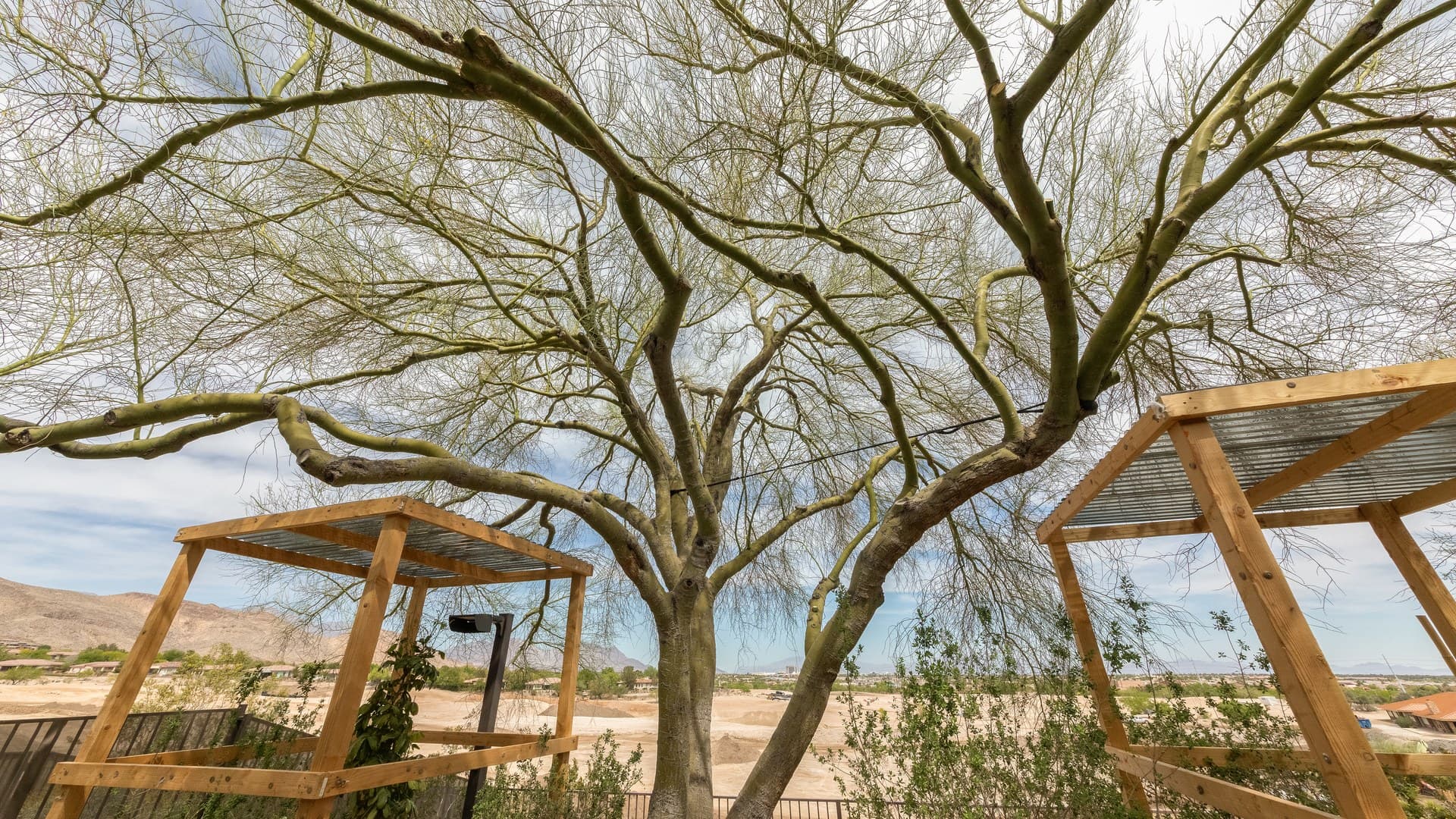
Learn what tree roots near foundations in Las Vegas can mean, which warning signs matter, and when to call an ISA Certified Arborist for an assessment.
Tree roots near foundations in Las Vegas can worry any homeowner who notices lifted pavers, a cracked walkway, or a mature trunk close to the house. A visible root does not automatically mean the tree is damaging the foundation. Roots, soil moisture, hardscape, irrigation, drainage, and the structure itself all need to be considered before deciding what to do.
Benjamin's Tree Service has served the Las Vegas Valley since 2001. Our licensed and insured team includes an ISA Certified Arborist (ISA Cert. WE-15785A), and our 5-star Google-rated crew evaluates trees near homes, block walls, pools, patios, and utilities throughout Clark County. This guide explains the warning signs worth documenting, the mistakes to avoid, and how a professional assessment can separate a manageable root conflict from a larger property concern.
Quick Summary
- Tree roots usually follow available moisture, oxygen, and loose soil; their presence near a house does not prove structural damage
- Lifted pavers and cracked walkways are more common root conflicts than direct damage to a sound foundation
- Leaking irrigation, drainage problems, expansive soil, and existing structural movement can complicate the diagnosis
- Do not cut major roots, trench beside the trunk, or apply root killer without an arborist evaluating tree stability
- Photograph changes, check irrigation, and schedule an assessment when movement is new, worsening, or close to occupied areas
Table of Contents
- How roots grow in Las Vegas soil
- Warning signs around foundations and hardscape
- What homeowners should not do
- How an arborist evaluates the conflict
- Practical options for managing roots near structures
- Frequently asked questions
Why Tree Roots Near Foundations in Las Vegas Need Site-Specific Evaluation
Most absorbing roots grow where soil conditions provide water and oxygen. In a Las Vegas yard, that often means irrigated planting beds, soil beneath mulch, the edges of turf, or small gaps beside hardscape. Caliche and compacted construction soil can limit deeper growth and encourage roots to spread through the more favorable soil available near the surface.
That growth pattern can bring roots into contact with pavers, curbs, irrigation lines, shallow footings, and block walls. It does not mean every nearby root is pushing through a home's structural foundation. A root may simply be following moisture along the structure, while movement in surrounding soil or concrete has another cause.
The diagnosis becomes more complicated when irrigation leaks beside the house, downspouts concentrate water, or expansive soil repeatedly wets and dries. A tree and the surrounding site must be evaluated together. The International Society of Arboriculture's guidance on managing tree hazards and risk emphasizes looking at the tree, its defects, and the people or property that could be affected rather than judging risk from one feature alone.
Warning Signs to Document Around the Tree and House
Start with observation rather than excavation. Walk the area from a safe distance and note what has changed, where it is happening, and whether the change is continuing.
Lifted Pavers, Walkways, or Patio Slabs
Shallow roots can lift individual pavers, create a ridge in a walkway, or raise the edge of a thin concrete slab. These conflicts are often obvious because the root and the raised surface follow the same path. They can still create a trip hazard and may indicate that the tree has limited rooting space.
Do not assume that cutting the visible root is a simple repair. A large structural root may help anchor the tree. Removing it can reduce stability, especially if the cut is close to the trunk or if several roots have already been damaged by construction. Our tree assessment report service can document root location, tree condition, nearby targets, and practical next steps before hardscape work begins.
Cracks That Are New or Growing
Photograph a crack with a ruler or another fixed reference and record the date. A single hairline crack in stucco, concrete, or a block wall does not identify its cause. Changes that widen, spread, or appear alongside soil movement deserve evaluation by the appropriate professionals.
An arborist can evaluate the tree and visible root zone. A qualified foundation contractor, engineer, plumber, or irrigation professional may also be needed when the evidence points beyond the tree. Tree crews should not diagnose hidden structural, plumbing, or geotechnical conditions outside their expertise.
Soil Heaving, Gaps, or a Changed Lean
Freshly lifted soil near the trunk, a gap opening at the base, or a tree that has recently begun leaning can signal root-plate movement. That is different from a root slowly raising a paver. If the tree is moving toward the home, driveway, street, or another occupied area, keep people and vehicles away and request an urgent emergency tree-service assessment.
Repeated Irrigation or Drainage Problems
Look for broken emitters, constantly wet soil, water collecting against the foundation, and irrigation applied directly at the trunk. Roots often proliferate where water is reliably available. Correcting a leak or poor drainage may be more important than cutting roots.
For established trees, water should generally be distributed through the active root zone rather than concentrated against the trunk. Southern Nevada Water Authority's seasonal watering guidance is a useful reference for current landscape schedules, while our guide to watering trees in the desert explains why soil checks matter more than a fixed daily habit.
What Not to Do When Roots Are Close to a Foundation
An urgent-looking crack or lifted slab can lead to an aggressive response that makes the tree less stable without solving the property problem.
Do Not Cut Major Roots Without an Assessment
Root size, distance from the trunk, species, tree condition, soil, and the number of roots affected all matter. There is no universal diameter or distance that makes a cut safe. Cutting a large root can remove support, reduce water uptake, and create a wound where decay may develop.
Do Not Trench Through the Root Zone
Installing a wall, drain, utility, pool line, or new footing can sever multiple roots at once. Before excavation, identify the tree's critical root area and discuss access with the contractor and arborist. Nevada law also requires utility locating before digging; calling 811 is separate from evaluating tree roots, but both checks belong in a careful excavation plan.
Do Not Use Root Killer or Improvised Barriers
Chemical root products cannot distinguish between an inconvenient root and one the tree needs for health or stability. Likewise, pushing a barrier into the soil can cut roots and redirect water in unexpected ways. Root barriers are planning tools, not a cure-all, and they work best when species, depth, drainage, and available soil volume are considered before installation.
Do Not Assume Removal Is the Only Answer
Some conflicts can be managed by resetting pavers, rerouting irrigation, increasing the opening around a trunk, changing a walkway layout, or monitoring the condition. Removal may be appropriate when a tree is structurally unsound, repeatedly damages essential infrastructure, or has no sustainable rooting space, but it should follow a documented evaluation.
How an Arborist Evaluates Tree Roots Near a Structure
A useful assessment begins above ground. The arborist reviews tree species, size, vigor, trunk flare, visible roots, lean, canopy balance, prior pruning, decay indicators, and the location of buildings, walls, walks, utilities, and occupied areas.
The site history adds context. Tell the arborist about recent construction, pool work, grading, irrigation changes, plumbing repairs, storms, and when movement was first noticed.
When more information is needed, the next step may involve careful root-zone investigation rather than broad digging. An air-excavation tool can sometimes expose roots with less damage than a shovel or trencher. The goal is to identify root location and condition while preserving as much of the system as possible.
The arborist then considers both likelihood and consequence. A healthy tree with a small root lifting one removable paver presents a different decision than a declining tree with a moving root plate beside a bedroom. If structural damage is suspected, the arborist's findings should be coordinated with a qualified building professional rather than treated as the final word on the foundation.
Practical Options for Managing Root Conflicts
The least disruptive option that addresses the actual problem is usually the best place to start.
Adjust Irrigation and Drainage
Repair leaks, move emitters away from the trunk, prevent water from collecting beside the structure, and confirm that irrigation reaches the broader root zone. Correct watering supports healthier root distribution and helps eliminate moisture conditions that can be mistaken for a root-only problem.
Modify the Hardscape
Pavers can sometimes be reset over a carefully prepared base, a walkway can curve around a major root, or a larger opening can be created around the trunk. Flexible or modular surfaces often accommodate gradual growth better than rigid concrete. Any grade change should avoid burying roots or piling soil against the trunk.
Use Selective Root Pruning Only When Justified
If a root must be removed, an arborist should determine whether the cut can be made without creating unacceptable instability or health stress. The cut should be clean, limited, and coordinated with the construction plan. The tree may also need follow-up monitoring or selective trimming and pruning based on its condition—not automatic canopy stripping to “balance” root loss.
Remove and Replace When the Site Cannot Support the Tree
Removal becomes a reasonable option when the tree has major structural defects, critical roots must be severed, essential infrastructure cannot be rerouted, or the tree's mature size is fundamentally incompatible with the space. Professional tree removal should account for the nearby structure, underground utilities, access, and whether stump grinding is compatible with the planned repair.
Replacement planning matters. Choose a species whose mature canopy and root-zone needs fit the available space, and place it far enough from foundations, walls, utilities, and hardscape. Our guide to the best trees for Las Vegas shade and privacy can help start that conversation.
Frequently Asked Questions
Can tree roots break through a concrete foundation?
Roots commonly exploit existing moisture, cracks, joints, and disturbed soil, but a nearby root does not by itself prove that it broke a sound structural foundation. Have the tree and the structure evaluated when cracks are new, widening, or accompanied by movement.
Should I remove a tree that is close to my house?
Not based on distance alone. Species, mature size, condition, root space, branch clearance, and actual conflicts all matter. A healthy tree may be manageable with monitoring and planned care, while a defective tree in the same location may warrant removal.
Can I cut a root that is lifting my driveway?
Do not cut it until an arborist evaluates its size, location, and role in tree stability. The safer option may be modifying the driveway or pavers. If root pruning is justified, it should be planned with the surface repair.
Who should inspect foundation cracks near a tree?
An ISA Certified Arborist can assess the tree and visible roots. A qualified structural engineer or foundation professional should evaluate the building, and irrigation or plumbing specialists may be needed when leaks or drainage are involved.
How can I prevent this problem with a new tree?
Choose a species that fits the site at maturity, provide adequate soil volume, plant at the correct depth, and keep it appropriately separated from structures and utilities. Plan irrigation and hardscape together so roots are not forced into one narrow moist corridor.
Schedule a Tree-and-Site Assessment
Tree roots near foundations in Las Vegas deserve a measured diagnosis, not a rushed cut. Benjamin's Tree Service can assess the tree, visible root zone, irrigation pattern, and nearby targets, then explain whether monitoring, hardscape adjustment, selective root work, or removal is the practical next step.
Call 725-227-6160 or request a free estimate online. We serve homeowners, HOAs, and businesses throughout Las Vegas, Henderson, Summerlin, North Las Vegas, and Clark County with licensed, insured tree care backed by ISA-certified expertise.
Benjamin's Tree Service
ISA Certified Arborists serving Las Vegas & the surrounding areas since 2001.
Related Reading
Property Protection
Tree Roots and Sewer Lines in Las Vegas: What to Know
Tree roots and sewer lines in Las Vegas can cause costly backups in older neighborhoods. Learn the w…
9 min read
Tree Removal
Palm Tree Removal in Las Vegas: A Homeowner's Guide
Thinking about palm tree removal in Las Vegas? Learn the warning signs, what professional removal in…
8 min read
Emergency Tree Service
Tree Touching a Power Line in Las Vegas: What to Do
A tree touching a power line in Las Vegas is a real electrocution and fire risk. Learn the exact ste…
8 min read