
Tree roots and sewer lines in Las Vegas can cause costly backups in older neighborhoods. Learn the warning signs, risks, and how to protect your pipes.
Tree roots and sewer lines in Las Vegas don't mix the way most homeowners assume. A tree can stand thirty feet from the nearest cleanout and still send roots straight into a sewer lateral, because roots aren't drawn to plumbing on purpose. They're drawn to the moisture and oxygen that a leaking joint or a hairline crack in an old clay or cast-iron pipe happens to provide. At Benjamin's Tree Service, our ISA Certified Arborists (ISA Cert. WE-15785A) have been helping Las Vegas Valley homeowners sort out root problems since 2001, and sewer-line intrusion is one of the more expensive surprises a mature tree can deliver.
Quick Summary
- Roots don't seek out pipes directly — they follow moisture and oxygen escaping through an existing crack, loose joint, or old pipe seam
- Slow or gurgling drains throughout the house, recurring backups, and a suspiciously green strip of lawn over the sewer line are the most common warning signs
- Older neighborhoods with clay or cast-iron sewer laterals are far more vulnerable than newer construction on PVC
- A CCTV sewer camera inspection from a licensed plumber is the only reliable way to confirm root intrusion inside the pipe itself
- Cutting a large root without an arborist's input can destabilize the tree — coordinate the plumbing fix and the tree evaluation together
- Benjamin's Tree Service has assessed root systems on Las Vegas Valley properties since 2001, ISA Certified (WE-15785A)
Table of Contents
- Why tree roots and sewer lines in Las Vegas are a bigger deal than homeowners expect
- How tree roots actually reach a sewer line
- Warning signs your sewer line may have root intrusion
- Which Las Vegas trees pose the biggest risk
- Protecting sewer lines when planting new trees
- What to do if you already have a tree near your line
- Tree roots and sewer lines across the Las Vegas Valley
- Frequently asked questions
Why Tree Roots and Sewer Lines in Las Vegas Are a Bigger Deal Than Homeowners Expect
Clark County's caliche hardpan pushes roots to behave differently than they would in looser, more forgiving soil. Where caliche blocks a root's downward path, it spreads laterally instead, following whatever soil channel offers water and air with the least resistance. A sewer trench backfilled with looser soil, sitting a few feet below a lawn that gets watered every week, is exactly that kind of channel. The University of Florida IFAS Extension notes that tree roots consistently grow toward the loosened, oxygenated soil found around underground infrastructure trenches, which is why a trench dug for a sewer line often becomes the most attractive real estate underground on the entire property.
That combination means a tree doesn't need to be planted carelessly to end up causing a sewer problem. A tree planted a reasonable distance away, on a lot with an aging clay lateral, can still end up with roots inside the pipe within a decade or two. The age and condition of the pipe usually matters more than the exact planting distance.
How Tree Roots Actually Reach a Sewer Line
A healthy, intact sewer pipe is not something roots can force their way into. What actually happens is more opportunistic. Clay pipe sections are joined with mortar or rubber gaskets that shrink, shift, or degrade over decades. Cast-iron pipe corrodes and develops small openings at joints and fittings. Even PVC, which is far more resistant, can develop problems at a poorly sealed joint or where ground movement has stressed a connection.
Once a root finds that opening, it doesn't need to grow large to start capturing wastewater nutrients and moisture. A single fine root can work its way through a crack the width of a pencil. From there, growth accelerates because the root has found a stable, moisture-rich environment, and the root mass inside the pipe expands until it catches paper, grease, and debris and slows or blocks the flow entirely.
Warning Signs Your Sewer Line May Have Root Intrusion
Most homeowners don't think about their sewer lateral until something backs up. A few signs are worth paying attention to well before that point:
- Slow or gurgling drains in multiple fixtures at once, especially the lowest drain in the house — a single slow drain is usually local, but several draining slowly together points to the main line
- Recurring backups that clear temporarily after a plunger or drain cleaner, then return within weeks or months
- A noticeably greener or lusher strip of lawn running in a line across the yard, tracking where wastewater is slowly leaking into the surrounding soil
- Sewage odor near a cleanout, yard drain, or low point in the landscaping
- Soft or sunken ground along the line's path, which can indicate the trench soil has settled around a failing section of pipe
Any one of these on its own isn't necessarily a sewer problem, but a combination is worth a professional look before it turns into a backup inside the house.
Which Las Vegas Trees Pose the Biggest Risk
Not every species is equally aggressive toward underground pipes. Desert-adapted trees common in Las Vegas landscaping, mesquite and palo verde among them, tend to root less aggressively toward a consistent moisture source than species built for wetter climates, provided they're getting adequate water from normal irrigation. The bigger risk tends to come from non-native shade trees planted decades ago, including mulberries, ash, and some older fruiting varieties, which root more opportunistically when they sense a steady water source nearby.
Mature age matters as much as species. An older tree with an established root system has already had years to find the path of least resistance underground, which is one reason sewer root intrusion shows up more often in Las Vegas's established neighborhoods than in newer developments with younger landscaping.
Protecting Sewer Lines When Planting New Trees
If you're planting a new tree, a few precautions go a long way toward avoiding this problem years down the road:
- Call 811 before digging so utility and sewer lateral locations get marked before you plant, not after
- Keep a reasonable setback between a new tree and any known sewer line — the exact distance depends on the species' mature size and root habit, so it's worth confirming the actual distance with an arborist
- Choose species with less aggressive root systems for planting spots close to known utility runs
- Consider a root barrier installed alongside the trench for trees planted near a lateral, which can redirect root growth away from the pipe without harming the tree
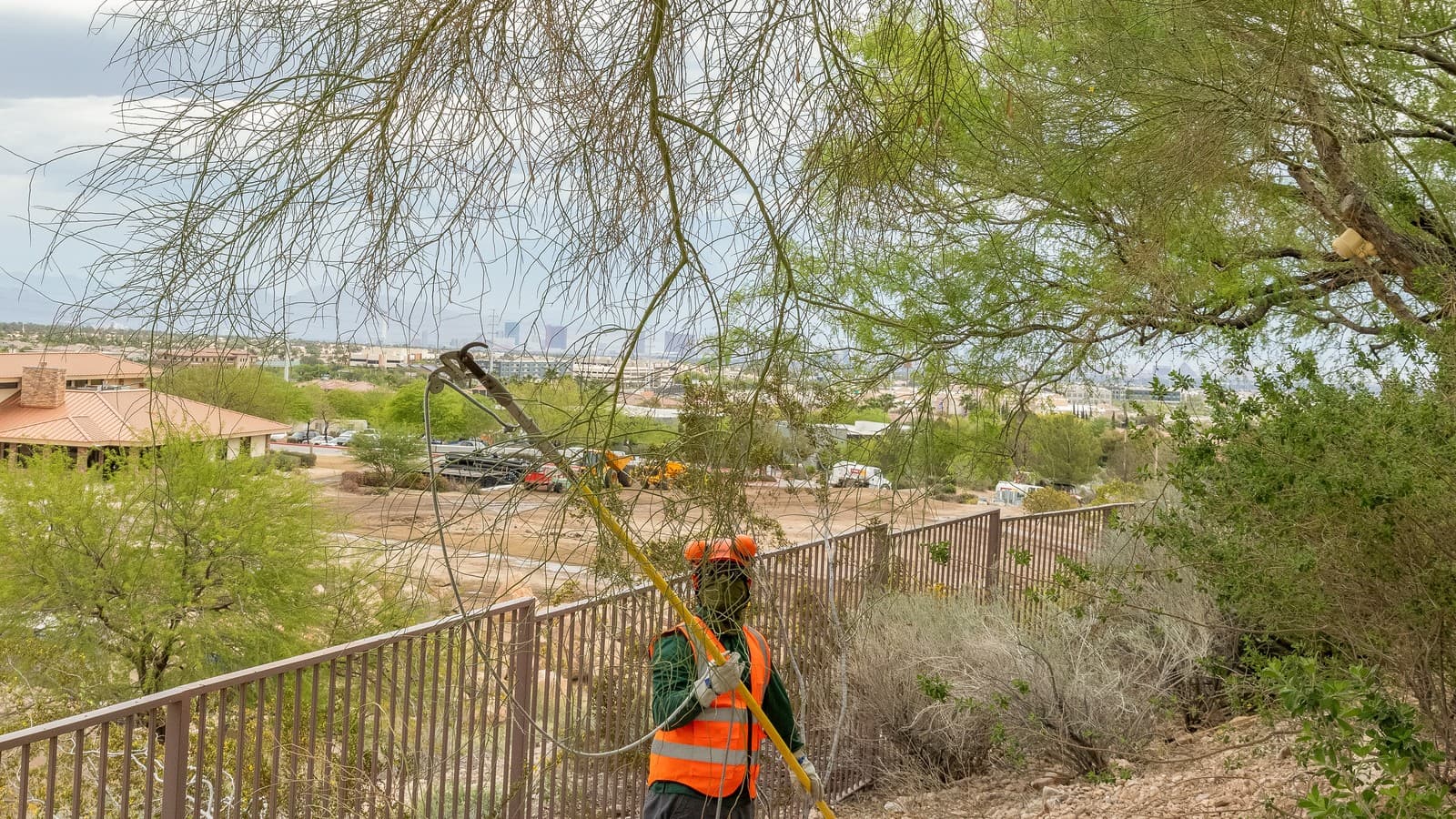
A tree assessment report before planting can flag exactly where a mature root system is likely to spread on your specific lot, which is more useful than a generic distance rule when caliche and irrigation patterns vary block to block.
What to Do If You Already Have a Tree Near Your Line
If you suspect root intrusion, the two professionals you need are a licensed plumber and a certified arborist, and the order matters less than getting both involved before anyone starts cutting. A CCTV sewer camera inspection from a plumber is the only reliable way to confirm roots are actually inside the pipe rather than just nearby, and it shows exactly where the intrusion is happening along the line's length. The International Society of Arboriculture recommends bringing in a certified arborist for exactly this kind of root evaluation, since assessing a tree's structural roots safely takes training most plumbers and homeowners don't have.
Once intrusion is confirmed, don't assume the fix is to remove the tree or hack away at the visible roots. A large structural root helps anchor a mature tree, and cutting it close to the trunk without an arborist's evaluation can destabilize the tree or trigger decline that shows up months later. Our tree assessment reports document which roots are safe to address and which ones the tree depends on for stability, so the plumbing repair and the tree's long-term health get planned together instead of working at cross purposes. In some cases, ongoing deep root feeding after a root has been trimmed helps a tree recover and reduces the stress that drives aggressive regrowth back toward the same pipe.
For a tree that's already caused repeated sewer failures and isn't a good candidate for root management, tree removal paired with a sewer-safe replacement species is sometimes the more practical long-term fix. Our guide on tree roots near foundations in Las Vegas covers the related question of root damage to hardscape and structures, which often gets diagnosed in the same visit as a sewer concern.
Tree Roots and Sewer Lines Across the Las Vegas Valley
Pipe age and soil conditions vary enough across the Valley that the same tree can be a low risk on one street and a real liability on another. Established neighborhoods in Summerlin and older sections of Henderson often still have original clay or cast-iron laterals running under mature landscaping planted when the homes were new, which is exactly the combination that leads to intrusion over time. Newer construction in North Las Vegas and Green Valley typically has PVC sewer lines, which resist root intrusion far better, though a poorly sealed joint can still eventually be an entry point.
Across the entire Las Vegas Valley, the same principle holds regardless of neighborhood: know what's running under your yard, know what's growing above it, and get both evaluated together rather than treating a slow drain and a nearby tree as unrelated problems.
Frequently Asked Questions
How do I know if tree roots are in my sewer line?
The clearest signs are slow or gurgling drains in multiple fixtures, recurring backups, and a greener strip of lawn tracking the line's path. A CCTV sewer camera inspection from a licensed plumber is the only way to confirm it directly.
How far should a tree be planted from a sewer line?
It depends on the species and its mature root habit more than a single fixed number. Aggressive-rooting species need more distance than desert-adapted trees like mesquite or palo verde. An arborist can give a distance specific to the species and your lot's soil.
Can I just cut the roots that are in my sewer line?
The plumber typically clears roots from inside the pipe as part of the repair. What an arborist evaluates separately is whether trimming roots at the tree itself is safe for the tree's stability, since a large structural root shouldn't be cut without understanding its role in anchoring the tree.
Do all trees threaten sewer lines equally?
No. Aggressive water-seeking species planted near an older clay or cast-iron line carry the most risk. Desert-adapted species on modern PVC lines are a much lower concern, though age and pipe condition still matter more than species alone.
Will removing the tree fix a root intrusion problem?
Sometimes, but not automatically. If the pipe itself is already damaged, removing the tree stops new root growth but doesn't repair existing cracks or joint failures. A plumber's inspection determines whether the pipe needs repair regardless of what happens with the tree.
Get Your Trees and Sewer Lines Assessed in Las Vegas Today
Tree roots and sewer lines in Las Vegas don't have to end in an expensive backup if the problem gets caught early. Benjamin's Tree Service has been evaluating root systems on Valley properties since 2001, licensed, insured, ISA Certified (WE-15785A), and rated 5 stars on Google.
Call us at 725-227-6160 or visit benjaminstreeservice.com/contact to schedule a tree assessment before a root problem becomes a plumbing emergency.
Benjamin's Tree Service
ISA Certified Arborists serving Las Vegas & the surrounding areas since 2001.
Related Reading
Property Protection
Tree Roots Cracking Your Las Vegas Driveway? What to Do
Tree roots buckling your Las Vegas driveway? Learn why desert soil pushes roots toward pavement, wha…
9 min read
Property Protection
Tree Roots Near Foundations in Las Vegas: What to Do
Learn what tree roots near foundations in Las Vegas can mean, which warning signs matter, and when t…
9 min read
Tree Removal
Tree Removal Near a Pool in Las Vegas: What to Know
Tree removal near a pool in Las Vegas takes careful access planning and root protection. Here's what…
9 min read