
Fruit tree pruning in Las Vegas: when to prune citrus and deciduous trees, what a pro cuts, and what to avoid in summer heat. Free estimates.
Fruit tree pruning in Las Vegas depends on the kind of tree: citrus and deciduous fruit trees follow different calendars, and a heavy cut at the wrong time can leave bark exposed to desert sun. Our trimming and pruning service covers preventative pruning and structural corrections. This guide explains when each type is usually cut and what a professional removes.
Quick Summary
Prune deciduous fruit trees, such as peaches and apricots, while they are dormant in winter, and, according to University of Arizona Extension guidance written for Arizona's citrus regions, prune desert citrus in late winter and spring, roughly February through April. University of Nevada, Reno Extension notes that pruning at its Southern Nevada research orchard happens in both the dormant and summer seasons, with summer cuts limited to vigorous upright shoots and height control. University of Arizona Extension advises against pruning citrus from May through mid-October, because exposed limbs and trunks can be damaged by intense sun. Fig and pomegranate trees are not covered by the sources we checked, so ask an arborist about them.
Key takeaways
- A fruit tree is not a shade tree. The cuts and the calendar are different.
- Citrus is pruned lightly. Extension says the lower canopy usually does not need to come off.
- Cutting a lot of foliage at once can expose bark that was shaded, and Las Vegas sun does the rest.
- Dead, broken or crossing wood can be removed at almost any time. Big structural cuts should wait for the right season.
- If a tree is tall, old or neglected, ask an ISA Certified Arborist before the first cut.
Why is fruit tree pruning different from trimming a shade tree?
A fruit tree is pruned for the tree's structure and its crop, while a shade tree is usually pruned for clearance, safety and form. University of Arizona Extension lists the jobs of citrus pruning as removing sprouts and weak, crossing or dead branches, and letting more light into the canopy. University of Nevada, Reno Extension adds that tree size is controlled by variety, rootstock and pruning.
Size is a big part of it. The University of Nevada, Reno Extension orchard in North Las Vegas keeps its trees pruned to roughly 6.5 to 7 feet tall so that the orchard is "ladder-less," meaning you can work the whole tree from the ground. At home, the same idea applies. A tree you can reach is a tree you can prune, thin and harvest without a ladder.
Our older post on high-yielding fruit trees in Las Vegas covers choosing and caring for fruit trees in general. This guide stays on the cuts themselves.
When is the best time to prune fruit trees in Las Vegas?
The best time depends on the type of tree. Deciduous fruit trees are generally pruned in winter, while they are dormant, and desert citrus is pruned in late winter and spring.
- Deciduous fruit trees (peach, apricot, plum, apple, pear): these are generally pruned in winter while dormant. University of Nevada, Reno Extension says pruning at its Southern Nevada orchard is done as needed in the dormant season and in summer.
- Citrus: University of Arizona Extension says regular pruning of desert-grown citrus should take place in the spring, from February through April, and that pruning is not generally recommended from May through the middle of October.
- Extensive citrus pruning in November through January: Extension does not recommend it, because pruning often stimulates tender new growth that is susceptible to freeze damage.
- Fig and pomegranate: the sources we reviewed do not give timing for these. Ask an arborist before making large cuts.
The University of Arizona guidance is written for Arizona's citrus regions. Las Vegas has its own winter lows, so treat those dates as a starting point and ask a local arborist to set the exact window for your yard.
What should you not prune in summer?
Do not take off large limbs or thin a lot of foliage in the heat. The summer risk is bark that was shaded and is suddenly exposed.
University of Arizona Extension explains it this way for citrus: when pruning exposes large limbs or the trunk to sunlight, finishing the job in late winter or spring gives the tree time to grow new foliage that will shade the exposed wood before the harsh summer sun arrives. Exposed limbs and trunks can be damaged by intense sunlight, which can lead to sunscald or bark rot.
The University of Nevada, Reno Extension orchard paints its young trees with thinned white latex paint to prevent sunburn. If a pruning job leaves bark exposed, ask the arborist how they plan to protect it.
Light summer work is a different matter. Extension describes summer pruning on mature trees as mainly removing vigorous upright shoots that are not needed as permanent branches and thinning shoots to control tree height. That is about control, not about removing the canopy.
Our post on olive tree pruning in Las Vegas explains the same sunscald risk for another desert tree.
What does a professional cut, and what do they leave?
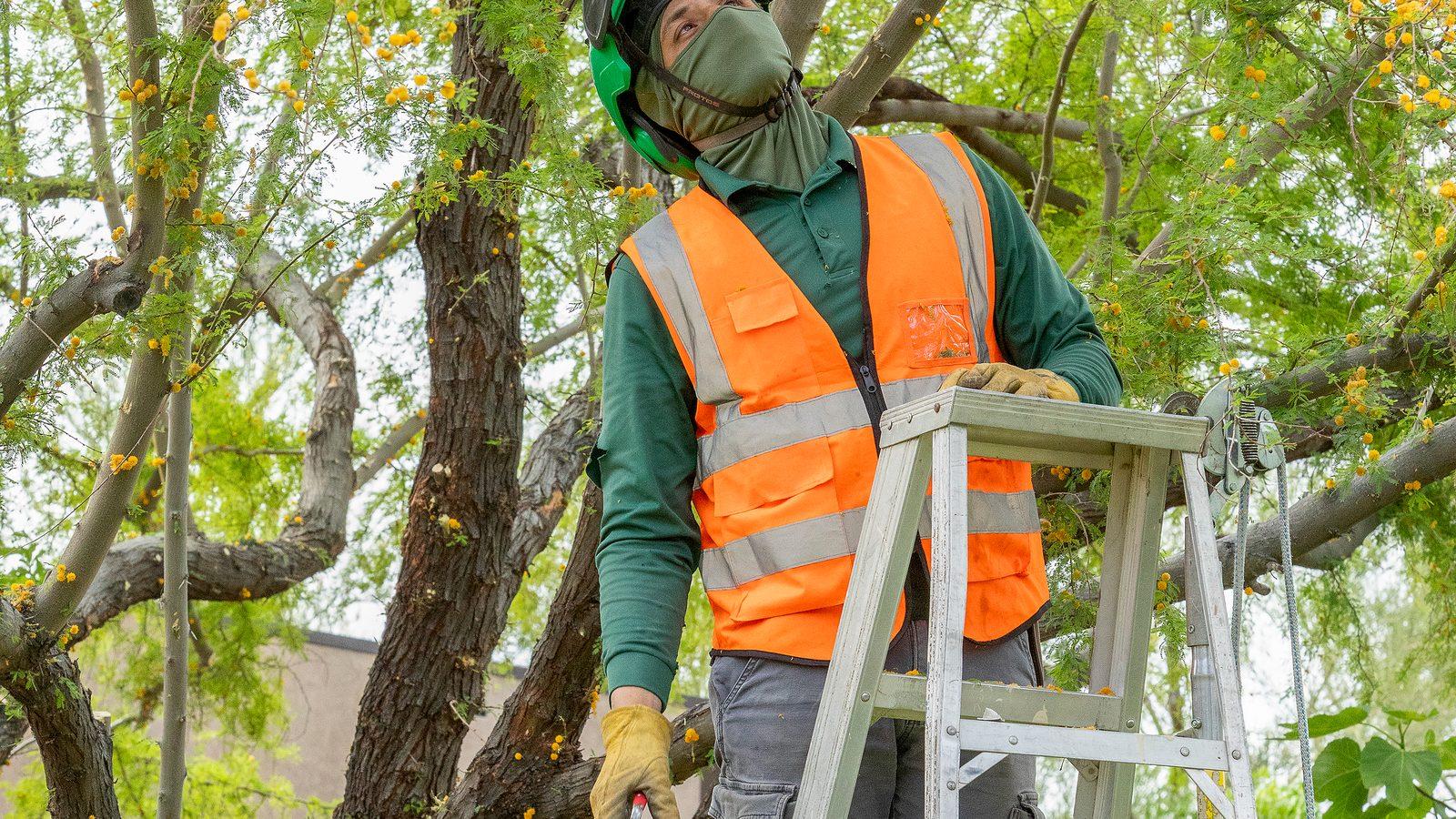
A professional removes wood with a reason and leaves the rest. ISA's guidance says each cut can change a tree's growth, so no branch should be cut without a reason.
On most fruit trees, a crew removes:
- Dead, broken and diseased branches
- Branches that cross or rub each other
- Weakly attached or crowded limbs that block light
- Vigorous shoots growing straight up that are not needed as permanent branches
- Sprouts that grow from the trunk or from the base
On citrus specifically, University of Arizona Extension adds these points:
- Sprouts and deadwood come out regularly.
- The center of the canopy may be opened up when there is no interior fruit.
- Low-hanging branches usually stay. Extension says there is nothing wrong with letting the canopy reach toward the ground, and that it is very hard to re-establish a low canopy once it is removed.
- A large branch is cut in three steps, with an undercut first, so the bark does not tear.
ISA calls topping, which is cutting branches back to stubs, perhaps the most harmful pruning practice known. If someone offers to "cut it way back" to reduce a tree's size, read our post on why tree topping hurts trees first.
Can you prune a fruit tree yourself?
You can handle small jobs on a small tree. Extension says sprouts are best removed by hand while they are small, and that smaller branches can be cut with hand pruners or loppers. A curved saw handles bigger branches.
Call a professional when:
- The tree is taller than you can reach from the ground.
- A branch is large, heavy or above a roof, wall or walkway.
- The tree has been neglected for years, and fixing it would take several seasons of cuts.
- You are not sure which branches are dead.
- You want to reduce the tree's size, not just tidy it.
Cutting with a chainsaw from a ladder is a job for a trained professional; OSHA publishes chainsaw safety guidance in Working Safely with Chainsaws. If a tree is overgrown, ask about a staged pruning schedule instead of one drastic cut.
How often should fruit trees be pruned?
Most fruit trees need attention every year. The University of Nevada, Reno Extension orchard is pruned annually. A short winter pass for dead or crossing wood, plus any light summer control, keeps each job small. Our guide on how often to trim trees in the Las Vegas desert climate covers general timing for other trees.
Young trees need shaping early, because a tree's structure matters for small, healthy fruit trees. Ask an arborist what a young tree in your yard needs.
Frequently Asked Questions
When is the best time to prune fruit trees in Las Vegas?
Deciduous fruit trees are generally pruned in winter, while dormant. University of Arizona Extension's guidance, written for Arizona's citrus regions, is to prune desert citrus in late winter and spring, from about February through April. Las Vegas winters differ, so ask a local arborist to set the exact window for your tree and your yard.
Can I prune fruit trees in summer?
Light summer pruning is described by University of Nevada, Reno Extension for mature trees: removing vigorous upright shoots and thinning to control height. Avoid heavy cuts in summer heat, because newly exposed bark can be damaged by sun. For citrus, University of Arizona Extension advises against pruning from May to mid-October except to remove large limbs that are already damaged.
How much can I cut off a fruit tree at once?
The sources we checked do not give one figure for Las Vegas, and it depends on the tree. Cutting a lot of foliage at once can expose bark to sun, so ask an arborist whether an overgrown tree should be pruned in stages over more than one season.
Should I seal pruning cuts with paint?
No. University of Arizona Extension says there is no need for pruning paint or other compounds on cuts, because the tree heals naturally from the branch collar. The extension discusses diluted white latex paint for newly exposed bark; ask an arborist about protection.
Does Benjamin's Tree Service prune fruit trees?
Our trimming and pruning service covers preventative pruning and structural corrections. Tell us the type of tree and what you see, and we will explain what we would cut and when. Estimates are free and no-obligation.
Get a Free Fruit Tree Pruning Estimate in Las Vegas
Benjamin's Tree Service has served Las Vegas since 2001, and our work is led by Benjamin Garcia, ISA Certified Arborist (WE-15785A). Tell us what kind of fruit tree you have and send a photo if you can, and we will tell you what we would prune now and what should wait.
Schedule Service or call 725-227-6160.
Sources
- University of Arizona Cooperative Extension: Pruning Citrus
- University of Nevada, Reno Extension: Research Orchard Fruit Evaluations & Recommendations for Southern Nevada, 2020 (Small-space Orchards)
- ISA TreesAreGood: Pruning Your Trees
- OSHA: Working Safely with Chainsaws
- Benjamin's Tree Service: Trimming and Pruning
Sources checked November 10, 2026.
Related Reading
Benjamin's Tree Service
ISA Certified Arborists serving Las Vegas & the surrounding areas since 2001.
Related Reading
Tree Care Tips
Tree Branch Removal in Las Vegas: When to Call a Pro
Tree branch removal in Las Vegas: learn which broken, dead or hanging limbs need a pro, what can wai…
9 min read
Tree Care Tips
Deep Root Watering for Trees in Las Vegas: A Practical Guide
Learn how deep root watering works for Las Vegas trees: where the water should go, how to check soil…
8 min read
Tree Care Tips
When Do You Need a Tree Risk Assessment in Las Vegas?
Learn when a tree risk assessment is worth ordering in Las Vegas, how it differs from a free estimat…
8 min read