
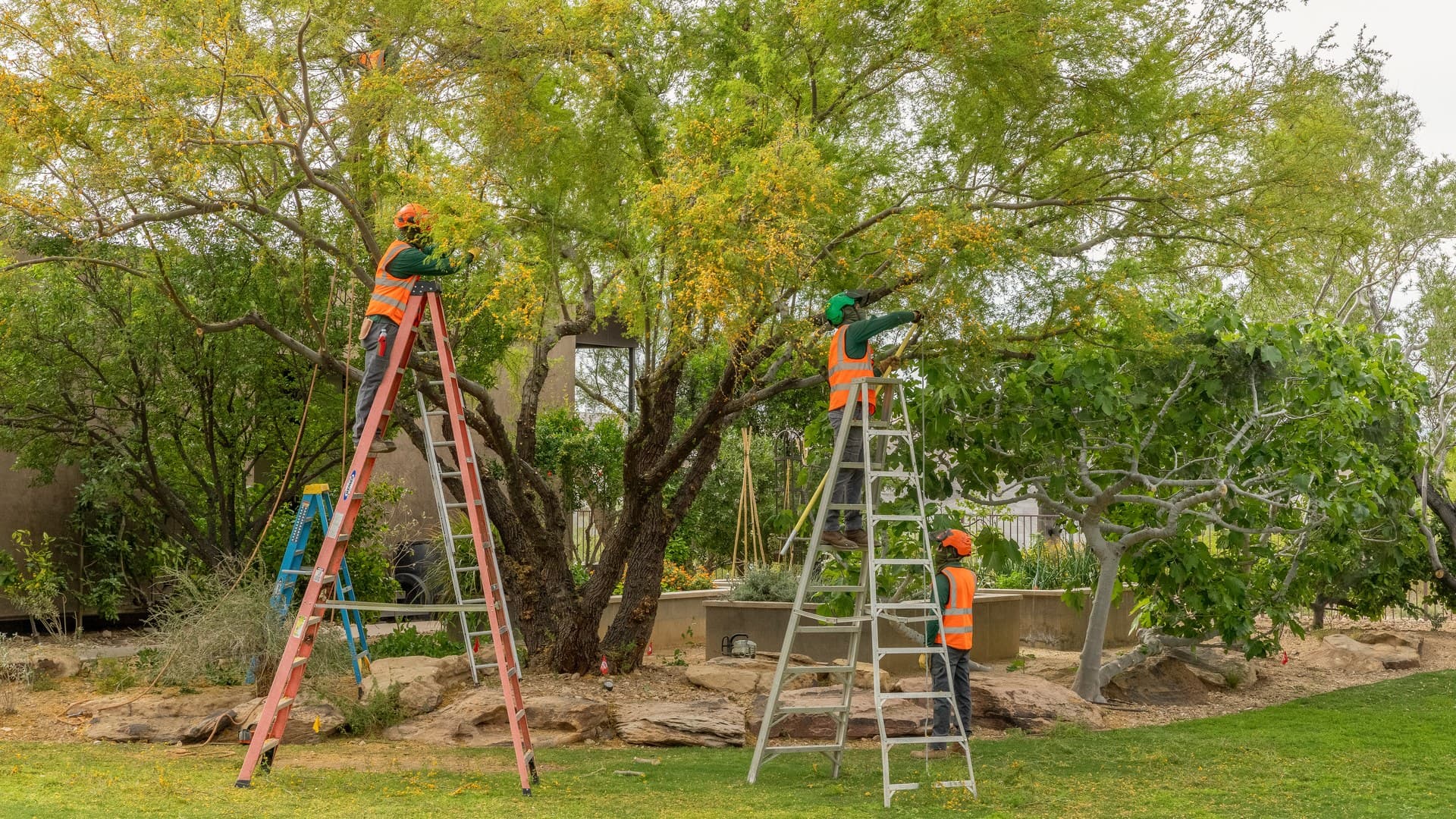
Mesquite tree trimming in Las Vegas needs species-specific timing. Learn when to prune, mistakes to avoid, and why ISA Certified Arborists do it right.
Mesquite tree trimming in Las Vegas is not the same job as trimming an ash, a pine, or an ornamental fruit tree. Mesquites grow fast, branch unpredictably, and develop weak, included-bark unions where multiple trunks meet — all of which make correct pruning technique and timing far more important than most homeowners realize. Get it wrong, and a mesquite that looked fine in April can drop a major limb during the first serious monsoon gust of July.
At Benjamin's Tree Service, we have trimmed mesquite trees across the Las Vegas Valley since 2001. Our ISA Certified Arborists (ISA Cert. WE-15785A) understand how this species actually grows in caliche soil and desert heat, and our licensed, insured, 5-star Google-rated crew handles everything from routine shaping to structural storm-prep pruning on the mesquites that shade a huge share of Las Vegas Valley front yards, backyards, and HOA common areas.
Quick Summary
- Mesquite is the Las Vegas Valley's most common shade tree, and its fast growth means it typically needs trimming every 12 months, more often than slower-growing species
- Weak branch unions and multi-trunk growth habits make mesquites prone to storm failure if they are never structurally trained
- Topping or "hat racking" a mesquite triggers dense, weakly attached regrowth that is more dangerous than the branch it replaced
- Winter dormancy (December–February) is the best window for major structural cuts; light shaping can happen nearly any time
- Mesquites commonly sucker from cut roots and stumps, which affects both trimming aftercare and eventual removal planning
- Benjamin's Tree Service has trimmed mesquites throughout the Las Vegas Valley since 2001
Table of Contents
- Why mesquite tree trimming needs a different approach
- When to trim mesquite trees in Las Vegas
- Common mesquite trimming mistakes
- Structural pruning for storm-ready mesquites
- Mesquite suckering and root health after trimming
- What to expect from a professional trimming appointment
- Frequently asked questions
Why Mesquite Tree Trimming in Las Vegas Requires a Different Approach
Mesquite — whether Chilean, honey, or velvet — is the most planted shade tree in the Las Vegas Valley, and for good reason: it tolerates alkaline caliche soil, needs relatively little supplemental water once established, and grows quickly into a full canopy that most desert-adapted species take much longer to reach. That speed is also the source of most mesquite problems homeowners eventually call us about.
Fast Growth Means More Frequent Trimming
A young or vigorously growing mesquite can put on several feet of new branch growth in a single season. Without regular attention, that growth tends to head off in multiple directions at once, creating co-dominant stems and narrow, V-shaped branch unions that trap bark instead of forming strong wood. Our trimming and pruning crews look for these unions early, because a branch union corrected at three years old is a five-minute cut — the same union left until the tree is mature can mean choosing between a weak, storm-prone limb and a much larger removal cut.
Weak Wood Where It Counts
Mesquite lumber itself is dense and hard, which surprises homeowners who assume "weak" applies to the wood generally. The real vulnerability is at the branch and trunk unions, where included bark from crowded, competing growth prevents the tree from forming a solid structural connection. Under the wind load of a Las Vegas Valley monsoon, that union — not the wood a few inches away — is where failure happens.
When to Trim Mesquite Trees in Las Vegas
Timing matters more for mesquite than for many other Las Vegas Valley species because of how the tree responds to cuts made during active growth versus dormancy.
Winter Dormancy Is Best for Structural Work
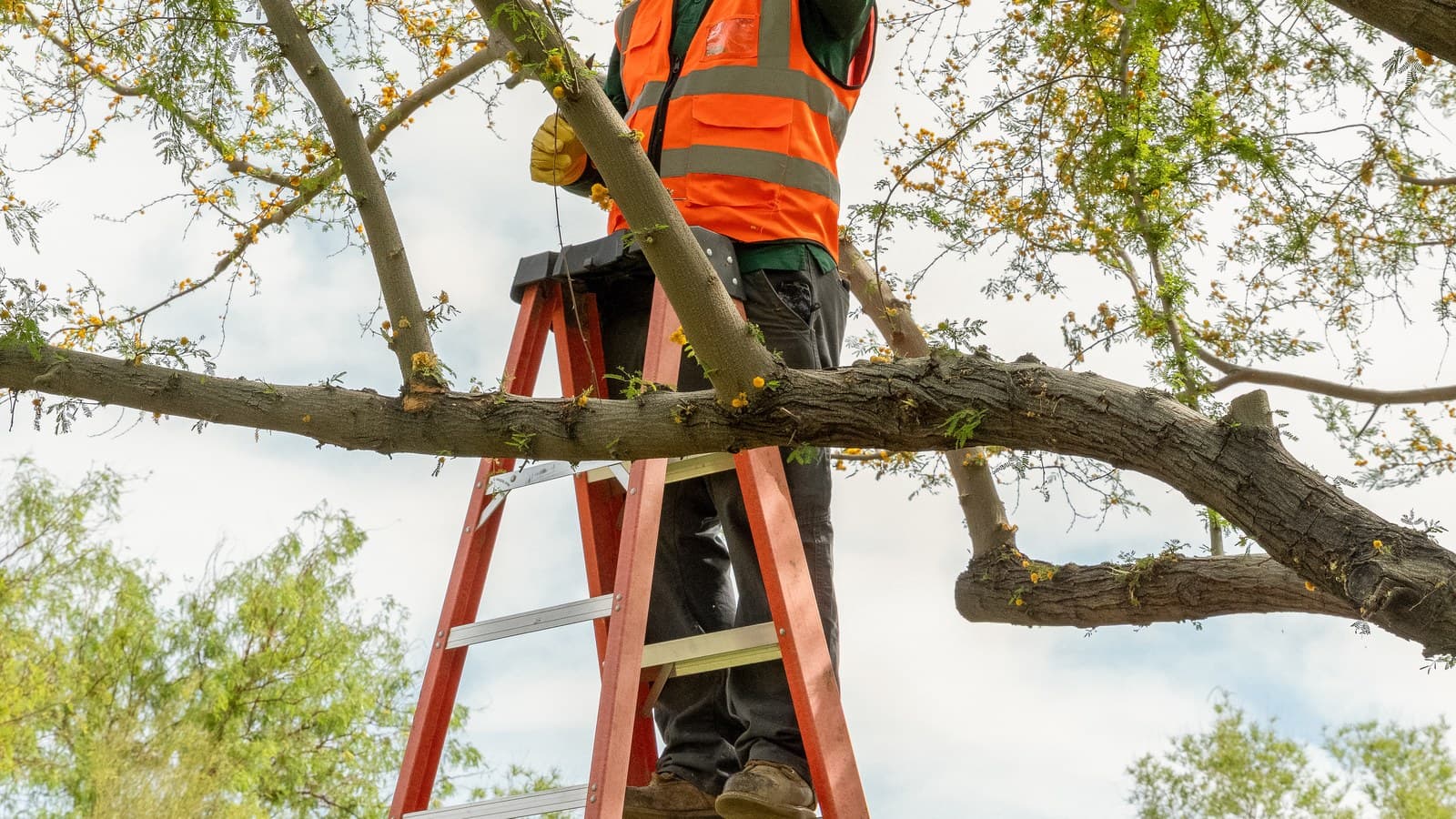
Mesquites typically drop most of their leaves in December and January, and that dormant window through February is the best time for any significant structural pruning — removing co-dominant stems, correcting included-bark unions, or reducing an overextended canopy. Cuts made while the tree is dormant heal with less stress and trigger less of the rapid regrowth that heavy summer pruning tends to produce.
Light Shaping Can Happen Nearly Any Time
Routine touch-ups — thinning small deadwood, clearing branches away from a roofline, or trimming growth back from a walkway — are low-risk throughout most of the year. The one stretch we recommend avoiding for anything beyond light work is the peak of summer heat, when a freshly cut, sun-exposed mesquite is more vulnerable to stress and sunscald on newly bare bark.
Before Monsoon Season, Not During It
June through September is Las Vegas Valley monsoon season, and it is the worst time to start major mesquite pruning — high winds and sudden storms can arrive with little warning, and a partially pruned canopy is often less stable than one that was never touched. Structural work should be finished well before the season starts; once monsoon storms are rolling through, our emergency tree service team handles storm response instead of scheduled trimming.
Common Mesquite Trimming Mistakes
Topping and "Hat Racking"
The single most damaging mistake we see on Las Vegas Valley mesquites is topping — cutting large branches back to stubs to quickly reduce height or canopy size. Mesquites respond to topping with a flush of fast, weakly attached water sprouts that grow back denser and less stable than the limb that was removed. Our guide on why tree topping hurts Las Vegas trees covers the mechanics in more detail, but on mesquite specifically, topped trees often need corrective pruning again within two or three years, at a higher cost than doing it right the first time.
Over-Thinning the Canopy
Removing too much interior canopy in one visit exposes previously shaded bark to direct desert sun, causing sunscald and long-term bark damage. A qualified arborist limits live-canopy removal to a percentage that keeps the tree's remaining foliage able to shade its own bark and trunk.
Ignoring Root Flare and Trunk Girdling Roots
Mesquites planted too deep, or mulched too high against the trunk, can develop girdling roots that slowly strangle the tree at the base. Trimming alone will not fix a girdling root issue, which is one reason we recommend a full site walkthrough rather than a quote based on photos alone.
Structural Pruning for Storm-Ready Mesquites
Given how often Las Vegas Valley mesquites end up in monsoon-related storm calls, structural pruning is really a form of insurance. The goal is to identify and correct weak unions, reduce excess weight on long horizontal limbs, and thin the canopy just enough to let wind pass through instead of catching it like a sail.
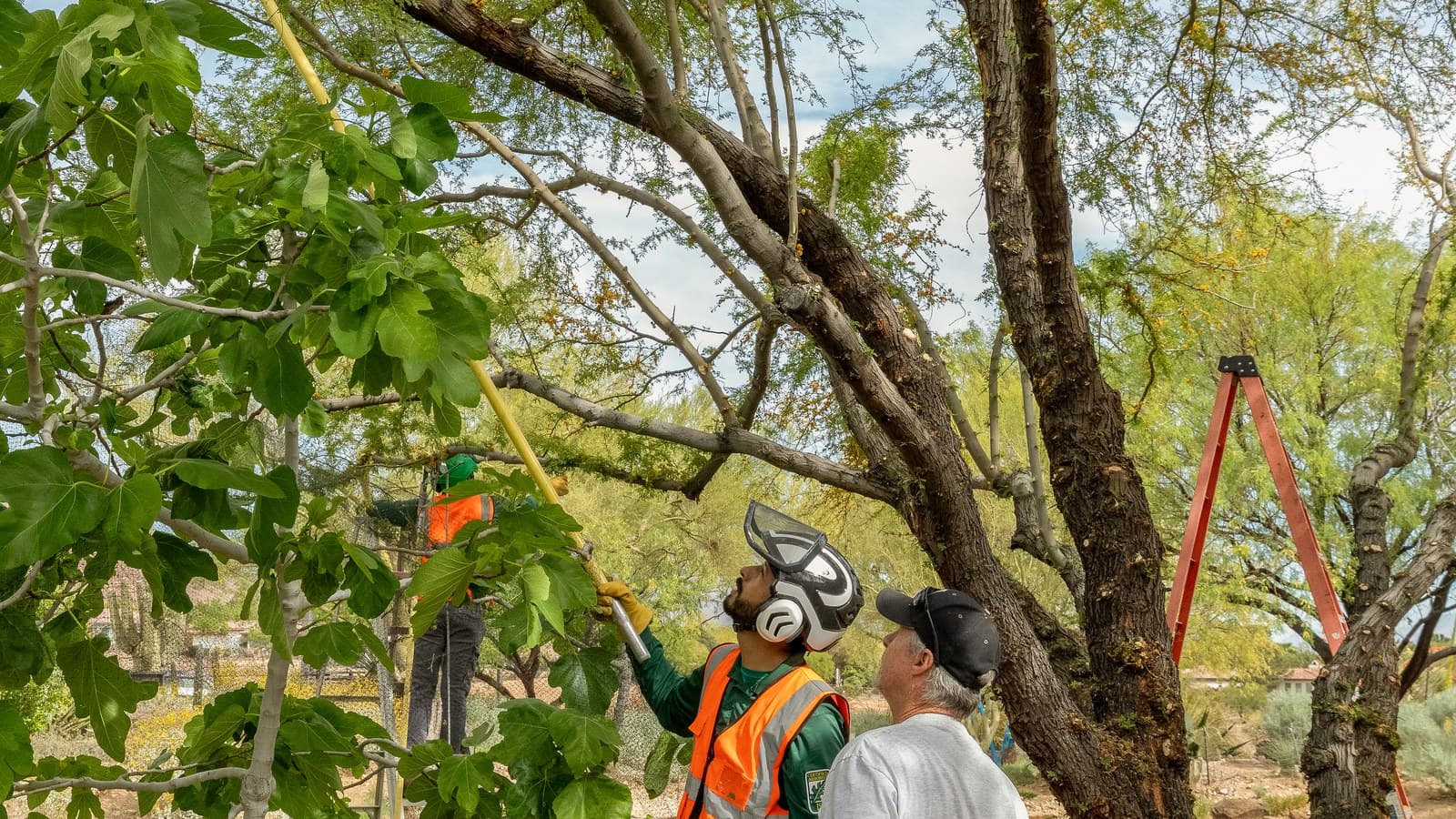
This is different from crown reduction versus crown thinning on a species like ash or pine, because mesquite's naturally irregular branching means the "right" structural shape is rarely symmetrical. An arborist experienced specifically with mesquite will train the tree toward its natural form rather than forcing a shape the species does not hold well.
Multi-Trunk Mesquites Need Extra Attention
Many Las Vegas Valley mesquites were allowed to grow as multi-trunk specimens from a young age, which is attractive but structurally riskier than a single-leader tree. Where trunks meet close to the ground with a narrow angle, that union should be evaluated early — sometimes the safest long-term fix is selective trunk removal while the tree is still young enough that the remaining structure can compensate.
Mesquite Suckering and Root Health After Trimming
Mesquite is well known for sending up suckers — new shoots from the root zone or trunk base — especially after significant pruning or stress. This is normal for the species, but left unmanaged, suckers redirect energy away from the main canopy and can create a thicket at the base of the tree.
Post-Trim Sucker Management
We typically recommend a follow-up visit six to eight weeks after major structural pruning to remove any new suckers before they establish. This is far more effective than an annual "whenever we notice it" approach, since young suckers are easy to remove and older ones require repeated cutting to fully control.
Deep Root Feeding Supports Recovery
A mesquite that has just gone through significant structural pruning benefits from root-zone support to recover efficiently. Our deep root feeding service delivers nutrients directly past Las Vegas Valley's caliche hardpan, which is especially useful after a heavier trim removes a meaningful portion of the tree's photosynthetic capacity. If a mesquite is being removed rather than trimmed, our stump grinding service also helps limit future root suckering from the stump itself.
What to Expect From a Professional Mesquite Trimming Appointment
A proper mesquite trimming visit starts with an on-site walkthrough, not a drive-by estimate. Our arborists check branch structure, trunk unions, proximity to structures and power lines, and any signs of girdling roots before recommending a scope of work.
Written, Itemized Estimates
Every visit includes a written estimate before any cutting begins, so homeowners know exactly what is being removed and why. For HOA-governed properties, we can also provide the documentation many communities require before major canopy work — our tree assessment reports service is built for that purpose.
Certified, Insured Crews
Every climb and cut is performed by a crew working under an ISA Certified Arborist (WE-15785A), fully licensed and insured in Nevada. That matters on mesquite specifically, since irregular branching and weak-union risk make rigging and cutting decisions less straightforward than on a more predictable tree form.
Frequently Asked Questions
How often should mesquite trees be trimmed in Las Vegas?
Most mesquites in the Las Vegas Valley benefit from trimming every 12 months given their fast growth rate, though younger trees establishing their structure may need more frequent light shaping while mature trees on a good structural foundation can sometimes go longer.
Is it bad to trim a mesquite tree in the summer?
Light trimming is generally fine year-round, but we avoid heavy structural cuts during peak summer heat because freshly exposed bark is more vulnerable to sun damage, and the tree has less energy available to recover from major cuts during extreme temperatures.
Why does my mesquite keep sending up new shoots after trimming?
Suckering is a normal mesquite response to pruning stress, especially after larger cuts. Removing suckers while they are young, and following up six to eight weeks after major trimming, keeps them from establishing and competing with the main canopy.
Can a topped mesquite be fixed?
Sometimes, though it takes time. Corrective pruning over multiple growing seasons can gradually restore a more stable structure by selecting and training the strongest new shoots while removing the weakest ones, but a severely topped mesquite may never fully recover its original form.
Do mesquite trees need special care before monsoon season?
Yes. Because mesquites are common storm-damage callouts during Las Vegas Valley monsoons, structural pruning finished before June — well ahead of peak storm activity — meaningfully reduces the odds of limb failure during a summer wind event.
Schedule Mesquite Tree Trimming in Las Vegas Today
Mesquite trees are one of the best assets a Las Vegas Valley property can have — reliable shade, low water use, and genuine curb appeal — but only when they are trimmed correctly and on the right schedule. Whether your mesquite needs routine shaping, structural storm-prep pruning, or a full assessment after storm damage, Benjamin's Tree Service has the species-specific experience to do it right.
Call us at 725-227-6160 or visit benjaminstreeservice.com/contact to schedule your free estimate. We are licensed and insured in Nevada, ISA Certified (WE-15785A), and proud to serve mesquite trees throughout Henderson, Summerlin, North Las Vegas, and the rest of the Las Vegas Valley.
Benjamin's Tree Service
ISA Certified Arborists serving Las Vegas & the surrounding areas since 2001.
Related Reading
Trimming & Pruning
Crape Myrtle Pruning in Las Vegas: Avoid Crape Murder
Crape myrtle pruning in Las Vegas done wrong causes crape murder and weak regrowth. Learn the right …
9 min read
Trimming & Pruning
Tree Topping in Las Vegas: Why It Hurts Trees
Tree topping can leave Las Vegas trees with weak regrowth and large wounds. Learn safer pruning opti…
9 min read
Trimming & Pruning
Palm Tree Trimming in Las Vegas: Homeowner's Guide
Learn when to trim palm trees in Las Vegas, how the process works, and why professional palm tree tr…
7 min read