
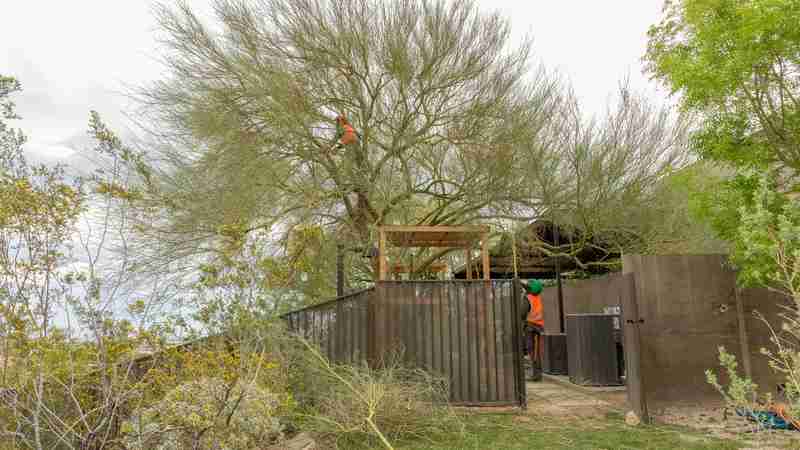
Tree trimming and tree pruning are not the same thing. Learn the key differences, when each service is needed, and why it matters for Las Vegas trees.
Most Las Vegas homeowners use the words "trimming" and "pruning" interchangeably when they call about tree service. And honestly, that is perfectly fine — we know what you mean either way. But in the professional arborist world, trimming and pruning are two distinct practices with different goals, different techniques, and different impacts on your trees.
Understanding the difference helps you communicate more clearly with your tree service provider and ensures your trees receive the right care at the right time. Whether you have mature mesquites shading your Henderson backyard or a row of fan palms lining your Summerlin driveway, knowing when your trees need trimming versus pruning can save you money and keep your landscape healthier for years to come.
> Quick Summary
> - Tree trimming focuses on shaping the canopy, controlling size, and maintaining a neat appearance
> - Tree pruning is a targeted health practice that removes dead, diseased, or structurally weak branches
> - Trimming is typically done on a regular schedule; pruning is done based on the tree's specific needs
> - In the Las Vegas desert climate, both services are critical — but for very different reasons
> - An ISA Certified Arborist can assess whether your tree needs trimming, pruning, or both
What Is Tree Trimming?
Tree trimming is primarily about aesthetics and size management. When an arborist trims a tree, the focus is on shaping the canopy, reducing overgrowth, and keeping the tree looking tidy within your landscape. Think of trimming as a haircut for your tree — it controls the overall shape and prevents the tree from growing into spaces where it should not be.
Common Reasons for Trimming
- Overgrown canopy: Branches extending over your roof, into your neighbor's yard, or blocking sight lines along a street
- Size control: Keeping a fast-growing species like mulberry or African sumac from dominating your entire yard
- Aesthetic shaping: Maintaining a uniform, clean look that fits your property's landscaping design
- Light and airflow: Opening up the canopy so sunlight reaches your lawn, garden, or other plantings beneath the tree
- HOA compliance: Many Summerlin and Henderson HOA communities require trees to be maintained at specific heights or setbacks from property lines
Trimming typically involves cutting back the outer edges of the canopy. An arborist removes the tips of branches that have grown beyond the desired shape. In Las Vegas, trimming is especially common on fast-growing shade trees that thrive in our irrigated residential landscapes — species that can add several feet of new growth each season despite the desert climate.
How Often Should Trees Be Trimmed in Las Vegas?
Most residential trees in the Las Vegas Valley benefit from trimming every 12 to 18 months. Some fast-growing species may need attention more frequently, while slower-growing desert natives like palo verde may only need trimming every two to three years. The key is monitoring growth rather than following a rigid calendar. If branches are encroaching on structures, blocking walkways, or creating a dense, tangled canopy, it is time to call for trimming and pruning service.
What Is Tree Pruning?
Tree pruning is a health-focused practice. While trimming shapes the outside of the canopy, pruning works deeper within the tree's structure. An arborist performing pruning is making targeted cuts to remove specific branches — dead wood, diseased limbs, crossing branches that rub together, and structurally weak attachments that could fail during a storm.
Pruning is more like surgery than a haircut. Every cut has a purpose, and a skilled arborist evaluates each branch before deciding whether it stays or goes.
Common Reasons for Pruning
- Dead or dying branches: Removing wood that is no longer alive prevents it from falling unexpectedly and attracting pests
- Disease management: Cutting out infected branches before disease spreads to the rest of the tree or neighboring trees
- Structural improvement: Eliminating branches with weak V-shaped crotches, co-dominant leaders, or included bark that could split under weight
- Crossing and rubbing branches: Where two branches contact each other, friction wounds create entry points for disease and pests
- Clearance for safety: Raising the canopy by removing lower branches so people can walk or vehicles can pass beneath safely
- Storm preparation: Reducing the risk of branch failure during the high winds and monsoon storms that hit Clark County each summer
Types of Pruning Cuts
Professional arborists use several specific pruning techniques depending on what the tree needs:
Crown cleaning removes dead, dying, diseased, and broken branches from throughout the canopy. This is the most common type of pruning and the one most Las Vegas trees benefit from regularly.
Crown thinning selectively removes interior branches to reduce density without changing the overall shape. This allows more wind to pass through the canopy — an important consideration during Las Vegas monsoon season when wind gusts can cause serious storm damage.
Crown raising removes lower branches to provide clearance beneath the tree. This is frequently needed along sidewalks, driveways, and near structures throughout the Las Vegas Valley.
Crown reduction decreases the overall size of the tree by making cuts back to lateral branches. This is a last-resort technique used when a tree has outgrown its space — it is far preferable to the harmful practice of tree topping.
Key Differences at a Glance
Understanding the core distinctions helps you make better decisions about your tree care:
Purpose: Trimming manages appearance and size. Pruning manages health and structural integrity.
Focus area: Trimming targets the outer canopy edges. Pruning works throughout the entire tree structure, including interior branches.
Frequency: Trimming follows a regular schedule based on growth rate. Pruning is performed based on the tree's condition — an arborist may recommend it after spotting dead wood, disease symptoms, or structural problems during an assessment.
Skill level: Both trimming and pruning should be performed by trained professionals on mature trees. Improper cuts — especially pruning cuts — can introduce disease, weaken the tree's structure, and create hazards worse than the original problem.
Why the Distinction Matters in the Las Vegas Desert
The difference between trimming and pruning has real consequences for tree health in our desert climate.
Extreme Heat and Sun Exposure
When a tree is over-trimmed or improperly pruned during Las Vegas summer, the remaining bark and branches can suffer sunscald. Exposing previously shaded interior wood to direct desert sun — where temperatures regularly exceed 110°F — can cause tissue damage that weakens the tree and invites boring insects. A trained arborist knows how much canopy to remove without leaving the tree vulnerable.
Limited Water Resources
Every branch you remove changes how the tree uses water. In a climate where irrigation is carefully managed and water conservation matters, removing too much live growth forces the tree to redirect energy into replacing what was lost rather than strengthening its root system.
Monsoon Wind Events
Clark County experiences intense wind events during monsoon season, typically July through September. Trees that have been properly pruned — with weak branch attachments removed and canopy density reduced — are far more resistant to wind damage than trees that have only been trimmed for appearance.
Can a Tree Need Both Trimming and Pruning?
Absolutely — and most Las Vegas trees do. A comprehensive tree care visit often includes elements of both:
1. Pruning first: The arborist identifies and removes dead, diseased, or structurally compromised branches from within the canopy
2. Trimming second: Once the health and structure are addressed, the arborist shapes the outer canopy for appearance and size management
At Benjamin's Tree Service, this is how we approach most residential tree care appointments. Our ISA Certified Arborists (ISA Cert. WE-15785A) evaluate every tree individually before making any cuts. We do not simply shear the outside of the canopy and call it done — we look at the full picture, inside and out.
This combined approach is especially valuable if you have not had your trees professionally serviced in over a year. Trees in Henderson, North Las Vegas, Summerlin, and throughout the Las Vegas Valley accumulate dead wood, develop crossing branches, and grow into unwanted spaces simultaneously. Addressing everything in one visit is more efficient and better for the tree.
What to Avoid: Topping Is Neither Trimming nor Pruning
One important clarification: tree topping — the practice of cutting main branches back to stubs — is neither proper trimming nor proper pruning. Topping removes too much canopy at once, triggers rapid weak regrowth, creates large wounds vulnerable to disease, and permanently destroys the tree's natural structure. If anyone recommends topping your trees, that is a red flag. A reputable tree service company will never recommend topping as a solution.
FAQs About Tree Trimming and Pruning
Is it okay to trim or prune trees in the summer in Las Vegas?
Light pruning to remove dead or hazardous branches can be done any time of year. However, heavy trimming or structural pruning is best performed during the cooler months — late fall through early spring — when trees are less stressed by heat.
How do I know if my tree needs trimming or pruning?
If branches are growing into walkways, over your roof, or beyond property lines, you likely need trimming. If you see dead branches, cracking limbs, or signs of disease, your tree needs pruning. The best approach is to schedule a professional assessment — an arborist can identify exactly what your tree needs.
Will my HOA accept professional trimming as meeting their requirements?
Most Clark County HOAs accept work performed by a licensed and insured tree service company. We recommend keeping your service receipt and before-and-after photos for your records. Many clients in Summerlin, Anthem, and Green Valley use our services specifically for HOA compliance.
You may also find our guide on Masterful Tree Pruning to Craft a Secret Garden helpful. For an independent reference on technique, the International Society of Arboriculture's guide to pruning your trees is an excellent place to start.
Schedule Your Trimming or Pruning Service
Whether your trees need trimming for appearance, pruning for health, or a combination of both, Benjamin's Tree Service has the expertise to do the job right. We have been serving Las Vegas, Henderson, Summerlin, North Las Vegas, and communities throughout Clark County since 2001. Our team includes ISA Certified Arborists (ISA Cert. WE-15785A), and we are fully licensed and insured in Nevada with a 5-star rating on Google.
Call us today at 725-227-6160 or schedule a consultation online to find out exactly what your trees need. We will assess every tree on your property and recommend the right combination of trimming and pruning to keep your landscape safe, healthy, and looking its best.
Benjamin's Tree Service
ISA Certified Arborists serving Las Vegas & the surrounding areas since 2001.
Related Reading
Trimming & Pruning
Olive Tree Pruning in Las Vegas: A Homeowner's Guide
Olive tree pruning in Las Vegas keeps grandfathered trees healthy and code-compliant. Learn timing, …
9 min read
Trimming & Pruning
Crape Myrtle Pruning in Las Vegas: Avoid Crape Murder
Crape myrtle pruning in Las Vegas done wrong causes crape murder and weak regrowth. Learn the right …
9 min read
Trimming & Pruning
Mesquite Tree Trimming in Las Vegas: A Homeowner's Guide
Mesquite tree trimming in Las Vegas needs species-specific timing. Learn when to prune, mistakes to …
10 min read