
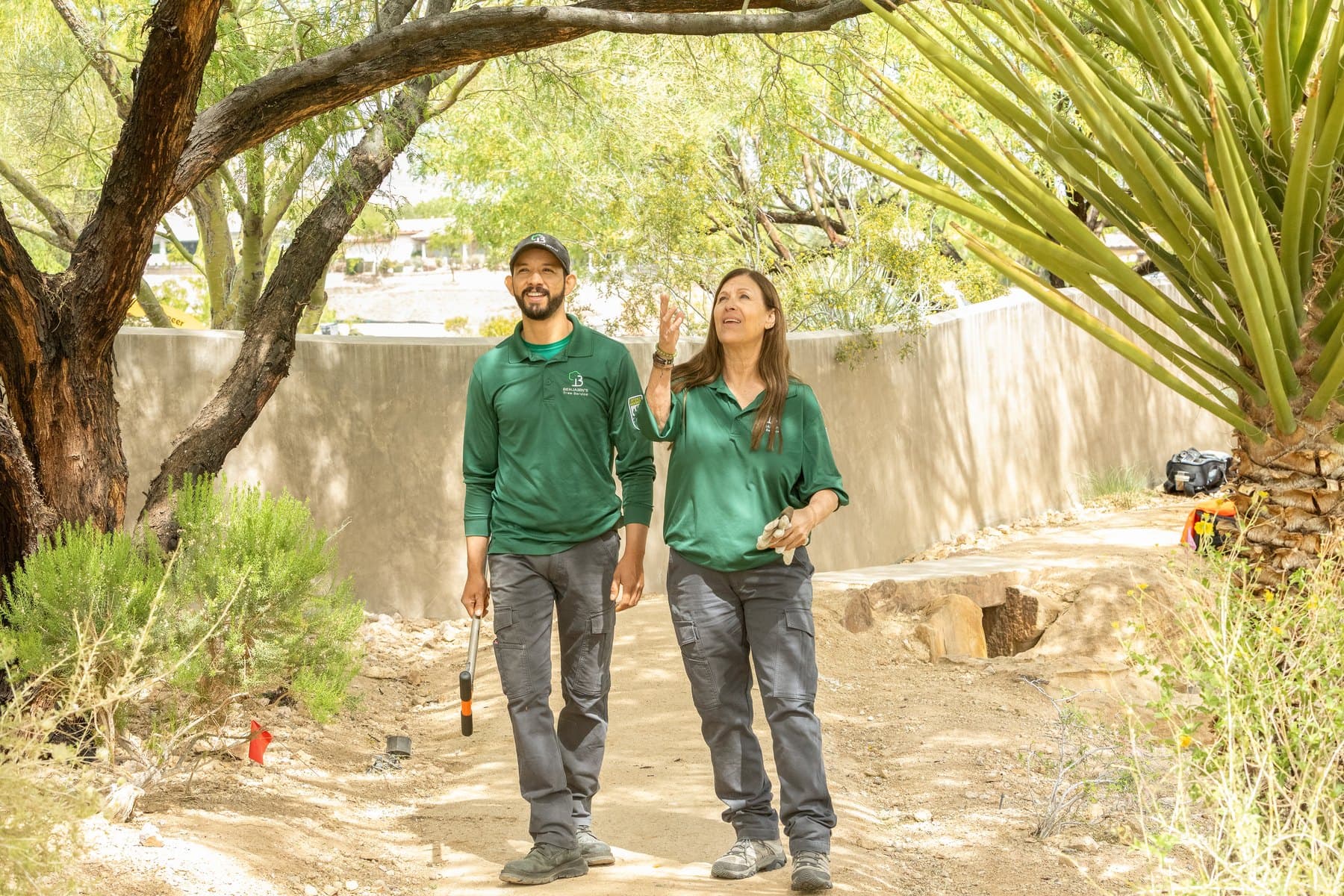
A complete Las Vegas monsoon tree care guide: how storms damage trees, warning signs to inspect for, what to do after damage, and when to call a pro.
Monsoon tree care in Las Vegas comes down to one idea: the storm does not create most tree failures, it reveals them. When strong desert winds and sudden downpours arrive between June and September, weak branch unions, dead limbs, hidden decay, and shallow roots that looked fine on a calm day can turn into urgent hazards near homes, vehicles, walls, and walkways. A single microburst can drive 60-to-80-mph gusts into a canopy that stood quietly all summer, snapping limbs, splitting trunks, and lifting roots out of the caliche.
This guide covers the full monsoon season—how storms damage valley trees, the warning signs to inspect for before the wind arrives, what to do safely after storm damage, and when to call a professional. Benjamin's Tree Service has served the Las Vegas Valley since 2001, and our ISA Certified Arborist (ISA Cert. WE-15785A) evaluates tree health, structure, and risk so property owners can make informed decisions before and after the next storm.
> Quick Summary
> - Inspect trees from a safe distance before monsoon season for cracks, deadwood, new leans, and unbalanced canopies
> - Proper structural pruning—never topping—is the most effective way to reduce storm damage
> - After a storm, treat every downed or leaning tree as electrically live until proven otherwise
> - Broken and hanging limbs, split unions, uprooted root plates, and new leans are the most common and most dangerous forms of storm damage
> - Never climb a storm-damaged tree, cut a loaded limb, or work near utility lines yourself—call a professional
How Monsoon Storms Damage Las Vegas Trees
Monsoon season brings a combination of stresses that desert trees are poorly equipped to handle. Sudden downbursts arrive after months of dry heat, when soil is compacted and many trees are already under drought stress. Wet soil from a heavy downpour loosens a tree's grip at the very moment the wind is pushing hardest against a full canopy. The result is failure that can seem to come out of nowhere.
Several factors make storm damage more likely on valley properties:
- Shallow roots in caliche soil. The hardpan layer beneath much of the valley forces roots to grow laterally near the surface instead of anchoring deep. Saturated topsoil can release those roots and let the whole tree tip.
- Heavy, unbalanced canopies. Trees that have not been pruned catch more wind. Long, overextended limbs act as levers on weak attachment points.
- Drought-weakened wood. Prolonged heat and inconsistent irrigation leave branches brittle and slow to compartmentalize decay, so they snap rather than flex.
- Fast-growing, weak-wooded species. Some popular valley shade trees put on rapid growth with structurally weak wood that fails readily in high wind.
A tree can look perfectly healthy—with a full, green canopy—while carrying a defect that a storm will find. That is why inspection matters before the wind arrives, and why response matters after.
Monsoon Tree Inspection: 7 Warning Signs Before the Storm
You do not need a ladder or a saw to check your trees. A careful look from the ground, from several angles, will surface most of the conditions that turn into storm damage. Watch for these seven signs.
1. Cracked, Broken, or Hanging Limbs
A partially broken branch may stay suspended in the canopy until wind shifts its weight. Look for fresh, pale wood, torn bark, splintered ends, or a limb hanging lower than it did before. Small dead twigs are different from a large broken limb over a roof, driveway, or play area. Do not stand beneath a damaged canopy to inspect it more closely.
2. A New Lean or Movement at the Root Plate
Some trees naturally grow at an angle. The concern is a lean that is new or increasing, especially after wind or irrigation changes. From a safe distance, check the soil at the base: raised soil, widening gaps, exposed roots, or a root plate that appears to be lifting can indicate movement. Never try to pull a leaning tree upright with a vehicle or cable.
3. Splits Where Major Stems Meet
Trees with two or more large stems can develop weak unions, especially when bark is pinched between the stems instead of forming a strong connection. Warning signs include a visible seam opening, fresh cracking, dark staining below the union, or one stem moving independently in the wind. These defects are often high in the canopy and difficult to judge from the ground.
4. Deadwood or Sudden Canopy Dieback
Dead branches do not bend and recover like healthy wood—they become brittle and break in wind. Look for limbs without leaves during the growing season, peeling bark, or a section of canopy that has declined compared with the rest of the tree. Canopy dieback can signal root stress, disease, or pests; our guide to signs a Las Vegas tree is diseased or dying explains other symptoms to watch for.
5. Cavities, Soft Wood, or Fungal Growth
Open cavities, decayed wood, soft areas, and fungal growth near the trunk or root flare can indicate internal deterioration. Cavity size alone does not determine whether a tree is unsafe—location, remaining sound wood, and nearby targets all matter. Do not probe cavities or strike the trunk to make your own diagnosis.
6. An Overextended or Unbalanced Canopy
Long, heavy limbs that reach far from the trunk create leverage at their attachment points, and a canopy heavier on one side responds unevenly to wind. Previous topping, storm breakage, or poor pruning make the imbalance worse. The fix is not to strip the canopy but to reduce weight selectively—our comparison of crown reduction and crown thinning explains how the right method depends on the tree.
7. Branches Touching Structures or Near Utility Lines
Branches rubbing a roof, pressing a wall, or hanging over a high-use area deserve attention before storm season. Utility-line conflicts require special caution: never climb or use pruning tools near energized lines—contact the utility provider when electrical infrastructure is involved.
How Proper Pruning Reduces Storm Damage
Proper structural pruning is the single most effective way to reduce a tree's wind risk. Thinning a dense canopy lets wind pass through instead of pushing against a solid wall of foliage, and removing dead, weak, or overextended limbs eliminates the pieces most likely to fail. Done before monsoon season, it is prevention; done as a last-minute reaction, it is far less effective and more dangerous.
Just as important is what *not* to do. Topping a tree—cutting the crown back to stubs—does not make it safer. It stresses the tree and produces weakly attached regrowth that fails even more easily in the next storm. Sound reduction and thinning, guided by an arborist, protect both the tree and your property. The International Society of Arboriculture's guidance on managing tree risk explains why routine care and targeted pruning beat reactive, heavy cutting. Professional trimming and pruning on a recurring tree service plan keeps that work on schedule so problems are caught before the wind, not after.
Avoid last-minute heavy pruning once a storm is in the immediate forecast. Safe tree work requires planning, proper equipment, and an understanding of how each cut changes load distribution.
Staying Safe After a Storm
If a storm has already caused damage, protect the people on your property before you assess anything. Storm damage is dangerous precisely because the situation looks stable when it is not.
Assume Every Downed Line Is Live
If a limb or trunk is touching a power line—or a line is down anywhere near a fallen tree—stay far back and treat it as energized. Do not approach, do not move branches, and keep children and pets away. Call 911 for any immediate danger and report downed lines to NV Energy.
Keep Clear of Hanging and Loaded Limbs
A branch that broke but did not fall is one of the most dangerous things on a storm-damaged property. It may be held up by nothing more than a strip of bark and can release without warning. Do not walk, park, or set up cleanup under a suspended limb; rope off the ground beneath it and keep everyone out until it is professionally removed.
Wait for Full Daylight and Dry Footing
Resist the urge to clear debris in the dark or the rain. Wet ground, unstable footing, and poor visibility multiply the risk. Give the storm time to fully pass before you step outside to look.
Common Types of Storm Damage—and How to Read Them
Once it is safe, inspect each tree from the ground and from several angles. You are gauging severity and urgency, not making repairs yourself.
- Broken and hanging limbs: fresh pale wood and limbs hanging lower than before. A large limb suspended over a roof, vehicle, or walkway is an urgent hazard.
- Split unions and cracked trunks: a visible seam, fresh cracking, or one stem now sitting lower than the other means the tree has lost structural integrity. A split trunk rarely recovers safely near a home.
- Uprooted and leaning trees: a new lean with soil heaving on the opposite side means the tree has failed at the root plate. Even partly standing, it can come down with the next gust.
- Root and soil movement: raised soil, a gap opening at the base, or exposed roots—easy to overlook because the canopy still looks normal, and dangerous to ignore.
What Homeowners Can Safely Do
There is real, useful work you can do without a saw or a ladder:
- Document the damage. Photograph every affected tree and any property damage from multiple angles before anything is moved—this is your record for an insurance claim.
- Clear small, ground-level debris. Twigs and small fallen branches clearly under no tension are fine to gather.
- Create distance. Move vehicles, patio furniture, and grills away from damaged trees and hanging limbs.
- Protect the area. Keep children and pets away from any damaged tree until it has been evaluated.
- Check irrigation. Look for lines broken by root movement or falling limbs so you can shut off water to a damaged zone.
Leave anything that requires reaching above shoulder height, cutting a limb under tension, or working near a structure or line to a professional crew. The Occupational Safety and Health Administration lists falls, falling objects, and energized lines among the most serious hazards in tree work—the same hazards that injure well-meaning homeowners every monsoon season.
When to Call a Professional Tree Service
Call a professional—not a handyman with a chainsaw—when any of these are true:
- A tree or large limb has fallen on a roof, wall, fence, vehicle, or pool
- A limb is hanging or suspended over any area people use
- A tree is newly leaning or has lifted soil at the base
- The trunk is cracked or a major stem has split
- Anything is touching, near, or tangled with a utility line
- The tree is large, and the work would require climbing, rigging, or a lift
A partially failed tree is under tension that is difficult to read from the ground, and cutting the wrong piece can cause it to spring, roll, or drop unpredictably. Benjamin's Tree Service provides 24/7 emergency tree service throughout Clark County, using controlled rigging and sectional removal to take damage apart safely. If you are unsure whether a situation can wait, our guide on when a tree needs emergency removal can help you gauge urgency, and what to expect from emergency tree service walks through the response—but when in doubt, call and describe what you see.
Can a Storm-Damaged Tree Be Saved?
Not every damaged tree has to come down. Recovery depends on the species, the size and location of the damage, how much canopy was lost, and whether the trunk and root plate are intact. As a general guide:
- Often saveable: clean limb breaks affecting less than a quarter of the canopy, minor bark tears, and small branches that can be pruned back to healthy tissue.
- Sometimes saveable: larger canopy loss on an otherwise healthy, well-structured tree, evaluated case by case.
- Usually removed: split trunks, failed root plates, more than half the canopy gone, or a lean toward a home or line.
An ISA Certified Arborist can make this call and, when a tree is worth keeping, restore its structure with proper pruning. A written tree assessment report documents the tree's condition and the cause of failure—useful for HOAs and insurers alike.
Documenting Storm Damage for Insurance
Homeowner's insurance often covers tree removal when a tree falls due to a covered event such as wind or a storm—but insurers may push back if a tree was already dead or visibly neglected. Protect yourself by photographing all damage before cleanup, keeping the crew's detailed invoice, and requesting a professional assessment of the cause of failure. Benjamin's does not file claims for you, but our documentation and reports are written to support the process with your adjuster.
Frequently Asked Questions
When should I schedule a monsoon tree inspection in Las Vegas?
Schedule before peak storm activity when possible, and request another inspection after any event that causes visible cracking, broken limbs, new leaning, or root movement. Trees near homes, parking areas, walkways, and play spaces deserve priority because the consequences of failure are higher.
Can a healthy-looking tree still be hazardous?
Yes. Green leaves show that part of the tree is functioning, but they do not rule out weak branch attachments, internal decay, root damage, or structural imbalance. A qualified inspection considers the entire tree and its surroundings.
Is topping a tree a good way to reduce wind risk?
No. Topping removes large portions of the canopy without regard for structure, stresses the tree, and leads to weakly attached regrowth. Proper pruning targets specific defects and preserves as much healthy canopy as practical.
How quickly should I deal with a leaning tree after a storm?
Treat a newly leaning tree as urgent. A lean that appeared after a storm, especially with soil heaving at the base, means the anchorage has failed and the tree can come down at any time. Keep people and vehicles clear and call for an emergency assessment.
Does Benjamin's offer emergency response during monsoon storms?
Yes. Benjamin's Tree Service responds to storm emergencies 24 hours a day, 7 days a week, throughout Las Vegas, Henderson, Summerlin, North Las Vegas, and the surrounding Clark County communities.
Call Benjamin's Tree Service This Monsoon Season
Do not wait for a cracked limb to become a fallen limb. Whether you want your trees inspected and pruned before the wind arrives or you need fast, safe response after storm damage, Benjamin's Tree Service is here with an ISA Certified Arborist and a locally experienced crew.
Call 725-227-6160 or request service online to schedule a monsoon tree inspection, structural pruning, or storm response in Las Vegas. If active storm damage is creating an immediate hazard, our emergency line is available 24/7.
Benjamin's Tree Service
ISA Certified Arborists serving Las Vegas & the surrounding areas since 2001.
Related Reading
Seasonal Care
Fall Tree Care Tips for the Mojave Desert
Fall is the best window for Las Vegas tree care. Mojave Desert tips on pruning timing, watering adju…
7 min read
Seasonal Care
How to Prepare Your Trees for Las Vegas Summer
Prepare Las Vegas trees for summer heat with proven watering, mulching, and pruning steps trusted by…
8 min read
Seasonal Care
Winter Tree Care Tips for Desert Areas
Use practical winter tree care tips for Las Vegas desert landscapes to prevent stress, protect roots…
2 min read